Looking to optimize your solar installation in 2025? Adding a battery might seem complex, but it’s a key step to better manage your production and consumption. This article guides you in finding the best hybrid inverter, one that will perfectly match your panels and your storage system. We’ll explore the most interesting options on the market to help you make the right choice.
Key Takeaways
- The choice of the best hybrid inverter depends on your existing solar installation and your storage needs. The Enphase IQ Battery 5P and Huawei LUNA2000 S1 models stand out in 2025.
- Solar batteries, although costly, are becoming increasingly relevant for self-consumption. They allow you to store excess production for later use, especially in the evening.
- A hybrid inverter combines the functions of a string inverter and a battery charger. It is essential for synchronizing solar production with consumption and battery charging.
- Lithium Iron Phosphate (LFP) technology is preferred for its safety and durability, often offering 15-year warranties.
- Before investing in a battery, consider alternative solutions like solar routers (Comwatt) or optimizing panel orientation to maximize self-consumption.
Enphase IQ Battery 5P
The Enphase IQ Battery 5P is presented as a solar energy storage solution designed to integrate seamlessly with your photovoltaic system. It is particularly interesting if you are already using Enphase IQ microinverters, as it is designed to work in conjunction with them. Each module of this battery offers a capacity of 5 kWh and an output power of 3.84 kVA. You can connect up to two modules per communication gateway, allowing you to reach a total of 10 kWh of storage. This is an option to consider if you are looking to maximize your self-consumption.
What sets the IQ Battery 5P apart is its focus on safety and simplicity. It operates with low-voltage direct current (DC), eliminating the risks associated with high-voltage DC. Furthermore, it uses Lithium Iron Phosphate (LFP) technology, known for its reliability and durability. The installation is designed to be easy, with a « plug & play » system that can be wall-mounted or placed on a pedestal, indoors or outdoors. The Enphase mobile app allows you to monitor your solar energy production and storage in real-time.
Here are some key points to remember about the Enphase IQ Battery 5P:
- Capacity per module: 5 kWh
- Output power: 3.84 kVA
- Technology: Lithium Iron Phosphate (LFP)
- Scalability: Up to 2 modules (10 kWh)
- Warranty: 15 years or 6,000 cycles
Integrating the Enphase IQ Battery 5P into your solar system can significantly improve your energy independence, allowing you to better manage your electricity consumption, even when the sun isn’t shining.
Huawei LUNA2000 S1
Huawei’s LUNA2000 S1 system represents a solar energy storage solution designed to adapt to your evolving needs. This home battery uses Lithium Iron Phosphate (LFP) technology, known for its safety and longevity. It offers a depth of discharge of 100%, meaning you can use almost all of its stored capacity without compromising its lifespan.
What sets the LUNA2000 S1 apart is its modularity. You can start with a single 6.9 kWh module and add up to two more modules to reach a total capacity of 20.7 kWh. This flexibility allows you to size your storage system according to your current consumption and future projections. Compatibility with Huawei SUN2000 inverters, whether single-phase or three-phase, simplifies its integration into your existing photovoltaic system.
Here’s an overview of its main features:
- Technology: Lithium Iron Phosphate (LFP)
- Capacity per module: 6.9 kWh
- Maximum capacity: 20.7 kWh (3 modules)
- Depth of Discharge (DoD): 100%
- Maximum output power: 3.5 kW
- Backup Functionality: Yes, for backup power in case of grid outages.
- Protection rating: IP66, ensuring resistance to water and dust.
- Installation: Possible indoors or outdoors, on a pedestal (standard) or wall-mounted (optional).
- Warranty: 15 years.
The robustness of the LUNA2000 S1, certified IP66, allows for flexible installation, whether on a pedestal or wall-mounted, indoors or outdoors. Its design aims to provide a reliable and durable storage solution for your home.
The LUNA2000 S1 is a serious option if you are looking for a scalable and high-performance storage solution. You can consult the details of this solar battery for more information.
Hybrid Inverter
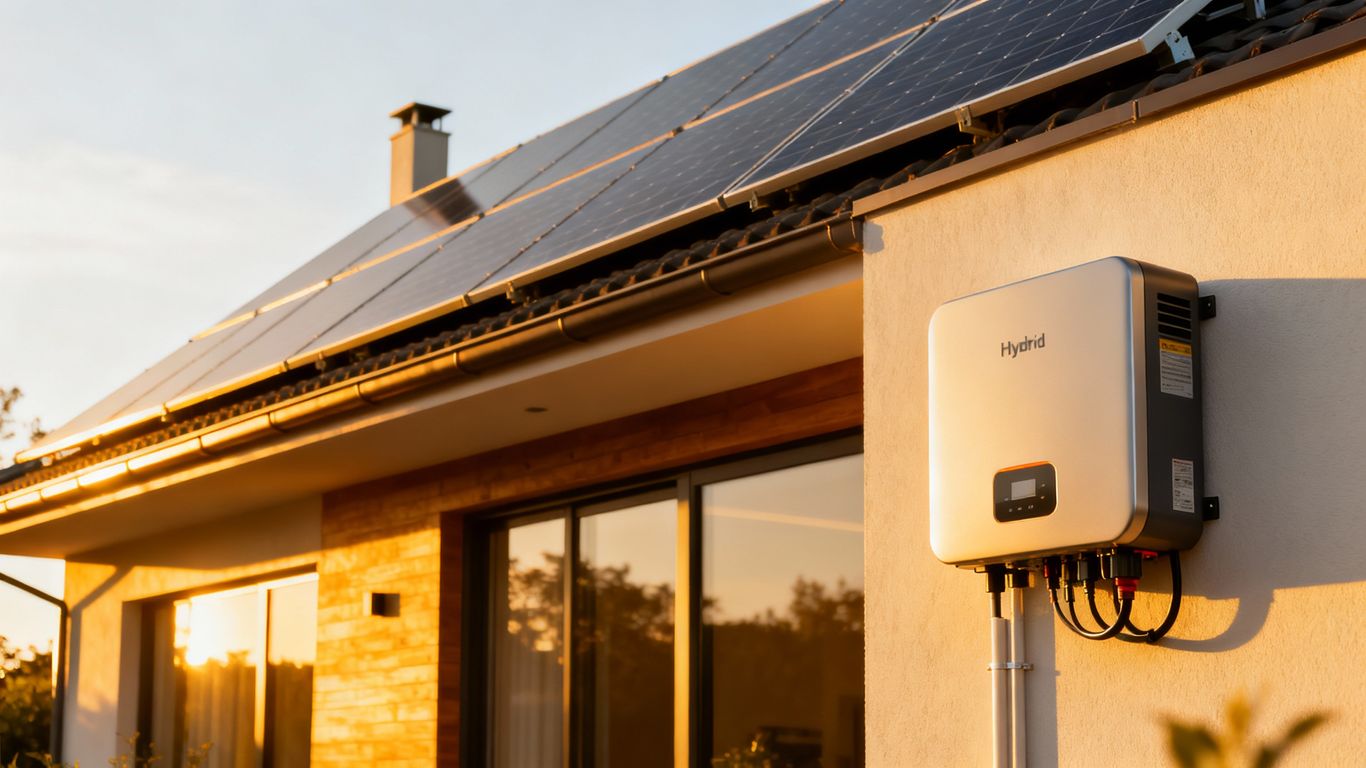
The hybrid inverter represents a significant evolution in the field of solar energy, as it does more than just convert the direct current from your panels into usable alternating current. Its unique feature is its ability to simultaneously manage the production from your solar panels and the storage of energy in batteries. It is the brain of your solar installation connected to a storage system.
Its primary role is to optimize the use of the electricity produced. When your panels generate more energy than you consume, the hybrid inverter intelligently decides where to send this surplus. It can first power your appliances as a priority, then charge your batteries. If the batteries are full and there is still a surplus, it can then inject it into the public grid, according to current regulations.
Conversely, when your consumption exceeds solar production (e.g., in the evening or at night), the hybrid inverter draws from the energy stored in your batteries to power your home. This allows you to maximize your self-consumption and reduce your reliance on the traditional electrical grid.
Here are some key points to consider for a hybrid inverter:
- Intelligent energy flow management: It prioritizes self-consumption, then storage, and finally grid injection.
- Battery compatibility: It is designed to work in conjunction with energy storage systems.
- Backup function (optional): Some models offer a ‘back-up’ function that can power essential circuits in your home during a power outage.
- Efficiency: Look for high European efficiency, above 96%, for efficient energy conversion.
Choosing a hybrid inverter is an important decision that directly impacts the performance and flexibility of your solar installation. It is essential to properly size this equipment based on your consumption needs and desired storage capacity.
Solar Battery
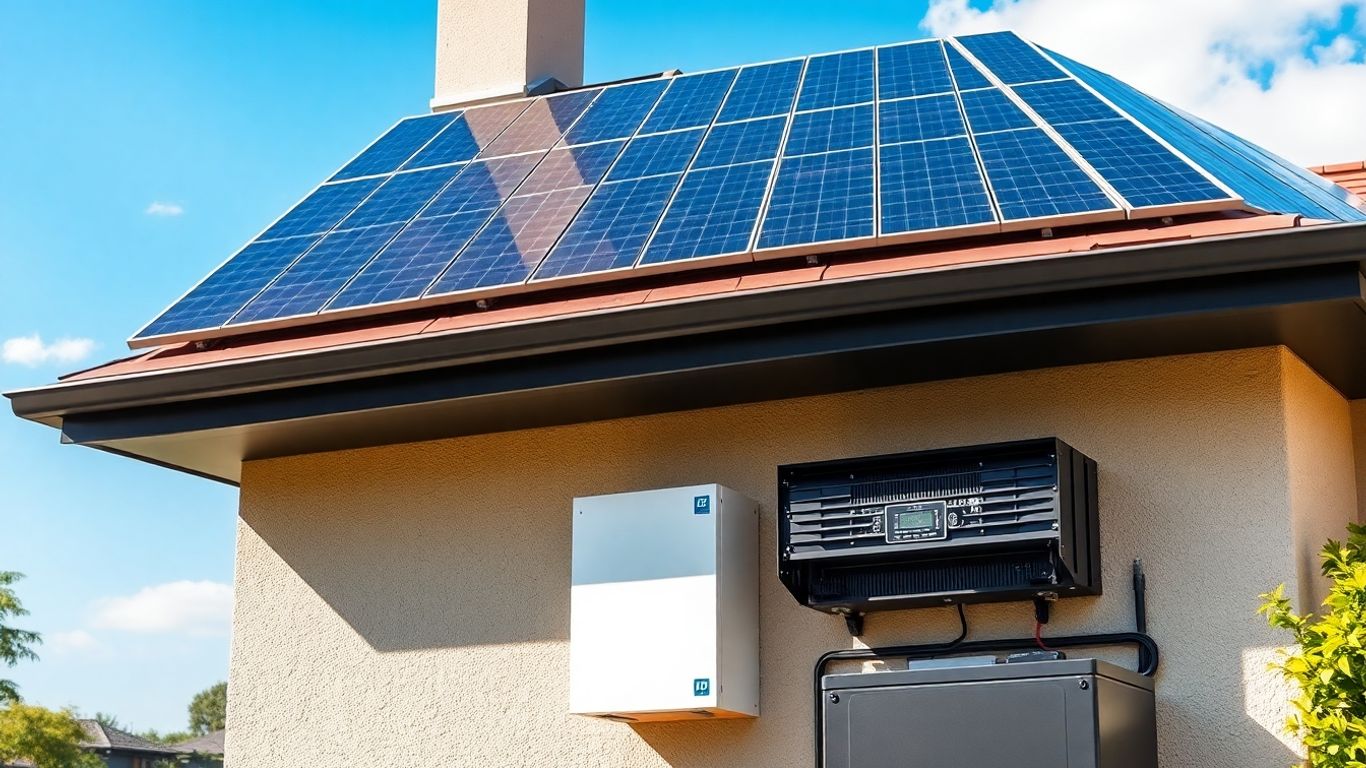
A solar battery is like the heart of your modern photovoltaic system. It allows you to store the energy produced by your panels during the day to use it when you need it, even when the sun is no longer shining. Think of it as your own electricity reserve.
The choice of a battery depends on several factors. You need to look at its storage capacity, expressed in kWh, which should match your consumption and the power of your panels. The depth of discharge (DoD) is also important; a 100% DoD means you can use almost the entire battery capacity without damaging it. The technology used, such as Lithium Iron Phosphate (LFP), is a guarantee of safety and longevity. Don’t forget to check the maximum output power, especially if you plan to power energy-intensive appliances.
Here are some points to consider for making the right choice:
- Storage capacity: Adapt it to your daily consumption and your panels’ production.
- Technology: Lithium Iron Phosphate (LFP) is currently the benchmark for its safety and durability.
- Scalability: Your energy needs may increase. A modular battery allows you to add modules later.
- Warranty: A warranty of 10 to 15 years is common and indicates product reliability.
The investment in a solar battery primarily aims to maximize your self-consumption and reduce your electricity bills. In a context where the price of grid electricity continues to rise, storing your own energy becomes a relevant economic strategy. It allows you to be less dependent on external energy suppliers. The cost of a complete installation with a battery can vary; for example, a DualSun pack with solar panels ranges from €4,309 to €7,135.
Installing a solar battery, although sometimes achievable with « plug and play, » is an operation that requires some expertise. It is always recommended to use a qualified professional to ensure the safety and optimization of your storage system.
Microinverters
Microinverters represent a different approach to converting direct current to alternating current. Unlike central inverters that manage a series of panels, each microinverter is installed directly behind a solar panel, or sometimes for two panels. This configuration allows for individual optimization of each panel’s production.
One of the major advantages is their ability to handle different constraints. If you have panels with different orientations, for example, some facing east and others south, each microinverter can operate independently, thus maximizing energy harvesting across your entire installation. This is a particularly interesting solution for complex roofs or those that receive partial shade at different times of the day.
In terms of reliability and longevity, microinverters often stand out with longer warranties, ranging from 10 to 20 years, which is longer than the typical lifespan of string inverters. Although their initial cost may be slightly higher, this investment is often justified by their performance and durability.
Here are some points to consider:
- Simplified installation: They attach directly to the mounting of each panel.
- Increased performance: Each panel is optimized independently, reducing losses due to performance differences between panels.
- Detailed monitoring: They allow for precise tracking of each panel’s production individually, facilitating troubleshooting in case of problems.
- Adaptability: Ideal for installations with multiple orientations or partial shading.
The installation of microinverters may require a dedicated communication gateway for production monitoring, which represents an additional cost to consider.
Recognized brands in this field include Enphase and APsystems, with newer players like Hoymiles also offering high-performance solutions.
String Inverter
The string inverter, often called a « string inverter, » is a proven technology for converting the direct current from your solar panels into alternating current usable by your home and the electrical grid. It manages a group, or « string, » of solar panels connected in series. This configuration is particularly effective when all your panels share the same characteristics: same orientation, same tilt. Thus, their production remains homogeneous.
Some advanced models include two MPPT (Maximum Power Point Tracking) devices. This allows them to independently manage two groups of panels, offering valuable flexibility if you have panels with different orientations, for example, one part facing south and another facing east.
One of the practical advantages of the string inverter is its ease of access for maintenance. It is generally installed in a ventilated room, protected from the weather, and its proximity to the panels minimizes power losses due to cable length. However, it is important to note that if a single panel in the string has a defect, it can affect the production of the entire group.
The string inverter is the central component that ensures the transformation of current and the optimization of the production of all the panels connected to it. Its installation in a ventilated location, such as a garage, is recommended to ensure its proper functioning and longevity.
In terms of lifespan, a string inverter is often warranted for 5 years, with an estimated lifespan of 10 years. Recognized brands in this field include SMA, Fronius, and Huawei, which offer reliable and high-performance solutions for your solar installation.
Comwatt
Comwatt positions itself as an interesting player in the field of solar energy management solutions. If you are looking to optimize your self-consumption, this brand offers approaches that deserve your attention. Their system aims to make solar energy more accessible and easier to manage on a daily basis.
One of Comwatt’s strengths lies in its ability to integrate different components of your installation, including solar panels and batteries, for smarter management. Their goal is to maximize the use of the energy you produce yourself.
Here are some points to consider regarding Comwatt:
- Intelligent Management: Their solutions are designed to analyze your consumption and adapt your solar energy production and storage in real-time.
- Flexibility: Comwatt strives to offer systems compatible with a wide range of panels and batteries, giving you more choices for your installation.
- Optimized Self-Consumption: The focus is on reducing your reliance on the electrical grid by promoting self-consumption.
It is important to note that the landscape of energy management solutions is rapidly evolving. Comwatt is part of this dynamic by offering tools to better control your solar energy production and consumption.
Zendure
The Zendure brand also offers interesting solutions for those looking to combine solar panels and batteries. Their model, the Hyper 2000, is a hybrid inverter designed for efficient energy management.
This system can manage up to four 500W solar panels each, offering a total management capacity of 2000W. What is particularly appreciated with the Hyper 2000 is its ease of installation. It is designed for simple connection, often described as « plug-and-play, » which can significantly reduce installation time and costs. Furthermore, you have the ability to monitor and control your energy production remotely, giving you valuable flexibility to track your solar installation’s performance. This is an option to seriously consider if you prioritize simplicity and remote control.
Here are some key points regarding the Zendure Hyper 2000:
- Management capacity: Up to 2000W, compatible with 4 x 500W panels.
- Installation: Ease of connection, often without complex work.
- Monitoring: Remote control and tracking of energy production.
- Technology: Integrates hybrid inverter functionalities for better solar energy management.
Integrating a system like Zendure’s can help you optimize your self-consumption by better managing the energy produced by your solar panels and stored in your batteries. It is important to check compatibility with the batteries you plan to use for your project.
For those interested in technical specifications and performance, it is useful to consult the details on microinverters to understand how different technologies work together. The Zendure Hyper 2000 is part of this residential energy optimization approach, offering a solution that is both efficient and accessible for panel-battery coupling.
SMA
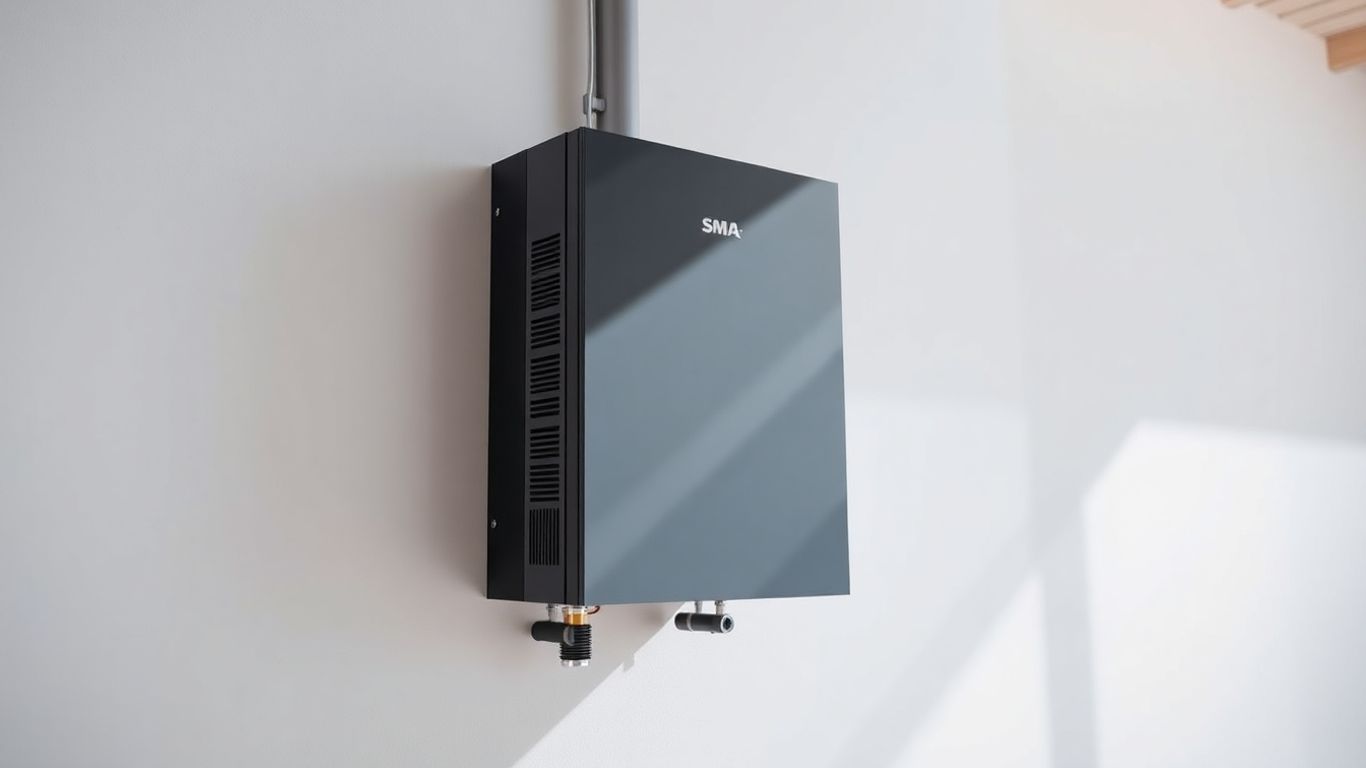
SMA is a well-known brand in the field of solar inverters, and for good reason. They offer robust and reliable solutions, often favored by professionals.
If you are looking for a string inverter, SMA is a benchmark. These devices are designed to manage a series of solar panels connected in series. This is a classic and effective approach, especially if all your panels have the same orientation and tilt. The advantage is that the inverter is generally more accessible for maintenance, which can simplify things.
However, it’s important to know that with this type of inverter, if a single panel in the string encounters a problem, it can affect the production of the entire group.
Here is an overview of the warranties you can expect with some of their products:
| Component | Warranty Period |
|---|---|
| String Inverter | 5 years |
| Estimated Lifespan | 10 years |
It is important to note that SMA also offers inverters with dual MPPT, which allows for the management of two groups of panels with different orientations. This is valuable flexibility for optimizing production in more complex situations. The company focuses on the quality of its products, which is often reflected in their long-term performance. You will find SMA solutions suitable for various types of solar installations, whether residential or larger.
Fronius
Fronius is a recognized brand in the field of solar inverters, and their hybrid solutions are no exception. If you are looking to combine solar panels and energy storage, you might find an interesting option with Fronius. They offer inverters capable of managing both your panels’ production and your batteries’ charging/discharging.
One of Fronius’ strengths lies in their approach to self-consumption. Their systems are designed to maximize the use of the energy you produce yourself. For example, the Fronius Reserva system has demonstrated its ability to achieve self-consumption rates exceeding 70%, which is quite impressive and reflects the efficiency of their technologies for optimizing your solar consumption.
Here are some aspects to consider with Fronius solutions:
- Storage flexibility: Fronius offers options to integrate batteries into your existing or new installation. It is important to check compatibility with the battery models you are considering.
- Intelligent management: Their inverters often feature energy management functions that allow prioritizing self-consumption, battery charging, or grid injection, according to your preferences and conditions.
- Recognized reliability: The brand benefits from extensive experience in the photovoltaic sector, which generally translates into robust and reliable products.
Integrating a Fronius hybrid inverter can be a key step for those who want to go further in managing their solar energy, by combining production and storage for increased independence.
It is always advisable to consult the precise technical specifications of Fronius models to ensure they perfectly match the size of your installation and your energy storage needs.
Conclusion: Which Hybrid Inverter to Choose in 2025?
There you have it, we’ve covered the options for your solar installation in 2025. Choosing the right hybrid inverter is a bit like choosing the right conductor for your photovoltaic system. It must be able to manage both the production from your panels and, if you wish, the storage in batteries. Don’t forget that the profitability of batteries is not always obvious today, and you need to carefully weigh the pros and cons before diving in. Pay close attention to technical specifications, lifespan, warranty, and most importantly, ensure the system matches your actual consumption needs. Don’t hesitate to request multiple quotes and compare offers carefully to find the most suitable solution for your situation. Your solar project deserves the best technology to bring you long-term satisfaction.
Frequently Asked Questions
What is the difference between a hybrid inverter and a string inverter?
A string inverter handles multiple solar panels at once and is usually placed in a location like a garage. A hybrid inverter, on the other hand, is more comprehensive because it can manage both solar panels and a storage battery. It’s like it does the job of both previous systems.
Is adding a battery essential for my solar installation?
No, it’s not mandatory. The most important thing is to consume as much of the electricity your panels produce as possible. Adding a battery will mainly depend on your budget and how you use your electricity. Tools like monitoring apps can also help you manage your energy better, with or without a battery.
What are the advantages of microinverters compared to string inverters?
Microinverters are attached behind each solar panel. This allows for better management of panels that don’t all have the same sun exposure or orientation. If one panel has an issue, the others continue to work. They are often guaranteed for longer, but can cost a bit more upfront.
Are solar batteries profitable today?
Currently, solar batteries are not always profitable. They are mainly useful for homes that do not have access to the electrical grid. Prices are expected to decrease and technology to improve in the coming years, which could make them more attractive.
How do I choose the right solar battery for my installation?
To choose your battery wisely, look at its storage capacity, which should match your panels’ power and your consumption. The technology used, such as Lithium Iron Phosphate (LFP), is important for safety and lifespan. Also, check the warranty offered by the manufacturer.
What is a ‘back-up’ function on a hybrid inverter?
The ‘back-up’ or ’emergency power’ function allows your solar installation to continue powering certain essential appliances in your home during a general power outage. This can be useful for keeping the lights, refrigerator, or roller shutters running.