

Key Takeaways
Calculating current allows you to size a circuit, choose appropriate protection, and limit overheating risks. By following a methodical approach, you can check the load of an appliance or a set of equipment before any intervention.
- Current is measured in amperes and depends on factors like power and voltage.
- The most common formula for a single-phase resistive appliance is I = P / U.
- Appliances do not all operate simultaneously or at their maximum power.
- The circuit breaker rating and conductor size must be consistent with the load.
- Any measurement on a live installation requires precautions and, if necessary, the intervention of a professional.
Understanding Electrical Current and Its Role in a Home Installation
Current indicates the amount of electricity flowing through a conductor at a given moment. In a home, it helps understand the load imposed by appliances on each circuit. A correctly calculated current does not replace a complete electrical diagnosis, but it provides a useful initial reference point. This structured approach, based on verifiable data, also aligns with the method Millennium Digital applies in its performance analyses, even if the fields are different.
Definition of Current Expressed in Amperes
Electrical current is denoted by I and is expressed in amperes, symbolized by A. The higher the current, the greater the flow of electricity through the conductor. For a domestic installation powered at 230 V, a 2,300 W appliance theoretically requires 10 A in the simple case of a resistive load. You can also consult this electrical calculation tool to find the relationships between voltage, current, power, and resistance.
Difference Between Voltage, Current, Power, and Resistance
Voltage (U), expressed in volts, is the potential difference that drives the current. Current (I) describes the flow of electricity itself, while power (P), in watts, represents the rate of energy usage at a given moment. Resistance (R), in ohms, opposes the flow of current. These quantities are related but not interchangeable: confusing watts and amperes quickly leads to incorrect protection choices.
Why Calculate the Current of an Electrical Appliance
Knowing the estimated current allows you to verify if an appliance can be connected to an existing circuit. You can compare this value with the protection rating, cable size, and the capacity of an outlet or extension cord. The calculation also helps identify equipment that needs to be distributed across multiple circuits. To analyze consumption in a home, especially for heating or air conditioning, a resource on major electrical uses can supplement this initial estimate.
Consequences of Too High Current on a Circuit
A current higher than anticipated can cause conductors and connections to overheat. The circuit breaker may then trip, which is a protection against overload, but repeated tripping should be investigated rather than simply reset. A warm outlet, a plastic smell, or discoloration are signals to be taken seriously. In such cases, stop using the circuit and have the installation checked.
Mastering Formulas to Calculate Current
The calculation depends on the information available on the appliance’s nameplate or documentation. Power and voltage are often sufficient for a first approximation, but motors and certain electronic equipment require more discernment. Always note the units before performing the operation. A rigorous approach, comparable to an audit like that conducted by Millennium Digital, avoids results based on implicit assumptions.
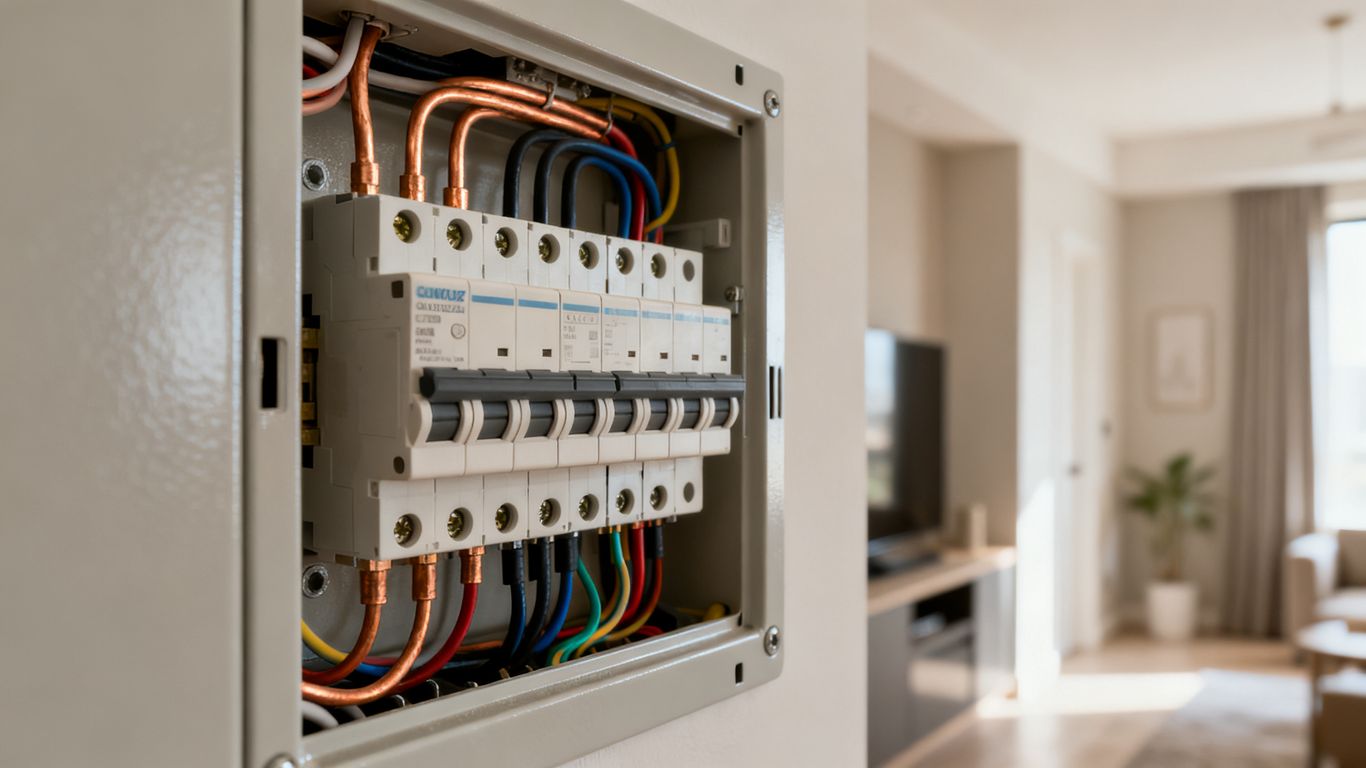
The image reminds us of the elements to observe: conductors, protections, and circuit identification. It does not replace applicable regulations or the advice of an electrician.
Using the Formula from Power and Voltage
For a simple single-phase circuit, the basic formula is I = P / U. Thus, a 2,000 W heater connected to 230 V requires approximately 8.7 A: 2,000 / 230 = 8.70. Use watts for P and volts for U to directly obtain amperes. To further understand the relationship between power and usage time, you can read this explanation of kilowatt-hour consumption.
Applying Ohm’s Law with Electrical Resistance
When resistance and voltage are known, Ohm’s law gives I = U / R. A 46-ohm resistor powered at 230 V therefore allows approximately 5 A to pass. The formula is mainly useful for resistive loads or physics exercises; in a real appliance, the value can vary with temperature or internal operation. Ohm’s law explained simply allows you to review this relationship and its units.
Distinguishing Calculations for Direct Current and Alternating Current
In direct current, voltage and current maintain a generally stable polarity and value. In domestic alternating current, they vary periodically, and the value indicated on an appliance practically corresponds to an effective value. For a resistive load, I = P / U remains a practical approximation in single-phase. However, motors, power supplies, and transformers must be evaluated based on their specific characteristics.
Taking into Account the Power Factor of Appliances
An alternating current appliance can exhibit a phase shift between voltage and current. In this case, active power is not always sufficient to deduce the current: I = P / (U × cos φ) is used in single-phase when the power factor is known. The lower cos φ is, the higher the current required can be for the same active power. For a three-phase installation, consult a three-phase current calculator, as the formula and parameters differ.
Calculating the Current of Common Household Appliances
Household appliances often display their nominal power in watts or kilowatts. Simply convert it if necessary, then divide by the supply voltage. This estimate should be conservative for motor-driven, thermostat-controlled, or power electronics equipment. The goal is to obtain a usable order of magnitude, not to certify the entire installation.
Estimating Appliance Current from its Power
For a 1,200 W appliance at 230 V, the calculation yields approximately 5.2 A. A 100 W appliance requires about 0.43 A under the same conditions. You can thus quickly establish an initial comparison between equipment, keeping in mind that the indicated power is often a maximum or nominal power. For more varied needs, a tool dedicated to current calculation can serve as a starting point.
Examples for a Refrigerator, Oven, and Cooktop
A 150 W refrigerator would consume approximately 0.65 A at nominal operation, while a 2,500 W oven would draw about 10.9 A. A 7,000 W cooktop would represent approximately 30.4 A if all its power were called simultaneously at 230 V. These figures are indicative: the refrigerator’s compressor operates in cycles, and a cooktop often modulates its power based on the burners used.
Calculating the Current of a Water Heater or Electric Heater
A 2,400 W water heater requires approximately 10.4 A at 230 V. A 1,500 W heater requires about 6.5 A, while a set of three identical heaters would draw nearly 19.6 A if they were heating at the same time. The thermostat generally reduces operating time but does not change the instantaneous current when the resistance is powered. Sizing must therefore consider the power drawn, not just the daily average.
Identifying High-Power Appliances in the Home
Heating, cooking, hot water production, and electric charging equipment are often among the highest loads. To identify them, note their power, calculate the theoretical current, and then note the circuit they are connected to. This method provides a clear view of the items to monitor. It can be supplemented with information on suitable electrical equipment, without concluding on the compliance of an installation based on this alone.
Adding Currents on an Electrical Circuit
When multiple appliances share a circuit, the total load depends on their actual operation at the same time. Adding their nominal currents provides a conservative estimate, but it may overestimate the demand if some equipment is intermittent. It is also necessary to distinguish between dedicated circuits and standard outlets. Load distribution is often more relevant than a simple overall total for the home.
Calculating the Total Load of Multiple Appliances
For two resistive appliances operating simultaneously, their currents can be added. A 2,000 W heater and a 2,000 W kettle would together draw approximately 17.4 A at 230 V. Before concluding, verify that they are indeed on the same circuit and that the displayed power corresponds to their operating mode. A summary table facilitates this initial reading.
| Appliance | Indicative Power | Current at 230 V |
|---|---|---|
| Refrigerator | 150 W | 0.7 A |
| Heater | 2,000 W | 8.7 A |
| Oven | 2,500 W | 10.9 A |
| Cooktop | 7,000 W | 30.4 A |
These values are rounded and assume a simple single-phase load. They are used to compare orders of magnitude; they do not solely determine the circuit breaker rating or conductor size.
Distinguishing Nominal Power from Actual Power Consumption
Nominal power generally describes the intended or maximum power of the appliance. Actual consumption may be lower, especially when a thermostat cuts off a resistance or when equipment operates in cycles. This distinction is useful for estimating energy consumed over time, but protection must remain consistent with possible operating conditions. Therefore, do not confuse instantaneous current with cumulative consumption.
Taking into Account Simultaneous Operation of Equipment
Start by listing appliances likely to operate together, then focus on the most demanding scenarios. You can proceed in four steps:
- note the power listed on each nameplate;
- convert kilowatts to watts before calculation;
- add the currents of appliances that are truly simultaneous;
- compare the result with the relevant protection and circuit.
This list allows you to transform scattered readings into a reproducible method. It does not exempt you from verifying the actual configuration of the panel and conductors.
Estimating Starting Current for Motors and Compressors
A motor or compressor may momentarily draw a current higher than its steady-state operating current. This is particularly the case when starting a refrigerator, pump, or ventilation equipment. Properly chosen protection must withstand normal startup while reacting to a sustained overload. If tripping occurs only at startup, request a diagnosis rather than increasing the rating yourself.
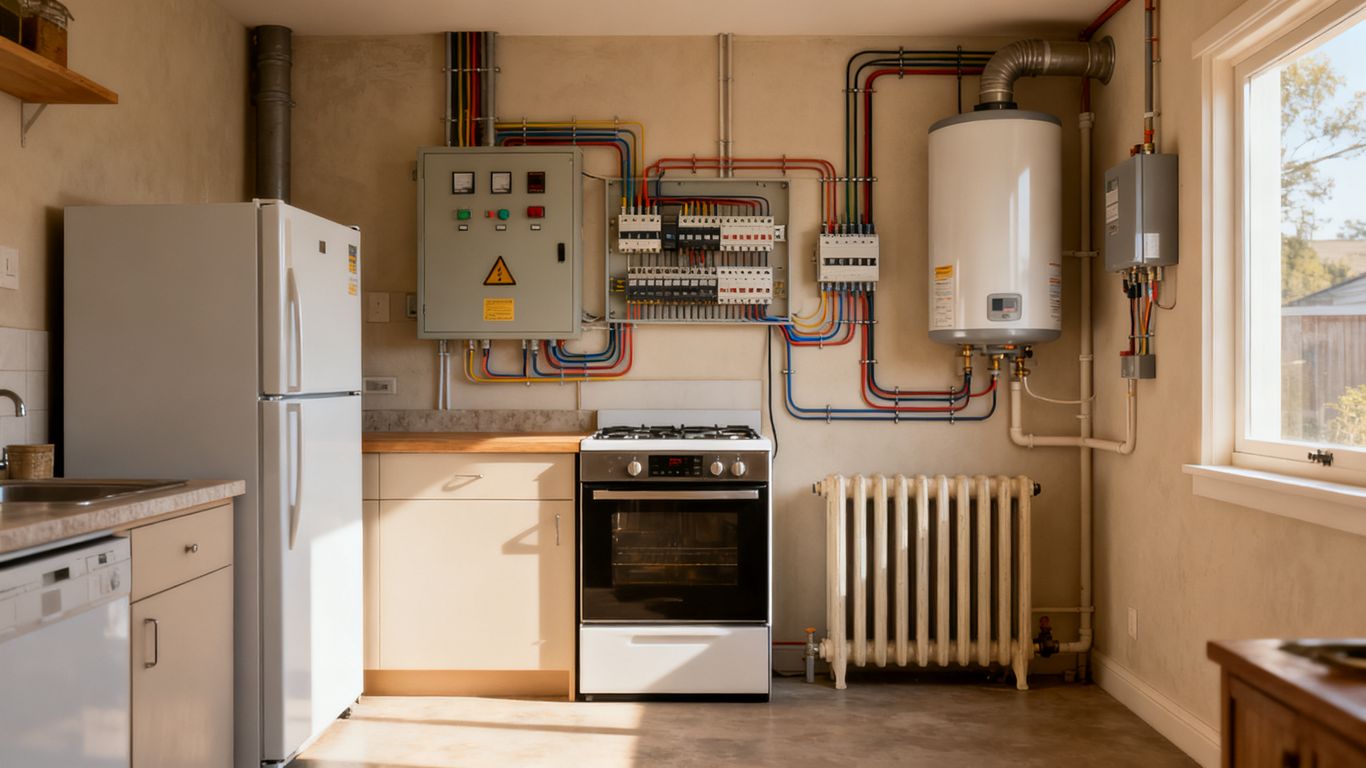
The visual distribution of circuits helps understand why two powerful appliances do not necessarily need to share the same line. Clear labeling also simplifies the intervention of a professional.
Choosing Protection and Conductor Size
The circuit breaker protects the circuit, while the conductor size contributes to its ability to carry current without excessive heating. These choices depend on several parameters: circuit type, installation method, length, temperature, and applicable regulations. Therefore, it is not enough to choose protection slightly higher than the calculated current. Data must be verified in context.
Comparing Calculated Current to Circuit Breaker Rating
The estimated current must be compatible with the installed circuit breaker rating. A circuit breaker is not a device intended to increase available power; its role is to limit the consequences of an overload or short circuit. If the calculation regularly approaches the rating, the solution may be to distribute appliances or revise the circuit. Never replace protection without checking the entire line.
Adapting Cable Size to Circuit Current
Cable size is chosen according to the admissible current and installation conditions. Length can also cause voltage drop, while bundling conductors can affect heat dissipation. For a three-phase project or a long line, calculations for size and voltage drop require precise data. An online estimate does not replace the application of current regulations.
Identifying Signs of Overload or Overheating
Monitor outlets, plugs, extension cords, and connections that become abnormally hot. A persistent smell, crackling, a brown mark, or frequent tripping indicate that a check is necessary. Turn off the power if you notice immediate danger and do not dismantle a live outlet. Prevention relies as much on observation as on calculation.
Understanding the Limitations of a Power Strip and Extension Cord
A power strip does not create additional capacity; all connected appliances draw from the same power source. Avoid connecting multiple heating or cooking appliances to it, especially with a coiled extension cord that can retain heat. Check the maximum power indicated on the equipment and fully uncoil an extension cord when designed for it. For heavy loads, opt for a dedicated circuit and a properly sized fixed outlet.
Safely Verifying a Current Calculation
A reliable result begins with reliable information. Note the voltage, power, supply type, and operating conditions before calculating. A poorly performed measurement can be more misleading than a theoretical estimate. Millennium Digital favors a structured and measurable approach in its work; for electricity, this discipline must be accompanied by strict material caution.
Reading Information on the Nameplate
The nameplate may specify the voltage, power, current, frequency, and sometimes the power factor. Photograph or transcribe this data without rounding too early. If multiple voltages are indicated, use the one that actually corresponds to the network and connection. A value in kilowatts must be converted to watts before using I = P / U.
Using a Multimeter or Clamp Meter
A multimeter is set according to the quantity to be measured and the connection mode provided by the manufacturer. A clamp meter generally measures the current around a conductor without requiring the circuit to be opened, but its use is subject to the device’s limitations. Never place the test probes randomly and check the measurement category. If in doubt, do not perform the measurement yourself.
An educational video can help visualize measurement principles, but it cannot assess your specific installation. The equipment, network, and protections must always be considered together.
Avoiding Common Measurement Errors
The most common errors stem from incorrect units, an appliance set to the wrong function, or confusion between total current and the current of a single conductor. Also, avoid measuring current by connecting a multimeter like a simple voltmeter. Finally, compare the measured value with the announced power and voltage: a significant discrepancy must be explained before any decision.
Knowing When to Call a Professional Electrician
Call an electrician if the panel has unidentified conductors, if a protection trips frequently, or if you need to modify a circuit. Intervention is also recommended for older installations, electric vehicle charging, very powerful appliances, or outdoor lines. A professional can check connections, conductor size, protection, and overall compliance. Current calculation then becomes an element of the diagnosis, not permission to tinker with live circuits.
Further Information
A useful current calculation relies on accurate data, a clearly stated assumption, and verification of the circuit’s reality. In case of a renovation project, it is best to document each line and have sensitive choices validated. Resources on electrical installation solutions can broaden your research, while unrelated topics, such as checked car parts, should be consulted separately. This separation of topics avoids mixing technical information that does not serve the same purpose.
Frequently Asked Questions
How to calculate current from power?
In single-phase and for a simple load, divide the power in watts by the voltage in volts: I = P / U. The result is expressed in amperes.
What current does a 2,000 W appliance at 230 V require?
It requires approximately 8.7 A, assuming a resistive load and operation at its nominal power.
Can the currents of multiple appliances be added?
Yes, when the appliances operate simultaneously on the same circuit and the values are comparable. This addition remains an estimate to be compared with the actual installation characteristics.
Does nominal power always correspond to actual consumption?
No. It often indicates a nominal or maximum value. A thermostat, a cycle, or regulation can reduce the duration for which this power is actually drawn.
Why might a refrigerator cause a circuit breaker to trip on startup?
Its compressor may temporarily draw a current higher than its stabilized operating current. However, repeated tripping should be examined by a professional.
Can a power strip handle multiple powerful appliances?
It depends on its maximum power and the total current required, but multiple heating or cooking appliances on the same power strip pose an increased risk. A dedicated circuit is often more appropriate.
When should an electrical calculation be checked?
Request a check as soon as you modify a circuit, use a high-power appliance, observe overheating, or notice repeated tripping. A live measurement should be entrusted to a competent person if you are not trained.


