Key Project Points
Installing solar panels requires careful attention to urban planning and co-ownership rules to avoid disputes.
- Never confuse exemption from declaration with the absence of urban planning rules.
- The general assembly is the central pivot for any installation in a co-ownership.
- Protected areas systematically require the opinion of the ABF (Architecte des Bâtiments de France) to validate your projects.
- A non-compliant installation exposes the owner to forced restoration.
- Anticipating procedures remains the best protection against criminal sanctions.
Understanding the Reality of Solar Panels Without Authorization
To consider a photovoltaic project, it is essential to distinguish what falls under simple installation and what requires an administrative framework. French law is evolving, but the principles of urban landscape protection remain a cornerstone of our law.
The Distinction Between Prior Declaration and Exemption from Authorization
Exemption from authorization does not mean a total absence of regulation. While some very small installations, such as plug-and-play modules, are exempt from prior declaration, most devices that modify the exterior appearance require registration at the town hall to ensure rigorous regulatory compliance with neighbors.
Determining Power and Surface Thresholds
Installed power often dictates the complexity of the procedures. Depending on local specifics, a ground project less than 1.80 meters high may be exempt from formalities. It is crucial to consult your municipality’s PLU (Local Urban Plan), a document that Millennium Digital experts often analyze during their strategic audits to secure their clients’ projects.
Overview of Works Subject to Simple Declaration of Works
In most cases of roof installation, a prior declaration is the norm. This informs the administration of the change in your building’s appearance while facilitating the mapping of solar energy. Here are the typical steps for a successful declaration:
- Submission of the Cerfa form to the town hall
- Waiting for the legal processing period
- Display of the receipt at the construction site
- Technical validation before commissioning
The Legal Framework in Co-ownership
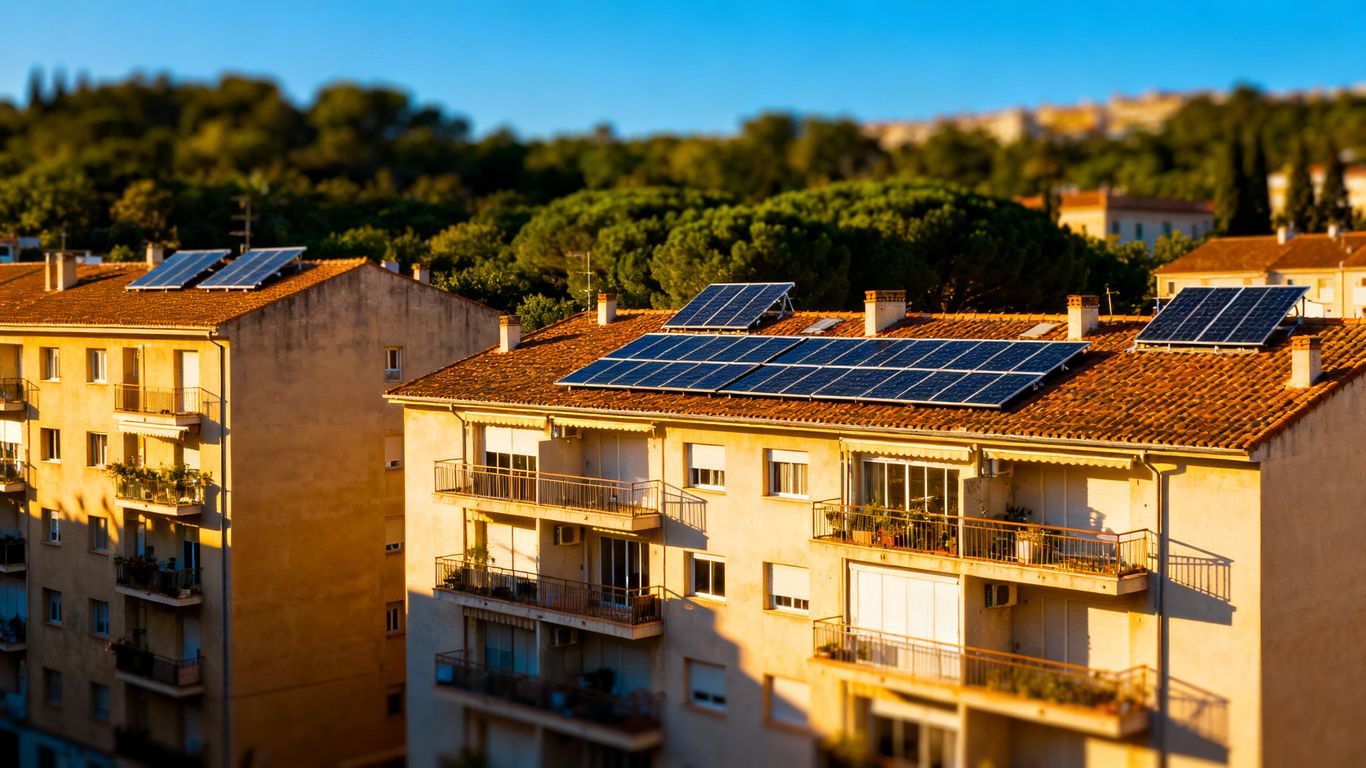
Co-ownership adds a layer of collective decision-making that often goes beyond simple individual administrative procedures. Before any installation, consultation with your neighbors and the building manager is essential to validate the feasibility of solar panels without specific authorization or with a simplified declaration.
The Crucial Role of the General Assembly
The general assembly is the sovereign body that approves or rejects work on common areas. As Millennium Digital consultants often emphasize, meticulous preparation of files, including visual simulations, increases the chances of obtaining a favorable majority for your project.
Management of Common Areas and Respect for Building Aesthetics
Modification of the exterior appearance of a building is subject to the co-ownership regulations. Even if the photovoltaic project aims for energy independence, it must integrate harmoniously with the existing architecture 9c80, so as not to detract from the property value of the subdivision or building.
Procedures for Obtaining Agreement from the Co-ownership Manager
It is advisable to contact the building manager from the initial phases to obtain the list of required documents. This prior exchange helps avoid rejections during official votes and ensures a process 1af0 based on transparency and good relations among co-owners.
Specific Constraints for Classified and Heritage Sites

Heritage areas impose strict limits to preserve the aesthetic integrity of the sites. In these sectors, the project must demonstrate perfect integration, sometimes requiring professional support to navigate the strict requirements of b9ad.
The Protection Perimeter of Historic Monuments
Proximity to a historic monument involves reinforced urban planning constraints. In this context, Millennium Digital always recommends a visibility audit to ensure that the installation does not detract from the visual perspective of the protected site.
Mandatory Consultation of the Architecte des Bâtiments de France (ABF)
The ABF’s opinion is decisive, even binding. To do this, a complete technical file detailing the materials and color of the panels must be presented to obtain an acceptable compromise.
Reconciling Energy Performance and Heritage Conservation
The tension between energy transition and the conservation of old buildings requires a balanced approach. Here are the parameters often evaluated by architects to approve an installation:
| Evaluation Criterion | Impact Level | Recommended Solution |
|---|---|---|
| Light Reflection | Moderate | Matte finish |
| Visual Integration | High | Solar tiles |
| Structural Impact | Low | Lightweight mounting |
The search for discreet solutions is key to obtaining the ABF’s approval without sacrificing the energy performance of your system f7be.
Alternatives and Devices to Facilitate Installation
To overcome urban planning constraints, the market now offers integration solutions that greatly simplify procedures. Technological innovation allows for the reconciliation of aesthetics and production, thus reducing the need for complex applications.
Use of Solar Tiles and Discreet Integration Solutions
Solar tiles offer an elegant alternative to traditional panels for sensitive sites 3189. They blend into the roofing, minimizing the risk of administrative refusal during the authorization request.
Implementation of Photovoltaic Panels in Non-Visible Areas
Installation in an area not visible from the public highway is often the preferred strategy. By relocating the panels to a secondary roof slope or a discreet area in the garden, you minimize the impact on the overall appearance.
Adoption of Facilitating Clauses in Co-ownership Regulations
Modifying your co-ownership regulations to include standard clauses on photovoltaics helps streamline future decisions. A proactive approach avoids lengthy debates for each new individual installation.
Responsibilities and Risks in Case of Non-Compliant Installation
Installing solar panels without prior authorization can lead to severe legal consequences. Although the temptation for a quick installation is great, the risk incurred by the owner far exceeds the cost of administrative procedures.
Legal Consequences and Obligation to Restore
In case of a dispute, a bailiff’s report can lead to an order for restoration at the sole expense of the owner. This procedure, often long and costly, invalidates the initial profitability of the project 7b00.
Criminal Sanctions and Fines Related to the Urban Planning Code
Ignorance of urban planning rules can result in substantial fines imposed by the municipality. The law thus protects the landscape coherence of French territory against any arbitrary installation.
Management of Disputes Between Co-owners and the Co-ownership Syndicate
Tensions between neighbors can block a project for years. Maintaining constant dialogue and using professional services can prevent legal challenges 4382 that could permanently divide the co-ownership.
Conclusion
The decision to install solar panels is a commendable step that nevertheless requires complete administrative rigor, from the initial verification of local rules to the management of collective agreements. By adopting a methodical approach and seeking informed advice, you ensure the sustainability and compliance of your energy transition for decades to come.
Frequently Asked Questions
Can solar panels be installed without any declaration?
Only very small installations, such as certain low-power plug-in solar kits, may be exempt from declaration if they do not alter the exterior appearance of the building.
What is the difference between a prior declaration and a building permit?
A prior declaration is a simplified file for routine work, while a building permit is required for larger projects or on very specific sites.
Is the ABF’s opinion mandatory everywhere?
No, the opinion of the Architecte des Bâtiments de France is only required in protected areas, such as the vicinity of a historic monument or in heritage conservation zones.
What to do in case of refusal of authorization by the town hall?
It is possible to contest a refusal or modify the project according to the administration’s recommendations to resubmit it while respecting urban planning requirements.
Is the agreement of the building manager sufficient to install panels on my roof?
No, the building manager is the administrator; it is the general assembly of co-owners that must vote to approve modifications to common areas such as the roof.
Are there any aids for solar installations, even in protected areas?
Yes, financial aid often remains accessible, but it is conditional on strict adherence to the ABF’s requirements to ensure the project’s integration.
If my neighbor installed panels without authorization, what can I do?
You can contact your municipality’s mayor to report non-compliant work, which will trigger a verification by the local urban planning services.