You’ve just bought an electric car and are wondering how to adapt your electrical installation to plug in your new vehicle? That’s an excellent question, as charging a car requires a specific approach. It’s not just a matter of plugging in a socket like you would for a toaster. You need to ensure everything is safe and compliant. In this guide, we’ll explore the electrical socket installation diagram for electric cars, step by step, so you can understand what’s necessary.
Key Takeaways
- Understanding the electrical socket installation diagram for electric cars is the first step towards a safe and compliant installation.
- Connecting a charging station requires a dedicated circuit from your electrical panel and regulatory protections.
- The electrical diagram must be adapted to the type of charging (single-phase or three-phase) and can incorporate load management systems.
- Correctly sizing the installation, including power and cable selection, is essential to prevent overloads.
- Components like the residual current device (RCD) and grounding play a major role in installation safety.
Understanding the Electric Car Charging Socket Installation Diagram
Before you start installing a charging station for your electric vehicle, it’s essential to fully grasp what an electrical installation diagram is. This document, far from being a mere formality, is your electrician’s roadmap. It precisely details how the new socket will be connected to your existing installation, taking all safety standards into account.
The electrical diagram is like the architect’s plan for your charging installation. It graphically represents all the components: the electrical panel, protections (circuit breakers, RCDs), wiring, and of course, the charging station itself. Its primary role is to ensure the installation will be not only functional but, above all, safe. It allows for visualization of the dedicated circuit that will be created for the charging station, to prevent any overload on the domestic grid. This document guarantees a compliant and long-lasting installation. It is particularly important for installations over 3.7 kW, which require the intervention of an IRVE (Infrastructure de Recharge pour Véhicule Électrique – Electric Vehicle Charging Infrastructure) certified professional.
Installing a charging station is not a trivial matter. The safety of property and people is paramount. That’s why there are strict standards, such as the NF C 15-100 standard, which govern these installations. The electrical diagram reflects this compliance. It ensures that all elements are correctly sized, that the protections are adequate, and that the connection is made according to best practices. Failure to comply with these standards can lead to risks of fire, short circuits, and may void your homeowner’s insurance in case of a claim. Hiring a qualified electrician who understands these diagrams is therefore a key step for a safe installation. You can consult the requirements for a compliant electrical installation.
For the electrician, the diagram is an indispensable work tool. It allows them to plan the work, choose the right materials, and make the connection without errors. For example, it details the cable cross-section to be used, the type of residual current device required (often Type A or F, with a sensitivity of 30 mA), and how to connect it to the panel. Without this plan, the installer would have to improvise, which is unacceptable for an electrical installation, especially when it comes to charging a vehicle. The diagram ensures that the installation will exactly match your needs and regulatory requirements, whether it’s a simple reinforced socket or a more powerful charging station. It is also useful for understanding the available electrical power in your home.
Key Steps for Connecting an Electric Charging Station
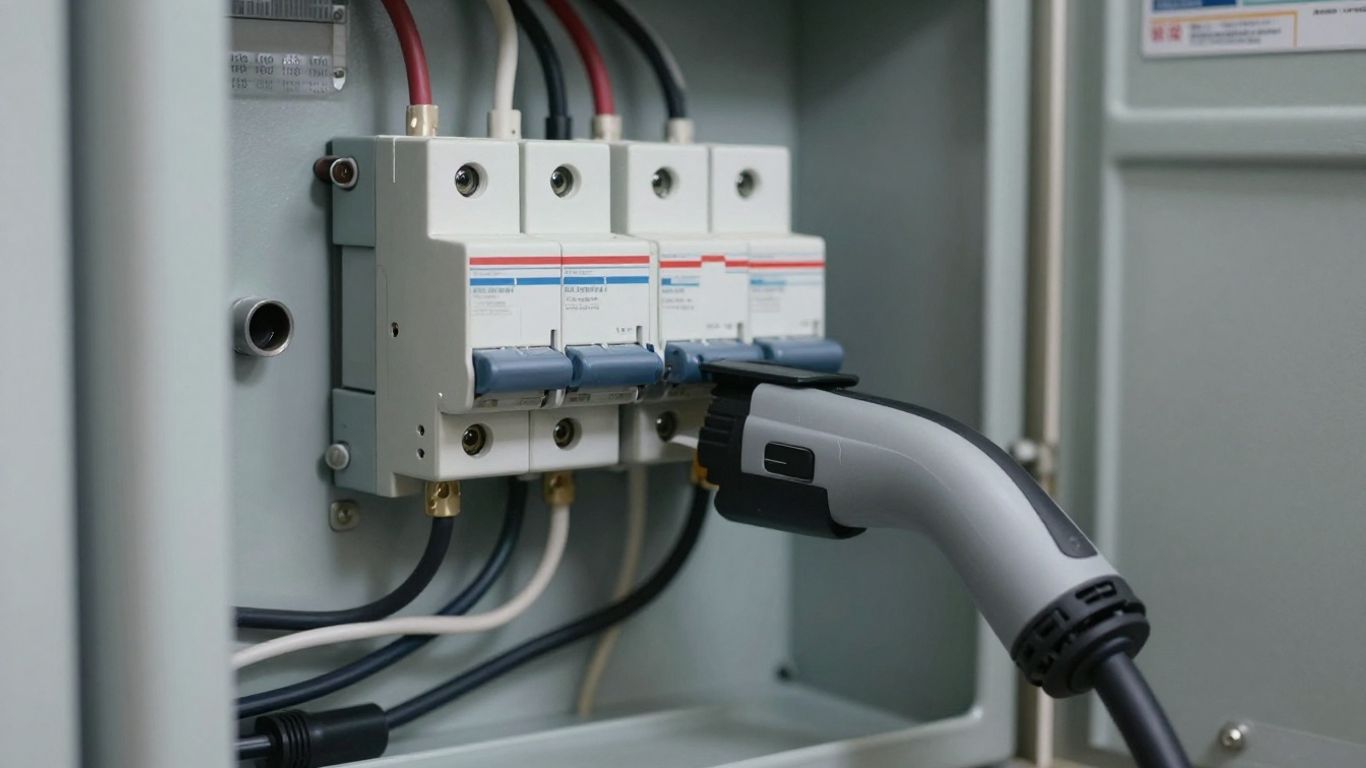
Installing a charging station for your electric vehicle is a bit like adding a new energy-hungry appliance to your home. You need to make sure everything is properly prepared to avoid problems. Here are the main steps to follow for a professional electrical connection.
Assessing Available Electrical Power
First and foremost, you need to check what your current installation can handle. Your electricity subscription is like your home’s speed limit. If you have a basic subscription, it might not be enough for the power a charging station requires, especially if you’re using other appliances at the same time. A professional will check the maximum power your meter can supply. For example, a 7.4 kW single-phase charging station requires a subscription of at least 32 amps. If this is not the case, you may need to consider modifying your electricity contract.
Creating a Dedicated Circuit from the Panel
Once you know the power is sufficient, you need to create an electrical line specifically for the charging station. You can’t just plug into any existing circuit, as the charging station needs a stable and safe power supply. This new circuit runs directly from your electrical panel to the charging station’s location. It’s like installing a new highway just for your electric car, so it has its own lane without interfering with others.
Installing Regulatory Protections
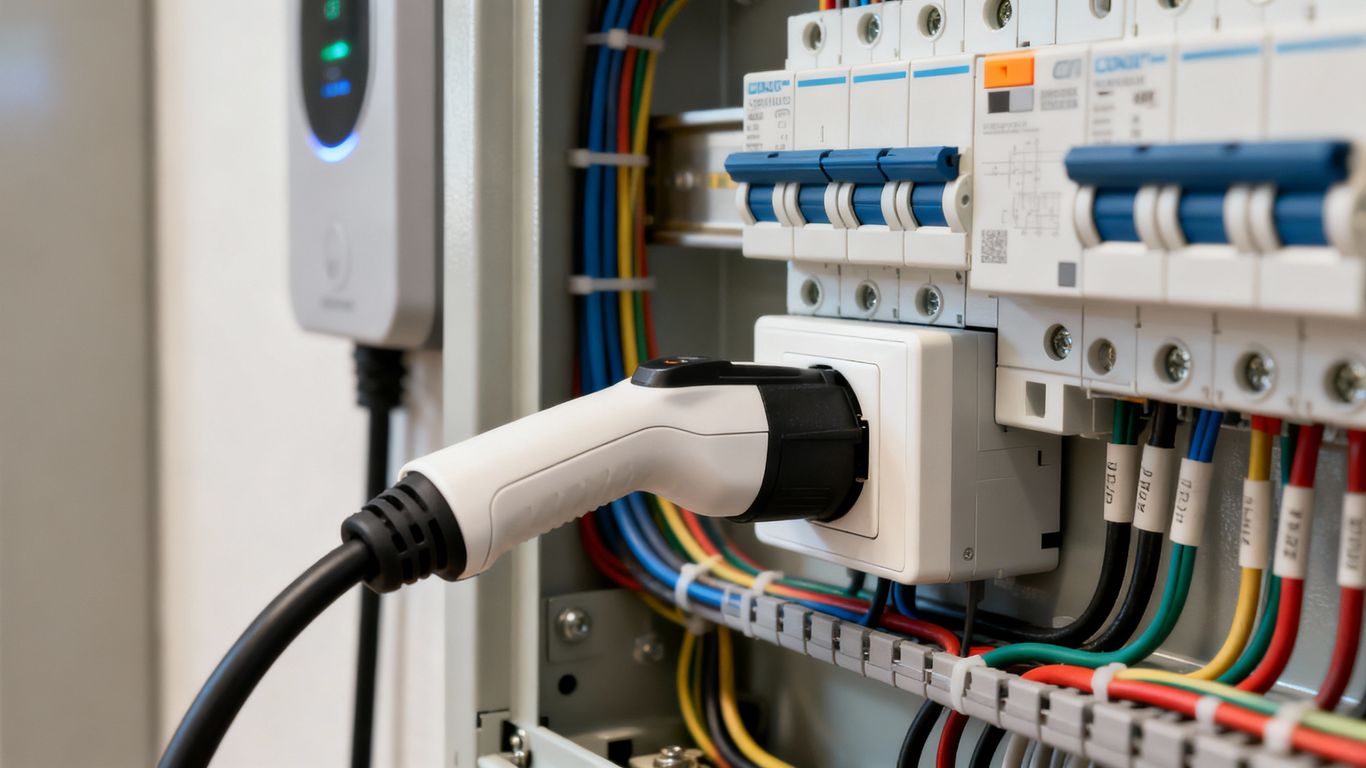
Safety is the most important thing. The NF C 15-100 standard mandates specific protections for electric vehicle charging circuits. A dedicated circuit breaker, often Type D, must be installed to protect against overcurrents. In addition, a residual current device (RCD), usually Type A or F, with a sensitivity of 30 mA, is required. This device detects leakage currents, including the DC currents that charging stations can generate, and quickly cuts off power in case of a problem. It’s like installing airbags and seatbelts for your electrical installation.
The choice of protections is very precise. It’s not about installing just any circuit breaker or RCD. The standards are there to ensure the installation is safe, even in case of a fault. A professional will know exactly which models to choose based on the charging station’s power and your installation.
Here is a summary table of common protections for a 7.4 kW single-phase charging station:
| Component | Specification | Role |
|---|---|---|
| Circuit Breaker | 32A Curve D | Overcurrent protection |
| Residual Current Device | 30 mA Type F | Leakage current detection (AC/DC) |
| Cable | 6 mm² minimum | Powering the charging station |
Configuring the Electrical Diagram for Different Charging Types
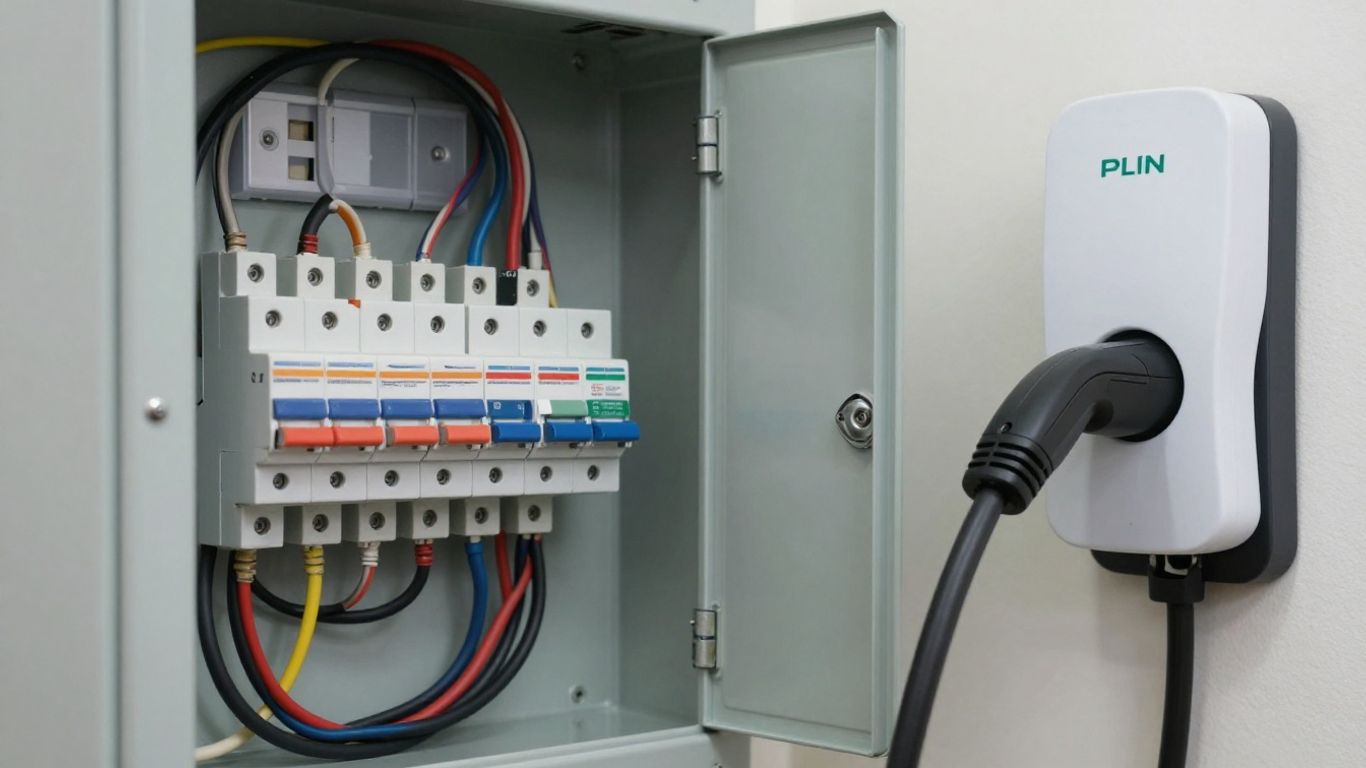
The electrical diagram for your electric vehicle charging installation is not a one-size-fits-all solution. It adapts based on the power of your charging station and your electrical supply. Understanding these variations allows you to choose the most appropriate configuration for your home.
Diagram for Standard Single-Phase Charging
Most domestic installations use a single-phase power supply. For standard charging, typically 7.4 kW (which corresponds to 32 amps), the electrical diagram must be specifically designed for this power. This involves using a dedicated circuit breaker, usually Type D and rated at 32A, to protect the circuit against overcurrents. In addition, a 30 mA residual current device, often Type F, capable of detecting the DC leakage currents emitted by the charging station, is required. The wiring must also be sized accordingly, with a minimum cross-section of 6 mm² to ensure safety and efficiency.
- Circuit Breaker: 32A, Type D
- Residual Current Device: 30 mA, Type F
- Cable: Minimum cross-section of 6 mm² (3 conductors: phase, neutral, ground)
It is imperative that this circuit is dedicated exclusively to the charging station. No other sockets or appliances should be connected to it to ensure safety and compliance with standards.
Adaptations for Three-Phase Charging
If your home is equipped with a three-phase power supply, you can consider higher charging powers, such as 11 kW or 22 kW. In this case, the electrical diagram must be adapted. A four-pole circuit breaker (which protects the three phases and neutral) rated at 32A is necessary. The wiring will need to be more substantial, with a cross-section of 5G6 mm² (five conductors: three phases, neutral, ground). The residual current protection device will also need to be adapted, often a Type B model, to handle potentially higher DC leakage currents in a three-phase configuration.
| Charging Type | Power (kW) | Current (A) | Circuit Breaker | Cable |
|---|---|---|---|---|
| Three-phase | 11 | 16 | 4P 16A | 5G2.5 mm² |
| Three-phase | 22 | 32 | 4P 32A | 5G6 mm² |
Integration of Load Management Systems
For installations with multiple charging points, or to optimize electricity consumption, load management systems can be integrated into the diagram. These systems, sometimes called ‘load balancing,’ intelligently distribute available power among the different charging stations. This prevents exceeding the maximum power of your subscription, thus avoiding unexpected power outages. The diagram will then include communication elements between the charging stations and a centralized management unit, often controlled via protocols like OCPP. This allows for fine-grained charging management, for example, by prioritizing charging during off-peak hours or adjusting it based on the production of your solar panels if you have them.
Sizing the Electrical Installation for Charging
Impact of Charging Power on the Circuit
When you install a socket to charge your electric car, the first thing to consider is the power. It’s not just a number on a spec sheet; it directly impacts your existing electrical installation. A charging station consumes power, and your grid needs to be able to handle it without issues. Think of it like adding a large household appliance, but one that can run for hours. If your installation isn’t robust enough, you risk overheating, intermittent power outages, or worse. Therefore, you need to properly assess what your meter and electrical panel can handle.
Calculating Maximum Required Power
To determine the power you need, you need to look at two things: the power your car can accept and what your electricity subscription can provide. In France, for typical home charging, we often talk about 7.4 kW in single-phase. This is sufficient for most daily needs, as it allows for charging a medium-sized battery overnight. If you have a vehicle that accepts more, or if you have a more powerful subscription, you might consider three-phase, which goes up to 22 kW, but this is less common for domestic use.
The basic calculation is quite simple: Power (in Watts) = Voltage (in Volts) × Current (in Amps). For example, with a 32 Amp subscription in single-phase (230V), you reach approximately 7.4 kW. This is why many charging stations are calibrated to this value. You need to ensure that your main circuit breaker and wiring can handle this current without problems.
Choosing the Right Power for Your Usage
So, how do you choose the right power? For most people, a 7.4 kW charging station is an excellent compromise. It’s compatible with most electric cars sold today and allows for a full charge overnight. If you have a plug-in hybrid car or only drive very little, a lower power, like 3.7 kW, might be sufficient, but this is less common.
Here are a few points to consider:
- Your daily mileage: If you drive a lot, faster charging will be more convenient.
- Your vehicle’s capacity: Check the maximum charging power your car can accept.
- Your electricity subscription: Make sure your electricity provider can supply the necessary power without significant extra cost.
- Desired charging time: Do you prefer to charge in a few hours, or are you okay with it taking all night?
It’s important not to unnecessarily oversize your installation. Power that is too high for your actual needs will not provide significant benefits and could even complicate the installation and increase costs. A well-sized and safe installation is better than an overly powerful and potentially risky one.
Essential Components for an Electric Charging Station Electrical Diagram
For your charging station to function correctly and, above all, safely, you need to choose the right components. Your installation’s electrical diagram isn’t just a drawing; it’s the technical instruction manual that tells the electrician how to connect everything.
The Residual Current Circuit Breaker (RCCB): Role and Specifics
The residual current circuit breaker (RCCB) is like the guardian of your installation. Its primary role is to cut off power in case of a problem, such as a surge or a short circuit. For a charging station, a Type C circuit breaker is often used, which is more robust against the current spikes that charging can generate. It must be sized to withstand at least 120% of the charging station’s load. For example, for a 7.4 kW charging station, which requires 32 amps, a 40 amp circuit breaker is needed.
The Residual Current Device (RCD) and Its Applications
The residual current device (RCD) specializes in detecting current leaks. It’s what protects you and your family from electric shocks. For charging stations, the standard recommends a Type A RCD, or even better, a Type F. The latter is more sensitive to continuous leakage currents, which are common with electric vehicles. It must be set to trip at 30 milliamperes (mA), a sensitivity that ensures effective protection without cutting power at the slightest fluctuation.
Grounding: A Safety Requirement
Grounding is the last line of defense. It allows any electrical current that escapes abnormally to be safely discharged into the ground. Without proper grounding, the other protections are of little use. The standard requires the resistance of this ground connection to be less than 100 Ohms (Ω). This is an essential check before putting the installation into service. It is represented on the diagram by the symbol ⏚.
Here’s a quick summary of the necessary protections:
- Circuit Breaker: Protects against overcurrents (overloads and short circuits).
- Residual Current Device: Protects people against indirect contact (current leaks).
- Grounding: Ensures equipment is earthed and faulty currents are discharged.
It’s important to note that the dedicated circuit for your charging station should not have any other devices connected to it. It must be independent to ensure the safety and proper functioning of your electric vehicle’s charging.
Selecting and Sizing Charging Cables
Cable Selection Criteria: Cross-Section and Length
Choosing the right cable for your charging station is a bit like choosing the right size hose for your garden. Too small, and the water (or electricity) doesn’t flow well. Too long, and you end up with a tangled mess. For your electrical installation, it’s similar, but with potentially more serious consequences.
The cable’s cross-section is its thickness. It’s determined by two main factors: the power of your charging station and the distance between your electrical panel and the location where the charging station will be installed. If the cable is too thin for the power it needs to carry, it will heat up. And when it heats up, things can go wrong. Furthermore, an undersized cable causes a voltage drop, meaning the charging station won’t receive all the energy it needs, and your car will charge slower, or not at all correctly.
The cable length is also important. The greater the distance, the higher the cable’s resistance, which accentuates the voltage drop. Therefore, a larger cable cross-section may sometimes be necessary to compensate for a long distance.
Cable Compatibility with Charging Station and Vehicle
It’s not enough to just look at the power. You also need to ensure the cable is compatible with your charging station and your vehicle. Most domestic charging stations are designed for alternating current (AC) use, which is standard. But always check the specifications of your charging station manufacturer. Similarly, your vehicle has a maximum charging capacity. The cable must be able to handle this power without issues.
The French standard NF C 15-100 sets limits for voltage drop in power cables. For a domestic installation, this drop should generally not exceed 3% of the nominal voltage. This may seem small, but for a 7.4 kW charging station, it represents a significant voltage difference that must be respected by choosing the correct cable cross-section.
Differences Between Single-Phase and Three-Phase Cables
Not all cables are the same, especially when moving from single-phase to three-phase. A three-phase system, used for higher powers (like 11 kW or 22 kW charging stations), generally requires cables with a larger cross-section to handle the power distributed across three phases instead of just one. Cables are often designated by their number of conductors (e.g., 3G for single-phase: phase, neutral, ground; or 5G for three-phase: three phases, neutral, ground). It is therefore essential to know the type of your installation to choose the appropriate cable.
Here’s a small table to give you an idea of the minimum recommended cross-sections based on power and distance (for a single-phase installation, up to 25 meters):
| Charging Station Power | Current | Minimum Cross-Section (< 25m) |
|---|---|---|
| 3.7 kW | 16A | 2.5 mm² |
| 7.4 kW | 32A | 6 mm² |
If the distance between the panel and the charging station exceeds 25 meters, you will often need to move to the next larger cross-section (e.g., 10 mm² for a 7.4 kW charging station over a long distance).
Solutions for Optimizing the Electrical Installation
Once your charging station is installed, it’s wise to think about how to optimize your electrical installation to avoid unpleasant surprises, such as a general power outage. It’s not just about plugging in the socket, but about ensuring everything works as well as possible without overloading your system.
Load Shedding to Prevent Overloads
Load shedding is like a guardian for your electrical panel. Its main role is to prevent the total power demanded by all your appliances from exceeding what your subscription can provide. If you’re charging your car while the oven is on and the heating is at full blast, your installation could trip. Load shedding manages this. It monitors consumption and, if necessary, temporarily reduces the power of the charging station to prioritize other appliances in your home. It’s a smart way to continue charging your vehicle without risking a complete shutdown.
- Principle: Avoid exceeding the power subscribed with your electricity provider.
- Operation: Adjusts the charging station’s power in real-time based on available power.
- Benefit: Allows simultaneous use of multiple high-consumption appliances without outages.
Energy Management for Consumption Control
Energy management goes a bit further than simple load shedding. It involves more advanced systems that allow you to better control and manage your electricity consumption, especially that related to charging your vehicle. These solutions can be programmed to charge your car during off-peak hours, for example, to reduce your costs. Some can even interact with your solar installation if you have one, to prioritize self-consumption of your own energy. It’s a more refined approach to managing your energy budget and reducing your carbon footprint.
Intelligent energy management not only leads to cost savings but also better integration of electric vehicle charging into the overall electrical grid.
Installing a Secondary Panel
In some cases, especially if your main electrical panel is already heavily loaded or if you plan to add other high-consumption equipment in the future, installing a secondary electrical panel can be a solution. This dedicated panel can accommodate the specific protections for your charging station, as well as other circuits, without overloading the main panel. This allows for better organization, easier maintenance, and increased safety. It’s an option to consider for more complex installations or to anticipate future needs.
- When to consider it: Main panel is saturated, plans for expanding the electrical installation.
- Benefits: Better circuit organization, simplified maintenance, enhanced safety.
- Implementation: Requires the intervention of a qualified electrician for compliant connection.
In Conclusion: A Smooth Installation
There you have it, you now know the essentials for adapting your electrical panel for a charging station installation. This is an important step for driving an electric vehicle with peace of mind. Remember that hiring a qualified professional is the best guarantee for a safe and compliant installation. This will save you a lot of hassle and ensure the longevity of your equipment. Think about it carefully, because an installation done according to best practices also means peace of mind for you and your household.
Frequently Asked Questions
Do I need to hire a professional to install my charging station?
For installations under 3.7 kW, you can sometimes do it yourself. However, for safety reasons and for more powerful charging stations (like those of 7.4 kW or more), it is strongly recommended, and often mandatory, to hire a qualified electrician. This is a guarantee that everything will be installed correctly and according to standards.
What are the main safety elements to consider for a charging station?
Safety is paramount! You absolutely need a dedicated circuit breaker and residual current device for the charging station. They are used to cut off power in case of a problem, such as a current leak, to prevent any danger. Grounding is also very important for discharging faults.
What is the difference between single-phase and three-phase charging?
Imagine electricity as water. Single-phase charging is like a standard faucet, sufficient for most home uses (around 7.4 kW). Three-phase charging is like having multiple faucets at the same time, allowing for much more power (up to 22 kW), which is faster but requires a more robust electrical installation.
How do I know which charging station power to choose?
It depends on your habits! If you charge your car overnight, a 7.4 kW charging station is often sufficient. If you need to charge faster or have a car with a large battery, a more powerful charging station might be useful, but be sure to check that your electrical installation can support it.
Does my charging station cable need to be specific?
Yes, the cable is important. Its size (its cross-section) must be adapted to the charging station’s power to prevent it from overheating. It must also be compatible with your car and the charging station itself. Cables for home use are generally Type 2 (T2).
What happens if my house doesn’t have enough power for the charging station and my other appliances?
This is where systems like ‘load shedding’ come in. Basically, if you use a lot of appliances at the same time as the charging station, the system can reduce the charging station’s power slightly to avoid tripping the main circuit breaker. It’s a smart way to manage available energy.