
Key Takeaways
To estimate the water consumption of a 5-minute shower, simply cross-reference the duration, actual flow rate, and the proportion of hot water. A home measurement can then replace averages with reliable data.
- At 6 liters per minute, a 5-minute shower uses about 30 liters.
- At 9 liters per minute, it reaches about 45 liters.
- At 12 liters per minute, it consumes about 60 liters.
- The mixer tap, pressure, and losses before the shower affect the result.
- A monthly reading allows for an assessment of household savings.
Understanding the Water Consumption of a 5-Minute Shower
The water consumption for a 5-minute shower does not correspond to a single value. It primarily depends on the showerhead’s flow rate, but also on the time the water actually runs. A shower advertised as short can therefore consume a lot if the flow rate is high or if the water is left running during soaping. To start with a reliable basis, you need to distinguish between theoretical volume and measured volume.
Calculating Consumed Volume from Flow Rate
The basic calculation is simple: consumed volume = flow rate in liters per minute × duration in minutes. With a flow rate of 9 liters per minute and a 5-minute shower, the theoretical volume is therefore 45 liters. This formula remains valid when the water flows continuously; it must be adjusted if you turn off the tap during certain steps.
You can also convert the result to cubic meters by dividing it by 1,000. Thus, 45 liters represent 0.045 m³. This data is useful when your water bill is expressed in cubic meters.
Comparing Common Showerhead Flow Rates
Showerheads do not all deliver the same volume. A model set at 6 liters per minute will be significantly less consuming than equipment delivering 12 liters per minute, for the same duration. The available pressure and the showerhead’s design can, however, alter the flow rate actually experienced.
To compare situations without approximation, use the same shower time and vary only the flow rate. Resources dedicated to the calculation of shower cost can complement this approach by distinguishing the cost of water from the cost of energy.
Measuring Your Actual Consumption at Home
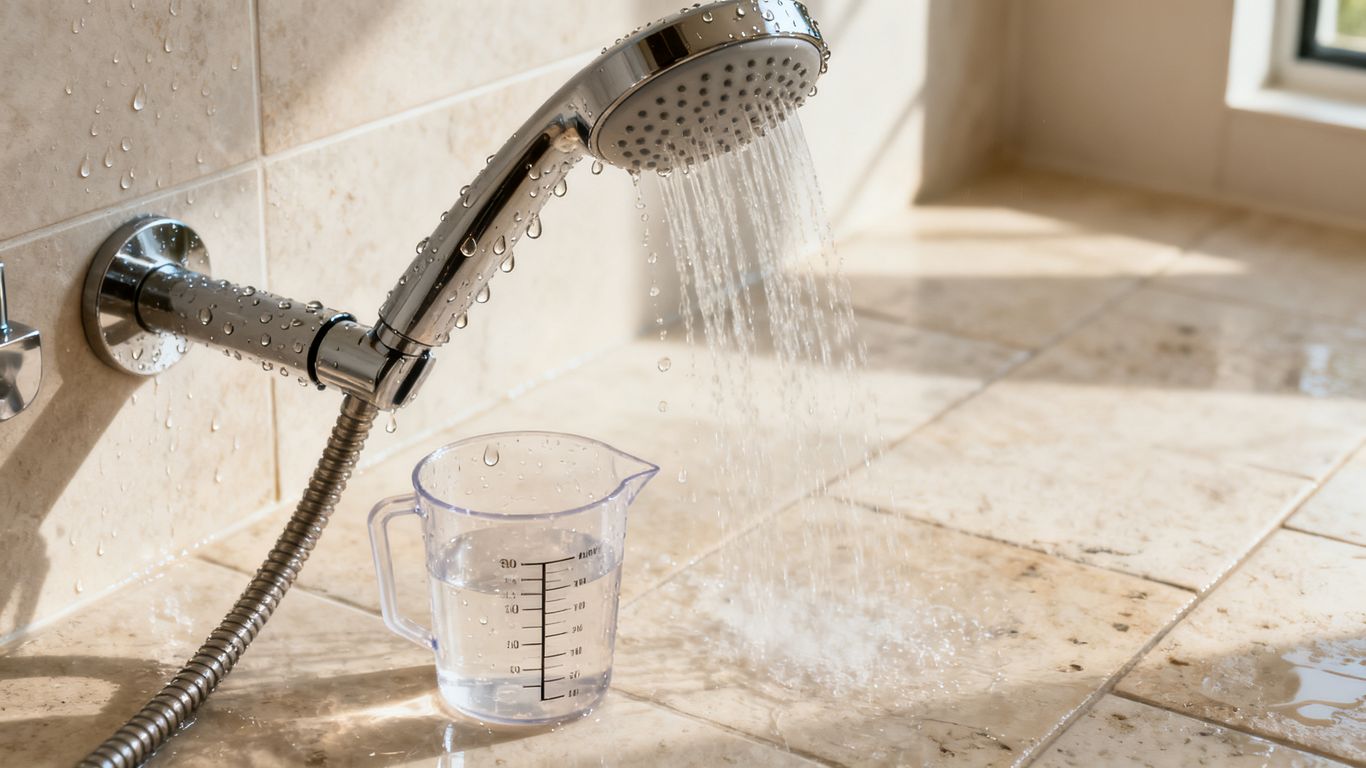
Direct measurement requires little equipment. Place a graduated container under the showerhead, let the water run for one minute, then note the volume collected. Repeat the operation at different settings if you sometimes use a hand shower or different spray patterns.
Perform the measurement when no one else is using a faucet, as a pressure variation can skew the result. This will give you a flow rate specific to your installation, which is more relevant than a general indication printed on the packaging.
Identifying Discrepancies Between Estimation and Daily Use
The gap between calculation and reality often comes from heating time, interruptions, and habits. A 5-minute shower by the stopwatch does not necessarily mean the water ran for 5 minutes. Conversely, a person may extend rinsing or leave the showerhead on while choosing soap.
To track these differences, note the approximate duration, measured flow rate, and interruptions for a week. This method, similar to tracking water habits, provides a more accurate view of your usage than a national average.
Measuring the Impact of Flow Rate on Consumed Volume
Flow rate is the most visible lever for understanding the volume consumed in five minutes. A reduction of a few liters per minute makes an immediate difference, without requiring a shorter shower. However, comfort depends on pressure, jet quality, and temperature, not just the displayed number.
Estimating Consumption with a Flow Rate of 6, 9, or 12 Liters Per Minute
At a constant duration, the volume changes in direct proportion to the flow rate. The following table provides a quick comparison for five minutes of continuous flow.
| Flow Rate | Volume Per Minute | Volume in 5 Minutes |
|---|---|---|
| 6 L/min | 6 liters | 30 liters |
| 9 L/min | 9 liters | 45 liters |
| 12 L/min | 12 liters | 60 liters |
These results describe a theoretical situation, without water drained before reaching temperature or pauses during washing. They nevertheless provide a good starting point for interpreting your readings and verifying your calculations.
Understanding the Effect of a Standard or Water-Saving Showerhead
A standard showerhead can deliver a higher volume than a low-flow model, but comfort is not just about the number of liters. Some jets distribute water better or mix in more air, giving a sensation of sufficient pressure with less flow.
Before replacing your equipment, measure the existing flow rate and check compatibility with your home’s water pressure. A comparison of water-saving showerheads can help you explore available options without assuming one model fits all installations.
Identifying Signs of Excessive Flow Rate
A high flow rate is not always obvious in use, especially when the pressure is comfortable. However, several indicators can guide your diagnosis: the container fills very quickly, the spray splashes widely, or the amount of hot water decreases rapidly for a single shower.
You can check the following points, in a practical order:
- measure the volume collected for exactly one minute;
- repeat the test with the hand shower and the fixed showerhead;
- check if the flow rate changes when other faucets are open;
- compare the volume actually used with the usual duration.
These observations help distinguish an intrinsically high flow rate from a pressure problem or an inappropriate setting. They also prevent replacing equipment that is functioning correctly.
Choosing a Flow Rate Suitable for Comfort and Water Savings
The right flow rate is one that allows for effective rinsing without unnecessary running water. If you have to extend the shower because the jet is too weak, excessive reduction can negate some of the expected savings. Therefore, test the setting over several showers rather than relying on a single impression.
A data-driven approach, like the one Millennium Digital applies in its B2B lead generation and growth automation activities, relies first on clear measurement. Here, it’s simply a matter of comparing perceived comfort and liters actually consumed before deciding.
Evaluating the Role of the Mixer Tap in Consumption
The mixer tap primarily affects temperature and the time water runs before, between, or after different steps. It does not automatically reduce flow rate, but precise adjustment can prevent hot water from being wasted. Its influence becomes particularly visible when the shower is far from the water heater or when the temperature varies in the network.
Distinguishing Between Mechanical, Thermostatic, and Electronic Mixer Taps
A mechanical mixer tap operates with two controls or a lever that combines flow and temperature. A thermostatic model maintains a selected temperature by compensating for certain supply variations. An electronic model adds a finer adjustment control, depending on the installation and available functions.
These technologies do not provide the same user comfort, but none eliminate the need to measure the showerhead’s flow rate. The mixer tap primarily controls the mixing and the on/off function; the final volume always depends on the running time and the delivered flow rate.
Reducing Adjustment Time Before Reaching the Right Temperature
When you turn on the water at full power to quickly reach the desired temperature, a significant amount can be drained without being used. Reducing the flow rate during this phase can limit this loss, provided it doesn’t make the adjustment too long.
Find a comfortable lever position and keep it as a starting point. With a well-adjusted mixer tap, you avoid back-and-forth adjustments between cold and hot water while maintaining a stable temperature during rinsing.
Using the Temperature Stop and the Shower Stop Function
The temperature stop limits unnecessary increases to very hot water. It also helps to more easily find a consistent setting, especially in a bathroom used by multiple people. A shower stop function, when available, allows you to pause the flow during soaping without completely changing the setting.
These devices do not replace conscious action. Check that the stop button does not cause abnormal pressure buildup and that it complies with the manufacturer’s recommendations for your faucets.
Checking the Influence of Pressure and Installed Equipment
Available pressure can change the flow rate and the sensation of the spray. A pressure reducer, a clogged filter, or a showerhead equipped with a limiter can explain a difference between two bathrooms. The condition of the hose and the presence of deposits in the showerhead also play a role.
Record the flow rate at different times of the day if you suspect variation. You can then separate the effect of the mixer tap from that of the general installation, instead of attributing all consumption to a single component.
Calculating the Energy Consumption of the Water Heater
The water consumed is only part of the cost of a shower. When water is heated, energy must also be supplied to raise its temperature from when it enters the home to the shower temperature. The amount depends on the volume actually heated, the starting temperature, the equipment’s efficiency, and the energy price.
Linking Hot Water Volume to Energy Quantity Needed
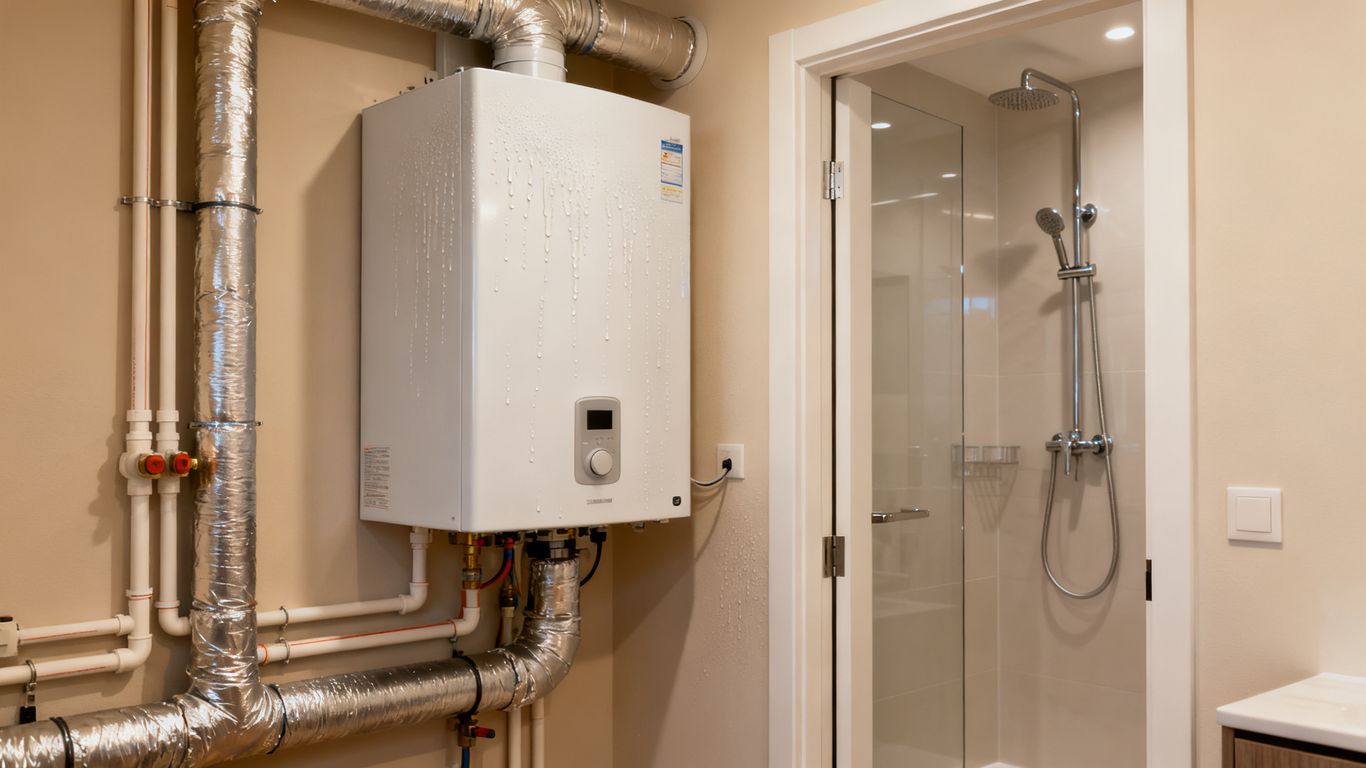
For a physical estimation, you can use the relationship E = m × c × ΔT. The volume of water in liters is approximated as a mass close to the same value in kilograms, c represents the specific heat capacity of water, and ΔT is the difference between the incoming and shower temperatures.
In practice, showers often use a mixture of hot and cold water. Therefore, the heated portion must be estimated rather than applying the formula to the entire consumed volume. Losses from the tank and the pipes are then added to the theoretical requirement.
Taking Incoming Water Temperature into Account
Water arriving at 10°C requires more energy to reach 38°C than water arriving at 15°C. This difference varies by season, region, and pipe location. It explains why two households with the same flow rate can have different costs.
To refine your calculation, record the cold water temperature at different times of the year. Then, use a reasonable average rather than an isolated measurement, especially if you are trying to project annual expenses.
Comparing Electric, Gas, and Thermodynamic Water Heaters
An electric water heater directly converts electricity into heat in the tank or at the time of production. A gas appliance uses another energy source, and its cost depends on efficiency and the applicable rate. A thermodynamic system recovers heat from the air, with an electrical consumption that cannot be directly compared to that of a conventional tank.
The comparison must include efficiency, storage losses, maintenance, and operating periods. Therefore, do not conclude based solely on the price displayed by the supplier: relate it to the energy actually used to heat the water.
Estimating the Total Cost of a 5-Minute Shower
To get a complete cost, add the price of cold water and wastewater treatment to the cost of energy needed for the hot water portion. You can then multiply the result by the number of weekly showers and the number of occupants.
In a data-driven management approach, Millennium Digital favors rapid validation and scenario comparison when evaluating a SaaS or app idea. For your household, the method is similar: start with a measured flow rate, test different durations, and check the results on your actual bills.
Accounting for Water Losses Before and During the Shower
Shower consumption sometimes begins before you step under the spray. Cold water in the pipes must be drained before hot water arrives, especially when the tank is far from the bathroom. These liters are not always included in estimates based solely on five minutes of washing.
Measuring Water Drained During Temperature Rise
Place a clean bucket under the showerhead before turning on the water, then separately collect the volume drained until the desired temperature is reached. This measurement gives you the startup loss, distinct from the volume used during the shower.
You can reuse this water for watering suitable plants, cleaning the floor, or flushing the toilet, provided you store it in a clean container and use it quickly. This action does not reduce the flow rate but reduces actual waste.
Limiting Losses Related to Pipes and Distance from the Tank
The longer the distance between the tank and the shower, the greater the volume of water in the pipe. Proper insulation of the pipes limits some heat losses, but does not eliminate the water that must be drained before reaching temperature.
If the configuration allows, a recirculation system or an adapted control can reduce waiting time. However, have the solution evaluated by a professional, as its operation can itself consume energy.
Reducing Waste During Soaping and Rinsing
Turning off the water during soaping is the most directly measurable action. With a flow rate of 9 liters per minute, a two-minute pause theoretically saves 18 liters, without reducing the time spent washing. The same reasoning applies to rinsing hair or waiting between products.
A simple guideline is to organize the shower in three stages: wetting, washing without water, then rinsing. This organization is consistent with tips for saving water, while allowing everyone to adapt the sequence to their needs.
Checking the Condition of Seals, Hoses, and Connections
A discreet leak can increase consumption without being visible during the shower. Inspect the connections, the hose, the showerhead seal, and the area around the mixer tap. A trace of limescale or persistent moisture warrants a quick check.
After use, dry accessible areas and check if a drop continues to fall. Replacing a worn seal generally costs less than a prolonged leak, but it must be done with a compatible part.
Reducing Shower Consumption Without Losing Comfort
Reducing water usage does not necessarily mean taking an uncomfortable shower. The result depends on the combination of a reasonable flow rate, stable temperature, and regular habits. You can progress in small steps and measure the effect of each change.
Installing a Low-Flow Showerhead
A low-flow showerhead reduces the volume delivered per minute of running water. Before installation, check the minimum required pressure, the connector diameter, and the possibility of maintaining a pleasant spray. A measurement before and after replacement will confirm the actual gain.
The choice should remain proportional to your installation. Too low a flow rate may encourage longer rinsing, making the overall calculation less favorable despite a reduced theoretical value.
Correctly Adjusting the Thermostatic Mixer Tap
A thermostatic mixer tap should be set to a comfortable temperature and maintained according to the manufacturer’s recommendations. Cleaning filters and checking the cartridge can maintain regular regulation.
Avoid frequently changing the temperature stop without reason. A stable setting facilitates starting the shower and limits manipulations that let water run while searching for the right temperature.
Adopting Good Habits During a 5-Minute Shower
The advertised duration is useful as a benchmark, but the running time is the most interesting data. To maintain your comfort, prepare soap and towel before turning on the water, then turn off the spray during pauses.
You can also:
- use a discreet timer during the first few weeks;
- wet hair and body in a single phase;
- turn off the water during soaping;
- reserve continuous spray for necessary rinsing.
After a few days, these habits become less restrictive. You can then check your consumption without turning the shower into a constant control exercise.
Maintaining Equipment to Keep Flow Rate Under Control
Limescale can alter the shape of the spray and create a sensation of insufficient flow. Regularly clean the showerhead according to the manufacturer’s instructions and rinse accessible filters. Do not pierce the nozzles or remove a limiter without understanding its role.
Periodic maintenance helps maintain a stable flow rate and avoid compensatory adjustments. If the spray remains irregular after cleaning, have the pressure and connections checked.
Comparing Several Consumption and Cost Scenarios
Comparing scenarios allows you to transform an intention of saving into a measurable goal. Keep the number of showers, the unit price of water, and the cost of energy constant, and change only one variable at a time. This method makes the results readable and avoids overly general promises.
Simulating a Shower with Different Flow Rates
For a 5-minute shower, scenarios at 6, 9, and 12 liters per minute result in 30, 45, and 60 liters, respectively. The difference between the lowest and highest flow rate is therefore 30 liters per shower. Over a week, a person taking seven showers would achieve a theoretical difference of 210 liters.
These figures assume the water runs for the entire duration. Add pre-heating losses separately and deduct pauses when you want to approximate reality.
Measuring the Effect of Duration on the Water Bill
At a constant flow rate, each additional minute adds exactly the corresponding flow rate. At 9 liters per minute, going from 5 to 7 minutes adds 18 liters. To calculate the cost, multiply this volume by the water and wastewater treatment rate, then add the energy needed to heat the hot water portion.
A comparison between shower and bath can provide a useful benchmark, but your habits remain decisive: a long shower with a high flow rate can approach the volume of a bath.
Comparing a Short Shower to a Bath
A bath generally requires a large volume, largely determined by filling the tub. A short shower can be more economical, but it won’t automatically be if it lasts a long time or if the showerhead delivers a high flow rate.
Therefore, compare the volumes actually measured, rather than the categories « shower » and « bath. » For a household decision, duration, fill level, and number of occupants matter more than the usage label.
Calculating Annual Savings for a Household**
To estimate annual savings, first calculate the difference between two scenarios, then multiply it by the number of weekly showers, the number of weeks, and the number of people involved. Then, convert liters to cubic meters and add the avoided energy for the hot water portion.
A household of four people saving 15 liters per shower, five times a week, theoretically avoids 15,600 liters per year. The financial result will depend on local rates and the hot water production system. A structured analysis, in the spirit of the Millennium Digital method for identifying email problems and measuring automation gains, consists of comparing the planned objective with the actual bills observed.
Summary
The consumption of a 5-minute shower is calculated first by flow rate, but a complete measurement must include heating time, pauses, temperature, and water heater efficiency. By measuring your flow rate, limiting losses, and comparing your bills over several months, you can choose improvements that are truly suited to your installation and comfort.
Frequently Asked Questions
How many liters does a 5-minute shower consume?
The volume depends on the flow rate. At 6 liters per minute, count about 30 liters; at 9 liters per minute, 45 liters; at 12 liters per minute, 60 liters, excluding losses before the shower.
How do I know the flow rate of my showerhead?
Place a graduated container under the showerhead for one minute, then note the volume collected. Repeat the test with different settings if necessary.
Does a thermostatic mixer tap automatically reduce consumption?
No. It primarily facilitates temperature stability. It can limit unnecessary running water during adjustment, but the volume always depends on the flow rate and the opening time.
Is the water drained before the shower counted?
It is counted by the meter if it comes from the network, even if you do not use it for washing. You can collect it and reuse it for certain domestic purposes.
What flow rate should I choose to save water?
A moderate flow rate, compatible with your installation’s pressure and your rinsing comfort, is a good compromise. Measure the result instead of relying solely on the advertised value.
Is a shower always more economical than a bath?
Not necessarily. A short shower often consumes less, but a long shower with a high flow rate can use a volume comparable to that of a bath.
How do I calculate the cost of a shower?
Add the cost of the water volume and wastewater treatment to the cost of energy needed to heat the hot water portion. Use your rates and your actual measurements to get a relevant estimate.


