

Installing solar panels on a flat roof might seem complex, but with the right information, it’s entirely feasible. Whether you’re an individual or a professional, understanding the different methods of fastening, tilting, and waterproofing is key to a successful and durable installation. This article guides you through the most common solutions to optimize your solar energy production on this type of roof.
Key Points to Remember
- Ballasting is a common method for fastening solar panels on a flat roof without piercing it, using materials like concrete blocks or gravel to ensure stability. However, the added weight on the structure must be carefully evaluated.
- The tilt of panels on a flat roof is crucial for production. An east-west orientation with a gentle tilt (10-15 degrees) is often more efficient than a south orientation with a steeper tilt (30-35 degrees), while also aiding self-cleaning.
- To ensure waterproofing, non-penetrating solutions like pads or rails welded to the waterproofing membrane are preferable, especially for commercial buildings, as they avoid the risk of leaks and do not add structural load.
- It is important to check your roof’s admissible load before installing solar panels, particularly with ballasted systems. Lighter mounting systems exist to minimize the impact on the structure.
- Grounding all components is an essential safety step to protect the installation and people against overvoltages and electric shocks.
Ballasting Solutions for Solar Panels on Flat Roofs
Ballasting represents a preferred installation method for solar panels on flat roofs, as it avoids any perforation of the waterproofing. This approach guarantees the integrity of your roof while ensuring the stability of your photovoltaic installation. It involves placing the panels on a structure, often made of galvanized steel, which is then stabilized by weights. These weights are calculated to resist wind forces and weather conditions, without the need to mechanically fasten the structure to the roof.
Principles of Ballasting for Panel Stability
The stability of a ballasted solar installation relies on a precise balance between the weight of the ballasts and external forces, primarily wind. You must consider the expected wind speed in your region, as well as the roof’s exposure (protected, normal, or exposed). Ballasting calculations take into account back wind, which exerts the strongest pressure on the panels. The surface area and size of the panels directly influence the weight needed to ensure good ground holding. It is therefore essential to properly evaluate these parameters to prevent any displacement or lifting of the structure.
Types of Ballasting: Concrete Blocks, Slabs, Gravel, or Earth
Several options are available for ballasting. Concrete blocks are a common, robust, and economical solution, although their handling can be heavier. Paving slabs can also serve as ballast, offering a more aesthetic option, provided they are heavy enough. Gravel or earth can be used in specific trays, offering a more integrated and sometimes lighter solution, but requiring a suitable containment structure. The choice will depend on your roof’s admissible load and your aesthetic preferences.
Advantages and Disadvantages of Ballasting for Waterproofing
The major advantage of ballasting is the preservation of the roof’s waterproofing. By avoiding penetrations, you eliminate any risk of leaks and premature degradation of your roofing. Installation is also faster and does not require specific waterproofing skills. However, ballasting involves a significant additional weight on the building’s structure, which must be validated by a technical study. Furthermore, the initial cost may be higher due to the weight of the necessary ballasting materials. Access for maintenance can also be slightly more complex depending on the type of ballasting chosen. It is important to note that non-penetrating mounting systems exist, using ballasted supports for a non-invasive installation.
Optimizing Solar Panel Tilt on Flat Roofs
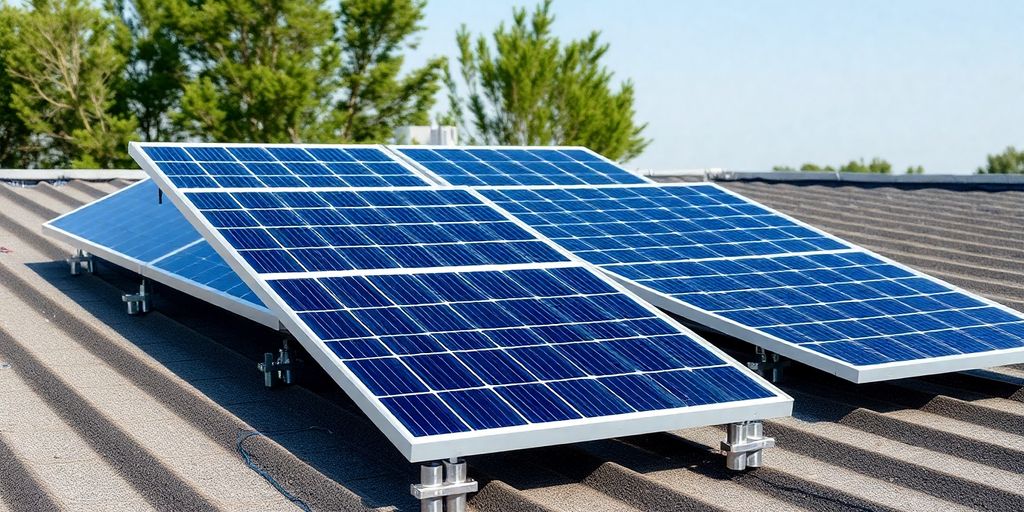
The tilt of your solar panels on a flat roof is a determining factor for optimizing energy production. It’s not just about laying them flat; a precise angle allows for optimal capture of the sun’s rays throughout the day and seasons.
Optimal Tilt Angles for Maximum Production
For a flat roof, a south orientation is generally preferred. In this case, a tilt angle between 30 and 35 degrees is often considered optimal for maximizing annual production. However, self-cleaning of the panels by rain and the risk of shading must also be considered. Too shallow an angle could retain dust and debris, while too steep an angle could create shadows on neighboring panels, especially if you install multiple rows.
Influence of East-West Orientation on Tilt
If your roof does not allow for a perfect south orientation, an east-west orientation can be considered. In this scenario, a gentler tilt, often between 10 and 15 degrees, can prove more effective. This configuration allows for capturing sunlight over a longer period of the day, thus compensating for a less ideal orientation. Furthermore, this angle reduces the risk of mutual shading between panels, which is a significant advantage.
Adjustable Mounting Systems for Customized Tilt
To achieve these optimal angles, various mounting systems are available. These structures allow for precise adjustment of your panels’ tilt. There are solutions that attach directly to the building’s framework, but for flat roofs, ballasted systems are often preferred to avoid any perforation of the waterproofing. These systems use metal or plastic structures that support the panels at the desired angle and are held in place by weight (gravel, slabs, etc.). It is important to choose a system adapted to your type of roof and your building’s constraints.
Ensuring Waterproofing During Solar Panel Installation
Installing solar panels on a flat roof requires special attention to preserve the integrity of your roofing. It is essential to choose fastening methods that do not compromise your roof’s waterproofing. A poorly executed installation can lead to water infiltration, causing significant and costly structural damage to repair.
Non-Penetrating Fastening Methods for Waterproofing
To avoid piercing the waterproofing membrane, several solutions exist. Ballasting is a common approach where the weight of the panels and their structure is distributed over the roof, without requiring through-fasteners. Ballasted rail or frame systems can be used, held in place by weights such as concrete blocks, concrete slabs, or gravel. This method is particularly suitable for commercial roofs where the structure can support an additional load. It is important to carefully calculate the necessary ballast weight based on local climatic conditions (wind, snow) and the building’s configuration. Good weight distribution is also essential to avoid overloading a specific area of the roof. You can find ballasted mounting systems designed for this, allowing for non-penetrating installation.
Solutions with Pads or Rails Welded to the Waterproofing
Another approach involves using systems that integrate directly with the waterproofing membrane. This includes, for example, pads or rails that are hot-welded onto the roofing. This technique creates a strong and watertight bond between the mounting system and the roof. It is often preferred for its reliability and durability, as it minimizes the risk of infiltration. These systems are designed to withstand mechanical stresses and temperature variations. The use of rails welded to the waterproofing is a proven method for photovoltaic installations on flat roofs.
Importance of Compatibility Between Fastening and Waterproofing Membrane
It is absolutely essential that the materials used for fastening the solar panels are perfectly compatible with your type of waterproofing membrane. Incompatibility can lead to premature degradation of the membrane, leaks, or insufficient adhesion of welded systems. Before any installation, it is recommended to consult the technical specifications of manufacturers of solar panels, mounting systems, and waterproofing membranes. A qualified professional can advise you on the best solutions adapted to your specific roof. Regular checking of fastenings and the condition of the waterproofing is also advised, especially after significant weather events.
Technical Considerations for Flat Roof Installation
Installing solar panels on a flat roof requires careful attention to several technical aspects to ensure the performance and durability of your system. It’s not enough to just place the panels; you need to consider the supporting structure, aerodynamics, and the preservation of waterproofing.
Evaluation of the Roof’s Admissible Load
First and foremost, it is imperative to know your roof’s load capacity. Every building has a limit to the weight it can support. Solar systems, whether ballasted or mechanically fastened, add an additional load. A structural analysis by a professional is often necessary to ensure that the roof can support the weight of the panels, mounting structures, and potentially ballast, without compromising the building’s integrity. The weight of snow or water accumulation in case of poor drainage must also be considered.
Impact of Ballasted System Weight on the Structure
Ballasted systems are a popular solution because they avoid piercing the waterproofing membrane. However, the weight of the ballast (concrete blocks, slabs, gravel) can be considerable. It is therefore essential to distribute this load properly over the roof structure. Poor distribution can lead to excessive localized stresses. The effect of wind, which can lift panels if they are not sufficiently ballasted, must also be taken into account, imposing dynamic stresses on the structure.
Lightweight and Low-Impact Mounting Solutions
For roofs with limited load capacity, or when you want to minimize the impact on waterproofing, lighter mounting solutions exist. These can include fastening systems that use rails attached directly to the building’s structure, or ballasted systems using less dense materials. The use of aluminum structures, for example, helps reduce overall weight. It is also possible to opt for systems that integrate with existing waterproofing, such as pads or welded rails, provided compatibility with the membrane is guaranteed. The goal is to find a balance between safety, performance, and respect for the roof. An optimal tilt, for example around 30-37° depending on latitude, can be achieved with adapted structures, thus improving energy production without excessively weighing down the system learn more about optimal tilt.
Installing solar panels on a flat roof should never be done without a prior assessment of the structure and waterproofing. The choice of mounting and ballasting system must be adapted to the specific characteristics of your building to ensure the safety and longevity of the installation.
Fastening Systems Adapted for Commercial Roofs
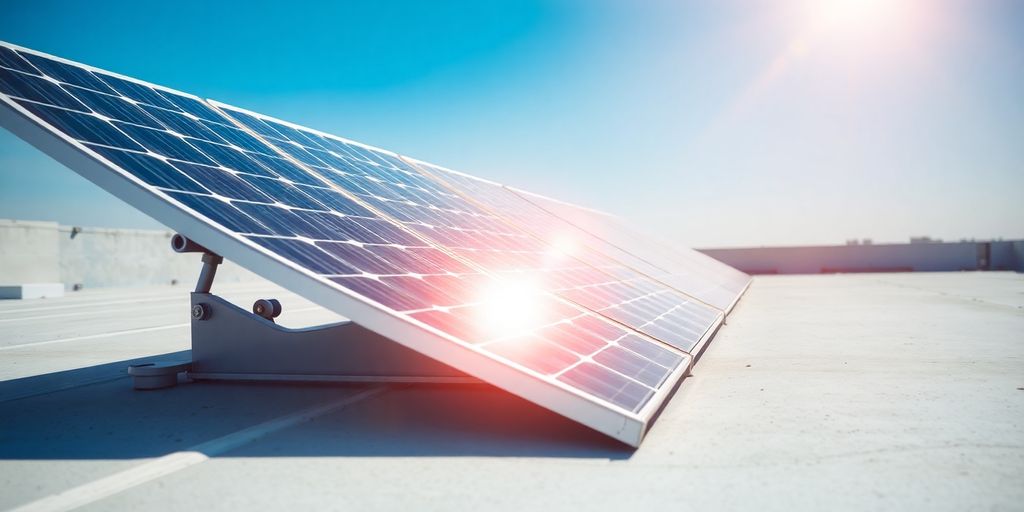
For commercial buildings, the choice of solar panel fastening system is particularly important. The type of roofing, the building’s structure, and regulatory constraints must be considered.
Mounting on Steel Decking and Corrugated Sheets
Roofs made of steel decking or corrugated sheets (often fiber cement) are common on industrial and logistics buildings. Installation on these supports is generally done via a rail system. These rails are fastened directly to the ribs of the steel decking using self-tapping screws. For corrugated sheets, specific supports adapt to the wave shape and are fastened with galvanized screws. This method keeps the solar panels very close to the roof, thus reducing wind impact. The fasteners often include a rubber support to ensure waterproofing. The use of shared rails, where a central rail serves two rows of panels, can reduce the number of rails needed and simplify installation, thereby decreasing costs and installation time.
Clamp Fasteners for Standing Seam Roofs
Standing seam roofs, often metal, require specific fasteners that do not pierce the membrane. Clamps are a preferred solution because they attach directly to the seam of the metal panel. They are designed to adapt to different types of seams and offer a solid mechanical fastening without compromising the roof’s waterproofing. This system is valued for its quick implementation and long-term reliability. It is important to ensure the compatibility of the clamps with the material and profile of the roof for optimal installation.
Mounting Solutions for Industrial and Logistics Buildings
The large flat roofs of industrial and logistics buildings, such as warehouses or shopping centers, present specific challenges. Although ballasting is an option, systems directly fastened to the structure are often preferred for insurance and safety reasons. Solutions that involve welding pads or rails to the waterproofing are particularly suitable. These methods, carried out by waterproofing professionals, avoid any perforation and do not add additional load to the structure. They are considered safer because they minimize the risk of damage related to waterproofing. The choice between ballasting and direct fastening will depend on the structural analysis and project requirements.
Grounding and Safety of Solar Installations
Grounding your solar installation is a non-negotiable step to ensure everyone’s safety and the proper functioning of your system. It allows for the dissipation of fault currents and protects against overvoltages, especially those caused by lightning. It is therefore essential to ensure that all metallic components, from solar panels to the mounting structure, are properly grounded.
Importance of Grounding Modules and Mounting System
Electrical continuity is key. Each solar panel and each element of the mounting structure must be interconnected to form a safe path to ground. This prevents the accumulation of electrostatic charges that could damage equipment or pose a risk to people. A properly grounded installation protects against electric shocks and fires. It is essential to follow the manufacturer’s instructions for connection, often done using specific lugs and stainless steel hardware.
Stainless Steel Grounding Connections
To ensure the durability and reliability of grounding connections, the use of corrosion-resistant materials is essential. Stainless steel is the preferred choice for bolts, washers, and cable lugs. These elements guarantee a stable electrical connection over time, even in sometimes harsh outdoor environments. Care must be taken to ensure that these connections are not affected by the removal of a module, in order to maintain the integrity of the entire system’s grounding. You can find suitable grounding kits to ensure this continuity between modules, the structure, and the rest of the installation for optimal safety.
Continuity of Grounding Connections
The design of the grounding system must allow for continuity to be maintained even if a component is removed or fails. This means that each connection must be independent in its role, but integrated into a global circuit. For example, removing the ground connection of a single panel should not interrupt the connection of other panels to ground. Good planning and the use of appropriate components, such as bonding splices between rails, are necessary to achieve this goal. This ensures that protection remains effective throughout the solar installation.
In conclusion: your flat roof, a solar asset
As you will have understood, installing solar panels on a flat roof is entirely feasible and can even be very advantageous. Whether you opt for ballasted systems, welded structures, or other methods, the choice will depend on your roof and your needs. Remember to carefully study the load constraints and waterproofing of your roof. Good tilt and thoughtful orientation will optimize your energy production. Do not hesitate to consult professionals to assist you in this project, which will allow you to produce your own green electricity.
Frequently Asked Questions
What is the best tilt for solar panels on a flat roof?
For your solar panels to work well, they need to be installed with a slight tilt. On a flat roof, a tilt between 10 and 15 degrees is often aimed for. This also helps the panels self-clean with rain and prevents panels in front from shading others.
Can solar panels be installed on a flat roof without drilling holes?
Yes, it is entirely possible to install solar panels on a flat roof without piercing it. Systems are then used that are either ballasted (weights like concrete blocks are placed on them) or welded directly onto the roof’s waterproofing. This is a good solution to keep the roof well-sealed.
What is ballasting for solar panels on a flat roof?
Ballasting is when weights like concrete blocks, slabs, or even gravel are used to hold solar panels in place on a flat roof. This avoids piercing the roof, but you must ensure the roof can support this additional weight.
Can my roof support the weight of ballasted solar panels?
You need to check the strength of your roof before installing solar panels. Ballasted systems add weight, and it is crucial that the roof structure can support this load without problems. A professional can tell you if your roof is strong enough.
Why is grounding so important for solar panels?
Grounding is very important for safety. It helps prevent electrical problems, especially during storms. All metallic elements of the panels and their support must be connected to the ground with special stainless steel parts.
What are the advantages of flat roofs for installing solar panels?
Flat roofs are perfect for solar panels because they offer a large surface area. They can be installed in different ways: either by tilting them slightly with special supports, or by ballasting them so they stay in place without piercing the roof. It’s a practical and discreet solution.


