

As a tenant, you may dream of reducing your electricity bill and doing your part for the planet with solar panels. But is it really possible when you don’t own the property? And if so, what aid is available to help you with this project? This is a question many people ask, and the answer is not always simple. We’ll look at how it works, the steps to follow, and, most importantly, what subsidies can give you a boost to install photovoltaics in your rented accommodation. Hang in there, we’re breaking it all down for you!
Key Points
- The owner’s consent is mandatory for installing solar panels on rented accommodation, except for plug & play kits.
- Several national aids such as the self-consumption premium and reduced VAT can help you, but they are often linked to electricity resale.
- Local and regional subsidies can supplement national aids; you should inquire with your local authority.
- “Plug & play” solar kits are a good alternative for tenants, as they do not require heavy work or the owner’s consent.
- Before investing, it is important to carefully calculate profitability and financial risks, especially if you do not plan to stay in the accommodation for long.
Installing photovoltaic panels in rented accommodation
Installing solar panels when you are a tenant may seem complex, but it is entirely feasible. It is important to understand the steps and conditions to be met to successfully complete this project. Here are the essential points to consider.
The indispensable owner’s agreement for installation
The first and most important step is to obtain written agreement from your landlord. Indeed, according to the law of July 6, 1989, any transformation of a rented property initiated by the tenant requires the landlord’s approval. This includes the installation of solar panels, which is considered a modification of the dwelling. Without this agreement, you risk having to restore the premises to their original state at your own expense when you leave. It is therefore essential to communicate clearly with your landlord and present the benefits of the installation, such as increased property value and reduced charges for future tenants.
Administrative procedures and grid connection
Once the owner’s agreement is obtained, you will need to carry out the same administrative procedures as if you were the owner of the property. This includes:
- The prior declaration of works to the town hall. This declaration is mandatory if the solar panels are installed on the roof, balcony, facade, or ground (for installations over 3 kWp).
- The grid connection request to Enedis. This request must be made in your name, as you are the occupant of the dwelling and the electricity consumer. You can also explore options for roof rental for photovoltaics.
- The possibility of selling surplus electricity produced to EDF OA. This requires some additional steps but can be an interesting source of income.
If your landlord does not wish to handle these procedures, you must obtain a mandate from them to act on their behalf.
Costs associated with solar panel installation
Installing solar panels represents a significant investment. It is important to carefully evaluate the costs and seek available financial aid. Costs may include:
- The purchase of solar panels and necessary equipment.
- Installation costs by a certified professional.
- Electricity grid connection fees.
- Any administrative fees.
There are financing solutions for your solar panels that can make the project more accessible, such as solar panel rental. This option allows you to benefit from the advantages of solar without having to bear the full initial costs. Remember to compare different offers and consider the long-term return on investment.
National subsidies for tenant solar panel aid
As a tenant considering solar panel installation, it is important to be aware of available national financial aid. These subsidies can significantly reduce the initial cost of installation and make your project more affordable. The French government has implemented several schemes to encourage renewable energy production, even in rental situations.
The self-consumption premium for photovoltaic installations
The self-consumption premium is financial aid paid by the State to encourage the installation of photovoltaic panels. It is intended for individuals who consume their own electricity production and sell the surplus. The amount of this premium depends on the power of your installation. To benefit from this premium, you must meet certain conditions, including using an RGE (Recognized Guarantor of the Environment) certified installer and installing photovoltaic panels connected to the national electricity distribution network. This premium is paid during the first five years of the installation’s operation.
The obligation to purchase produced electricity
The purchase obligation is a system that requires energy suppliers, such as EDF, to buy the electricity you produce with your solar panels that you do not consume. This allows you to generate additional income by selling your surplus electricity. Purchase tariffs are set by the State and vary depending on the power of your installation and your consumption mode (self-consumption with surplus sale or total sale). To benefit from the purchase obligation, you must conclude a contract with an approved energy supplier. It is important to note that tariffs and premiums may evolve, so it is advisable to stay informed of the latest updates.
Reduced VAT for installation work
In some cases, you can benefit from a reduced VAT rate of 10% for solar panel installation work. To do this, you must have the work carried out by a professional and meet certain conditions, such as installing the panels on a dwelling completed more than two years ago. This VAT reduction can represent significant savings on the total cost of the installation. It is important to check if your project is eligible for this reduced rate before starting the work. Don’t forget to check maintenance audits to ensure the longevity of your installation.
It is important to note that these national aids are subject to eligibility conditions and may evolve over time. It is therefore advisable to inquire with the competent organizations (such as ADEME or your region) to find out the latest information and the procedures for obtaining these aids.
Local and regional aid for tenant solar panels
As a tenant interested in solar energy, it is important to know that financial aid may exist at the local and regional levels. This aid complements national schemes and can make your project more affordable. It is therefore relevant to inquire about opportunities available in your region.
Subsidies from local authorities
Regions, departments, and municipalities can offer subsidies to encourage the installation of solar panels, even for tenants. These aids are often subject to specific conditions, such as energy performance criteria or income ceilings. It is therefore essential to contact your regional or general council, as well as your town hall, to find out about existing schemes and eligibility requirements. These aids can take the form of direct subsidies, subsidized loans, or tax exemptions.
Specific aid programs for departments
Some departments implement targeted aid programs to support the energy transition. These programs can include financial aid for the installation of solar panels, as well as advice and personalized support. For example, the Hauts-de-Seine Departmental Council (92) offers financial aid for private housing improvement. The Loire-Atlantique Departmental Council (44) finances collective solar panel installation projects. These initiatives aim to encourage self-consumption and reduce the environmental footprint of homes.
Communal initiatives in favor of solar energy
At the communal level, initiatives can also be put in place to promote the installation of solar panels. Some municipalities offer financial aid, free advice, or personalized support for tenants wishing to install solar panels. These initiatives can also take the form of collective projects, such as the installation of solar panels on the roofs of communal buildings or the creation of renewable energy cooperatives.
It is important to note that local and regional aids are often cumulative with national aids, which can make your solar panel installation project even more financially attractive. Do not hesitate to inquire with the various competent organizations to find out what aids you can claim.
Here is an example of a summary table of potential aids:
| Community | Type of aid | Indicative amount |
|---|---|---|
| Region | Subsidy | Variable depending on the region |
| Department | Subsidized loan | Variable depending on the department |
| Municipality | Advice and support | Free |
Alternatives to traditional solar panels for tenants
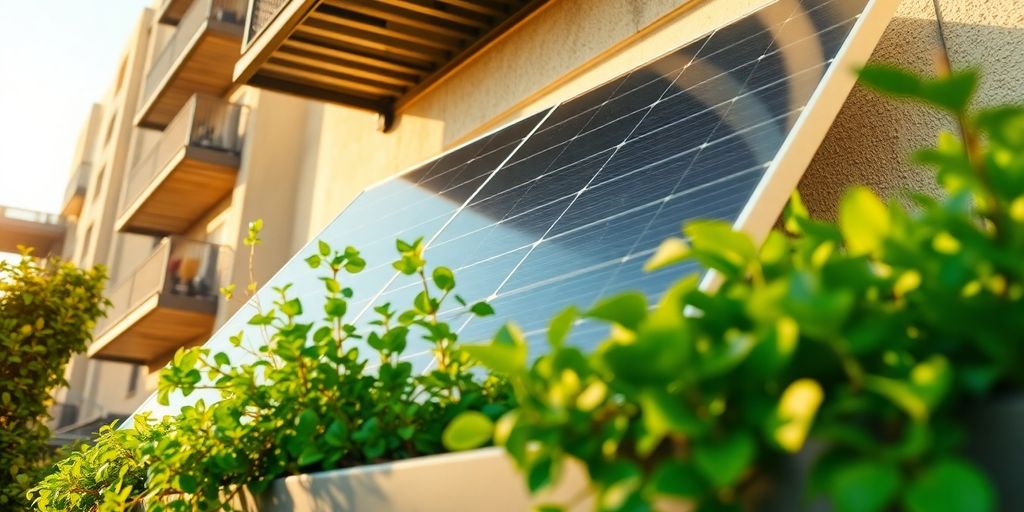
If installing traditional solar panels proves complex for you as a tenant, know that there are interesting alternative solutions. These options can allow you to enjoy solar energy without requiring heavy work or significant investments. Let’s explore these alternatives together.
The plug & play solar kit for balcony or terrace
The plug & play solar kit represents a simple and accessible solution for tenants. These kits, designed to be easily installed on a balcony or terrace, plug directly into a standard electrical outlet. They allow you to produce your own electricity and reduce your energy bill.
Here are some advantages of these kits:
- Easy and quick installation
- No structural modification of the dwelling
- Affordable cost
- Easy to move in case of relocation
Portable and modular solar solutions
Portable and modular solar solutions offer increased flexibility. These are solar panels that you can easily move and orient to optimize energy production. These systems are particularly suitable if you have limited outdoor space or if you want to be able to use solar energy while traveling. You can find rental options for these systems.
The impact of alternatives on energy production
Although these alternatives are simpler to implement, it is important to note that their energy production is generally lower than that of a traditional photovoltaic installation. However, they can be an excellent way to discover solar energy and reduce your electricity consumption.
It is essential to evaluate your energy needs and compare the different options available to choose the most suitable solution for your situation. Do not hesitate to consult professionals for personalized advice.
Profitability and financial considerations for tenant solar panel aid
Return on investment of solar installations
As a tenant, evaluating the return on investment (ROI) of solar installations is essential. The ROI depends on several factors, including the initial cost of the installation, the savings made on your electricity bill, and any available financial aid. It is important to note that, unlike an owner, you will not directly benefit from the income generated by the sale of surplus electricity. However, a significant reduction in your energy expenses can make the investment worthwhile, especially if you plan to stay in the accommodation long-term. Remember to consider the impact of financial aid on the initial cost.
Amortization of plug-in solar kits
Plug-in solar kits, often more affordable and easier to install, represent an interesting alternative for tenants. The amortization of these kits is generally faster than that of traditional rooftop solar installations.
Here are some points to consider:
- The initial cost is lower, which reduces the time needed to reach the break-even point.
- Installation is simple and does not require major work, which reduces additional costs.
- Energy production, although limited, can cover part of your electricity consumption, leading to immediate savings.
It is crucial to carefully evaluate your electricity consumption and the solar kit’s production capacity to determine if the investment is profitable in your specific situation. Also consider the possibility of transferring the kit to another dwelling if you move.
Financial risks for the tenant
Investing in solar panels as a tenant involves financial risks that must be taken into account. If you leave the dwelling before the installation is amortized, you risk not recovering your entire investment. Furthermore, in case of damage or malfunction of the panels, the question of financial responsibility may arise, especially if the installation has not been approved by the owner. Make sure you have the owner’s agreement for the installation of solar panels. It is therefore essential to carefully weigh the pros and cons before embarking on such a project and to discuss the terms with your owner to avoid any future disputes. It is important to note that the owner is the only one to benefit from the income if they choose to sell the energy produced by the solar panels. It is therefore important to understand plug-in solar panels before getting started.
Management and maintenance of solar panels in rental
Responsibilities of the owner and tenant
In the context of solar panel installation in a rented dwelling, it is essential to clearly define the responsibilities of each party regarding management and maintenance. Generally, the owner is responsible for structural maintenance and replacement of major equipment, such as inverters. However, the rental agreement may stipulate specific obligations for the tenant.
Cleaning and maintenance of equipment
Regular cleaning of solar panels is important to maintain their efficiency. Dust, leaves, and other debris can reduce the amount of sunlight reaching the photovoltaic cells. Here are some tips:
- Clean the panels at least twice a year.
- Use soft water and a soft brush to avoid scratching the panels.
- Avoid using harsh chemicals.
It is important to note that some solar panel rental contracts include a maintenance service. Carefully check the terms of your contract to know the included services and the responsibilities of each party.
Component replacement and general maintenance
General maintenance of solar panels includes regular checking of electrical connections, inspection of cables, and checking the condition of fasteners. In case of component failure, such as an inverter, it is generally the owner’s responsibility to replace it. A well-maintained installation ensures optimal energy production and extended equipment life. It is important to discuss these aspects with the owner before installation to avoid any misunderstandings. If you opt for solar panel rental, maintenance is often included in the contract. Here is a summary table of typical responsibilities:
| Task | Usual Responsibility |
|---|---|
| Panel cleaning | Tenant (often) |
| Inverter replacement | Owner |
| Cable inspection | Owner |
Impact of lease termination on solar installation
Contractual clauses relating to improvements
When considering the installation of solar panels in a property you are renting, it is essential to fully understand the clauses in your lease agreement regarding improvements. These clauses define the conditions under which you can carry out work and what happens to these improvements at the end of the lease. It is imperative to negotiate these clauses with your landlord before proceeding with the installation.
The fate of solar panels in case of departure
What happens to your solar panels if you leave the property? Several options are possible:
- You may be required to remove the panels at your own expense and restore the property to its original condition.
- You can transfer the installation to the owner or the next tenant, with the agreement of all parties.
- You can negotiate financial compensation with the owner for the residual value of the panels.
It is crucial to clarify these aspects in an addendum to the lease agreement to avoid any subsequent disputes. Without a written agreement, the owner may demand restoration to the original condition, which would involve significant costs for you.
Financial implications for the tenant
The financial implications of lease termination can be significant. If you have to remove the panels, you will bear the costs of removal and restoration. Furthermore, you will lose the initial investment made in the installation. It is therefore important to carefully evaluate the solar monitoring and financial risks before embarking on such a project. Here are some points to consider:
- The cost of removing the panels.
- The cost of restoring the roof.
- The loss of the initial investment.
- The possibility of negotiating compensation with the owner.
In summary
Installing solar panels when you’re a tenant is possible, but you need to be well-organized. The most important thing is to have your landlord’s written agreement. Without it, no work can be done. There are aids, such as the self-consumption premium or reduced VAT, which can help pay for part of the installation. But be careful, these aids are often for the owner, not directly for the tenant. If you can’t install panels on the roof, plug-in solar kits for a balcony are a good solution. They don’t produce as much, but it’s still something to make small savings. The idea is to see what is simplest and most profitable for your situation. Each case is a little different, so you need to look at all the options carefully.
Frequently Asked Questions
Can a tenant install solar panels?
Yes, it’s possible, but you absolutely need your landlord’s written agreement. Without their green light, you can’t do major work like installing solar panels on the roof. If you just want a small panel for the balcony, it’s simpler, because it doesn’t affect the building’s structure.
What financial aid is available for a tenant who wants to install solar panels?
Several aids exist. The best known is the self-consumption premium, which gives you money if you use the energy you produce. There’s also the purchase obligation, where EDF or other companies must buy your surplus electricity. And for the work, VAT can be reduced to 10% under certain conditions. Don’t forget to check for aid from your region or city, as they can also help!
Who is responsible for maintaining solar panels in a rental?
If you install solar panels on the roof, it’s generally the landlord who takes care of cleaning and maintenance. The tenant has no obligation, unless it’s clearly stated in the rental agreement. For small solar kits on a balcony, it’s up to you to maintain them.
What happens to the solar panels if I move out?
If you leave the dwelling, you need to see what’s written in your contract. Normally, the improvements you’ve made (like solar panels) remain in the dwelling. This can have financial consequences for you, as you’ve invested. It’s very important to discuss this point with your landlord before installing anything.
Is installing solar panels profitable for a tenant?
For a rooftop installation, the return on investment is long, often between 8 and 12 years. If you stay for a shorter period, it’s not necessarily profitable for you. For small balcony solar kits, it’s much faster, often 2 or 3 years. This is a point to consider carefully before getting started.
What are the solar solutions for a tenant without the landlord’s agreement?
If you can’t install panels on the roof, “plug & play” solar kits are a great alternative. You plug them into an outlet and they produce electricity. This is perfect for balconies or terraces, and you don’t need the landlord’s agreement because there’s no major work involved. This already allows you to make small energy savings.


