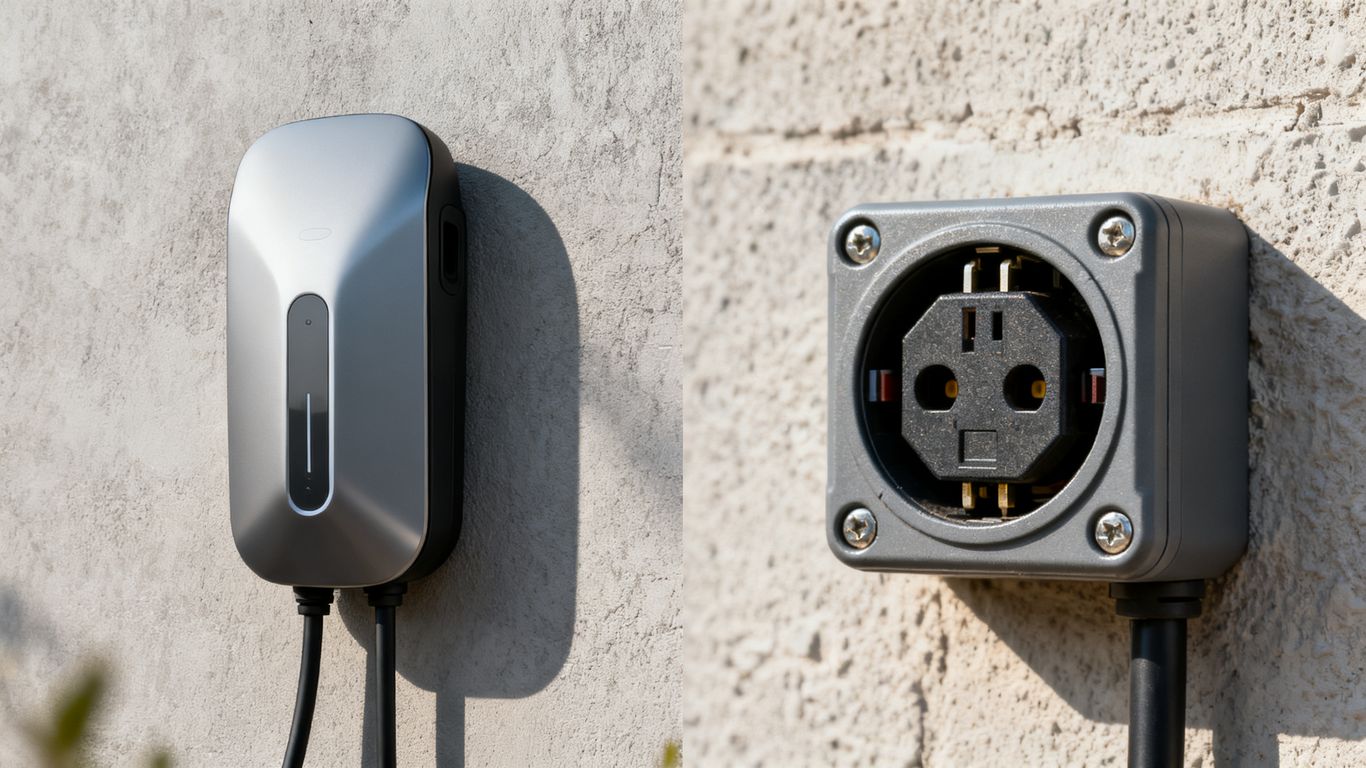
Here are the key takeaways to help you decide between a reinforced outlet and a charging station for your home.
Key Takeaways
- A charging station is more powerful and charges faster than a reinforced outlet.
- The installation cost of a reinforced outlet is generally lower than that of a charging station.
- Reinforced outlets are often sufficient for plug-in hybrid vehicles.
- Charging stations offer additional features like scheduling and remote control.
- Hiring a professional is recommended for the safety of any electrical installation.
Fundamental Differences Between a Charging Station and a Reinforced Outlet
When considering installing a charging solution for your electric vehicle at home, two main options present themselves: the charging station and the reinforced outlet. Although they serve the same purpose, their technical characteristics, performance, and financial implications differ significantly. Understanding these distinctions is essential for making an informed choice.
Charging Power: Technical Comparison
The most striking difference between a charging station and a reinforced outlet lies in their maximum power. A reinforced outlet, often called a Green’Up outlet, is designed to deliver power up to 3.7 kW. This is a significant improvement over a standard household outlet (limited to 2.3 kW), but it remains modest for modern electric vehicles.
In comparison, a home charging station can offer much higher power levels, typically from 7.4 kW to 22 kW. This greater capacity allows for much faster charging.
| Device Type | Maximum Power |
|---|---|
| Household Outlet | 2.3 kW |
| Reinforced Outlet | 3.7 kW |
| Charging Station | 7.4 kW to 22 kW |
Charging Time by Device
Charging power directly impacts the time needed to recharge your vehicle. For a battery with a capacity of 50 kWh, for example:
- With a reinforced outlet (3.7 kW), a full charge can take over 15 hours. This is often sufficient for plug-in hybrid vehicles with smaller batteries, or for supplemental charging.
- With a 7.4 kW charging station, the same vehicle will be charged in about 7 hours. A more powerful station (22 kW) will further reduce this time.
It is therefore clear that for drivers with significant mobility needs or intensive use of their electric vehicle, a charging station is a much more suitable solution to optimize charging time.
Features and Available Options
Beyond simple power, charging stations stand out for their advanced features. They can offer:
- Connectivity: remote control via a mobile app, consumption monitoring.
- Scheduling: charging during off-peak hours to reduce electricity costs.
- Enhanced security: badge authentication (RFID), station locking.
- Integration with other systems: compatibility with solar panels, for example.
The reinforced outlet, on the other hand, focuses on safety and slightly increased power compared to a standard outlet, without offering these convenience or smart management options. Installing a charging station can also have a positive impact on the value of your property.
It is important to note that, regardless of the chosen solution, the installation must be carried out by a qualified professional. Charging an electric vehicle puts a significant strain on your existing electrical system, and improper installation can pose risks of overheating or fire.
Reinforced Outlet Installation Cost: Cost Structure and Variables
Cost of Equipment and Installation
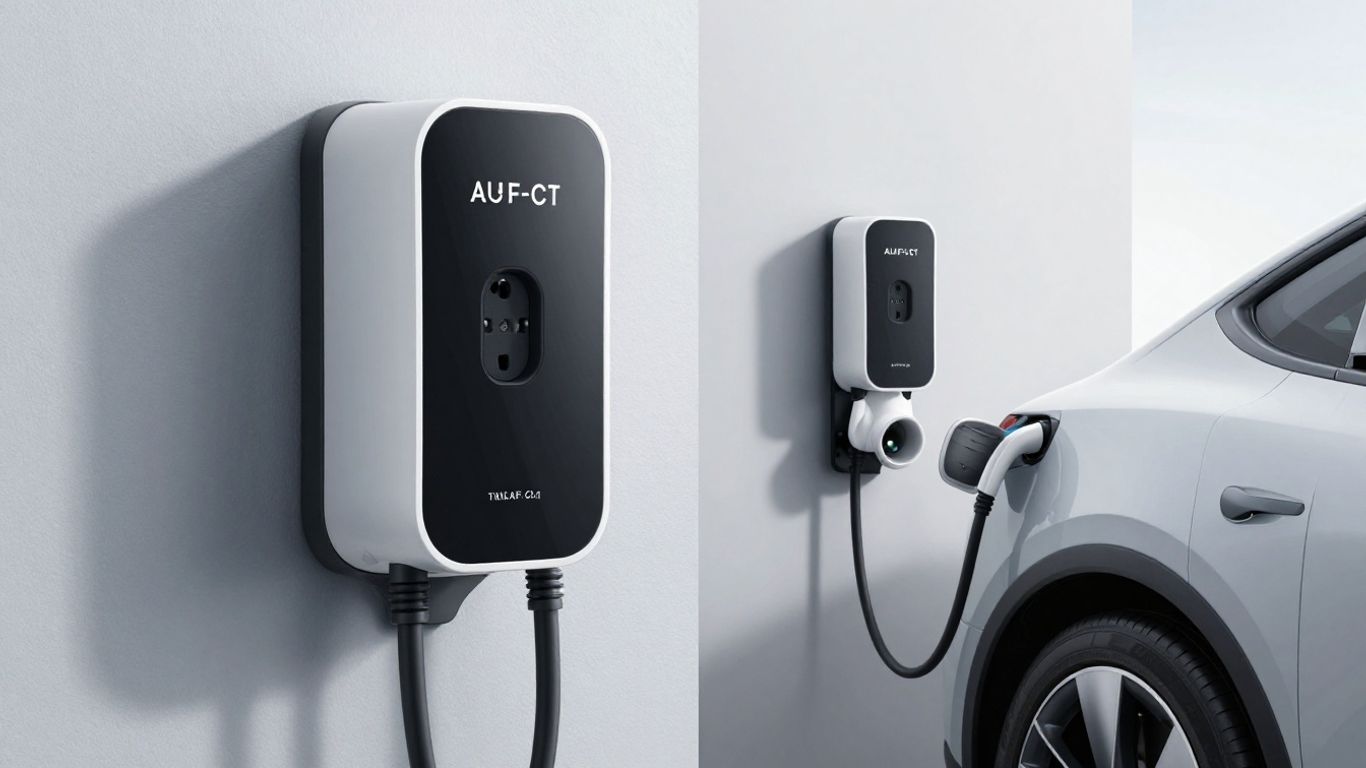
When considering the installation of a reinforced outlet for your electric vehicle, it’s good to know that the budget required is generally more affordable than for a full charging station. The cost of the outlet itself, often called Green’Up or equivalent, falls within a reasonable range. Added to this is the electrician’s fee for installation. This latter point is the most variable, as it will depend on the complexity of the installation.
To give you a more precise idea, the total price for a reinforced outlet, including equipment and labor, often ranges from €400 to €710 [a7a5]. Of course, this can fluctuate. If your electrical panel is old or if the distance between it and the desired location for the outlet is significant, you’ll need to budget extra for ancillary work.
Factors Influencing the Final Price
Several elements can increase or decrease the bill. The distance between your electrical panel and the location where you want to install the outlet is a key factor. The farther it is, the more cable is needed and the longer the electrician’s work will take. The brand and model of the reinforced outlet chosen also play a role, as does the need to reinforce your existing electrical system. Sometimes, a specific circuit breaker needs to be added or a line modified. It’s also important to note that not all installers have the same rates. Therefore, getting multiple quotes is a step not to be overlooked.
Impact of VAT and Aid
Good news: the installation of a reinforced outlet can benefit from a reduced VAT rate. Currently, it’s possible to take advantage of 10% VAT instead of the usual 20%, provided your home is more than two years old. This is a significant advantage that lowers the total cost. Unlike charging stations, reinforced outlets generally do not qualify for specific financial aid like the Advenir premium, except in very specific cases for co-ownership buildings. You should thoroughly research the available programs at the time of your project.
It is always recommended to use a professional for this type of installation, even if the law does not always require IRVE certification for a reinforced outlet. The safety and performance of your installation depend on it.
Choice Criteria Between Charging Station and Reinforced Outlet
Faced with electric mobility, the choice between a charging station and a reinforced outlet may seem complex. However, it is essential to thoroughly analyze your needs to make the right choice.
Analysis of Mobility Needs
Your daily use of the electric car is the first factor to consider. If you regularly travel long distances, a charging station is essential. It offers higher charging power, significantly reducing the time needed to regain range. For shorter trips or if your vehicle is a plug-in hybrid with a small battery, a reinforced outlet might suffice. It allows for slower charging, often overnight, which is generally sufficient for these uses. Also consider the frequency of charging; if you need to recharge quickly several times a week, a charging station is more suitable.
Performance and Ease of Use
The major difference lies in power. A reinforced outlet is limited to 3.7 kW, while a charging station can reach 22 kW or more. This translates into very different charging times. For example, a 50 kWh battery will take about 15.5 hours on a reinforced outlet, compared to 7 hours on a 7.4 kW charging station. Ease of use is therefore directly linked to charging speed. Modern charging stations also offer advanced features such as off-peak hour scheduling, remote control via an app, or compatibility with energy management systems. These options improve the user experience and can optimize your electricity costs. A reinforced outlet, while simpler, offers less flexibility.
Scalability and Future Adaptation
It is wise to think about the evolution of your needs and technology. If you plan to change your vehicle to a model with a longer range, or if your use of the electric car intensifies, a charging station offers better scalability. It can be sized for higher power levels and adapt to future standards. Furthermore, installing a charging station can increase the value of your property, an argument not to be overlooked. A reinforced outlet, being more basic, could become limiting in the long run. It is important to check the available power on your electricity meter before making any decision.
The installation of an electric charging device, whether it is a charging station or a reinforced outlet, must be carried out by a qualified professional. This ensures the safety of your installation and prevents risks of overheating or short circuits, which are particularly important when charging an electric vehicle that heavily strains the domestic network.
Safety and Compliance of Electrical Installation
When you install a reinforced outlet or a charging station for your electric vehicle, the safety of your electrical installation is paramount. It’s not just about plugging in a device, but about ensuring everything is done according to best practices to avoid any incidents.
Applicable Standards and Risks Involved
For any electrical installation, there are standards to follow. In France, the NF C 15-100 standard dictates the rules. It concerns the design, execution, and maintenance of low-voltage electrical installations. For a reinforced outlet, which is designed to withstand a higher and longer load than a standard outlet, compliance with these standards is even more important. Non-compliant installation can lead to risks of fire, short circuits, or even electrocution.
The main risks are related to cable overheating, poor connections, or insufficient electrical protection. A standard household outlet is not designed to handle the continuous load required for charging an electric car, even at low power. This is where the reinforced outlet comes in, offering better resistance and increased safety compared to a standard outlet. It is designed to manage current intensity over time. If you’re looking to understand how a reinforced outlet works, there are guides to help you.
Choosing a Professional for Installation
Although installing a reinforced outlet is technically simpler than installing a charging station, it is strongly recommended to use a qualified professional. For charging stations, it is mandatory if the power exceeds 3.7 kW, and the installer must be IRVE (Infrastructure de Recharge pour Véhicules Électriques) certified. A certified electrician guarantees that the installation complies with all current standards and is safe. They can also advise you on the best location and the appropriate equipment for your existing system. Using a professional provides peace of mind and protects you from risks associated with improper handling. It’s an investment in your safety.
Overcurrent Management and Home Protection
Charging an electric vehicle requires a stable and protected electrical supply. Reinforced outlets and charging stations are equipped with specific protection devices. The most important is overcurrent management. This means that if the current becomes too strong, the system automatically cuts off the power to prevent damage to the vehicle, the outlet, or to cause a fire. This is usually done via a suitable residual current device (RCD) installed in your electrical panel. This RCD is different from that of a standard outlet; it is calibrated for the power required for charging. It is also important to check the total available power in your home to avoid overloading your general installation. Good protection prevents the entire neighborhood from being plunged into darkness if your car decides to act up.
The installation of an electric vehicle charging equipment, whether it is a reinforced outlet or a charging station, must be carried out in compliance with electrical safety standards. This includes checking the available power, using appropriate protection, and ideally, the intervention of a certified professional to ensure a safe and compliant installation.
Here are the key steps for a safe installation:
- Check existing electrical installation: Ensure your electrical panel can handle the additional load.
- Choose suitable equipment: Select a reinforced outlet or charging station that meets standards and your needs.
- Professional installation: Hire a qualified electrician for installation according to best practices.
- Functional tests: Verify that everything works correctly and that protections are active.
Adhering to these points is essential for safely charging your electric vehicle at home. It’s an important step to fully enjoy your electric car without worries. For more information on safe installations, you can consult information on charging infrastructure.
Practical Installation of a Reinforced Outlet: Key Steps
Installing a reinforced outlet at your home is a process that requires some preparation to ensure it is both functional and safe. Although the law allows for self-installation in some cases, it is strongly recommended to use a qualified professional to ensure a compliant and risk-free installation. Here are the key steps to consider.
Selecting the Optimal Location
Choosing the location for your reinforced outlet is important. It should be easily accessible, ideally protected from the weather if located outdoors, and not too far from where you usually park your vehicle. Also consider its proximity to the electrical panel, as this can influence the installation cost.
Checking Available Power
First and foremost, it is essential to check the available electrical power on your current installation. A reinforced outlet requires a dedicated circuit and appropriate protection, usually a 16A circuit breaker. You must ensure that your electricity meter can handle this additional load without overloading the existing installation. If your subscribed power is insufficient, a modification may be necessary, which represents an additional cost. It is advisable to consult your electricity provider or a professional to assess this step. Consulting installation steps can give you a more precise idea of the diagnostics to perform.
Testing and Validating Overall Safety
Once the outlet is installed, tests are necessary to validate its proper functioning and safety. This includes checking for overheating during charging, correct tripping of the circuit breaker in case of a problem, and general compliance of the installation with current standards. A professional will ensure that everything is in order before handing over the installation to you.
It is important to note that, unlike charging stations, the installation of a reinforced outlet generally does not qualify for the same financial aid, although VAT may be reduced to 10% in some cases. Inquire about existing programs to optimize your budget.
Here are the key points for a successful installation:
- Location: Accessible, protected, and close to the vehicle.
- Power: Verification of the domestic electrical grid’s capacity.
- Professional: Use a qualified electrician for optimal safety.
- Tests: Validate proper functioning and compliance after installation.
Installing a reinforced outlet is a simpler and often less expensive solution than a charging station, particularly suitable for plug-in hybrid vehicles. For fully electric vehicles, charging time may be longer, but ease of use remains a major advantage. Remember to check the compatibility of the charging cable supplied with your vehicle, as not all manufacturers systematically provide the cable suitable for this type of outlet. Solar kits with batteries can also be an option to consider for more autonomous charging.
Conclusion
Ultimately, the choice between a reinforced outlet and a charging station really depends on your specific needs. If you have a plug-in hybrid vehicle or don’t drive much, a reinforced outlet may suffice and represents a lower investment. However, for faster charging, advanced features, and better adaptation to the future of electric mobility, a charging station, despite a higher initial cost, often proves more advantageous in the long run. Don’t forget to consult a professional for a safe and compliant installation.
Frequently Asked Questions
What is the main difference between a charging station and a reinforced outlet?
A charging station is more robust and charges your car much faster. A reinforced outlet is a bit less powerful, so it takes longer to charge.
Can I install a reinforced outlet myself?
Technically, it’s possible if you have the right electrical knowledge. But be careful, to be sure everything is done correctly and safely, it’s best to hire a qualified electrician. It’s safer for you and your home.
What is the average price to install a reinforced outlet?
For the outlet itself, expect to pay around €130 to €350. The installation by a professional is added to this price. It’s often cheaper than installing a full charging station.
Is a reinforced outlet suitable for all electric vehicles?
It’s best suited for plug-in hybrid cars, which have smaller batteries. For 100% electric cars with large batteries, charging will be quite slow, it can take all night.
Are there any financial aids for installing a reinforced outlet?
Unfortunately, for reinforced outlets, there are no special aids like for charging stations. However, you can sometimes benefit from a reduced VAT rate.
Is a reinforced outlet as safe as a charging station?
Yes, if installed correctly by a professional, it is much safer than a standard outlet. It has protections to prevent overheating and electrical problems. Charging stations sometimes have additional safety features.