The year 2025 is fast approaching, and with it, new questions arise for those considering installing solar panels. One of the major concerns is the storage of the energy produced: should you opt for a physical battery, which stores electricity at your home, or a virtual battery, which manages your surplus in a dematerialized way? Recent regulatory and pricing changes make this choice even more relevant. This article helps you see more clearly to make the best choice for your solar installation.
Key Takeaways
- A physical battery offers local and immediate storage of your solar energy, ensuring energy independence and a backup in case of power outages.
- A virtual battery, on the other hand, manages your energy surplus in a dematerialized way, offering seasonal flexibility without initial hardware investment, but with recurring costs.
- The initial investment for a physical battery is higher, but it promises a more attractive return on investment in the long term and a better self-consumption rate.
- A virtual battery may seem more accessible at first, but you need to consider grid connection fees and reliance on the grid, which can impact its actual profitability.
- The choice between a virtual and physical battery will depend on your consumption profile, your budget, your desire for independence, and your expectations for the return on investment for your solar installation.
Understanding the Fundamentals of Solar Energy Storage
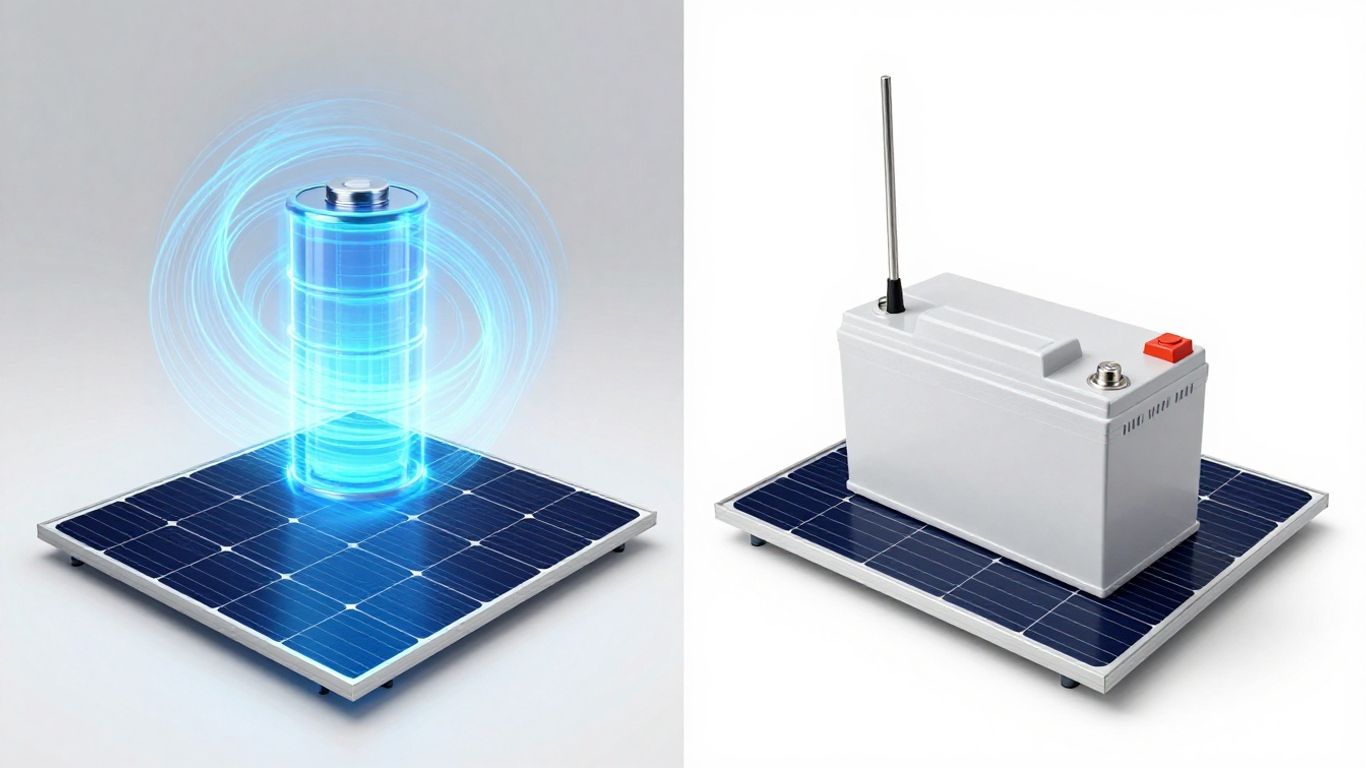
To choose your solar energy storage system wisely, it’s essential to grasp the basic principles governing the two main approaches: the physical battery and the virtual battery. These technologies, while aiming for the same goal – optimizing the use of your photovoltaic production – function very differently.
A physical battery is a bit like having your own small power plant at home. It’s a tangible device, installed at your home, that stores the electricity produced by your solar panels when it’s not immediately consumed. Think of it as a reservoir: when your panels produce more than your household needs, the excess fills this reservoir. Later, when your panels are not producing enough (e.g., at night or when the sky is overcast), you draw from this reserve. It’s a solution that offers you a certain independence from the electrical grid, as the energy is stored right next to you.
- Operation: Solar panels produce electricity. If the instantaneous consumption is less than the production, the surplus charges the physical battery. When production is insufficient, the battery discharges to power your home.
- Advantages: Allows immediate use of stored energy, reduces reliance on the grid, and can serve as a backup in case of outages.
- Disadvantages: Higher initial cost, limited lifespan, and requires installation space.
A virtual battery, on the other hand, is a more modern and intangible approach. It doesn’t rely on a physical device at your home, but rather on an accounting system managed by your energy provider. Imagine a bank account for your electricity: when your solar panels produce more than you consume, this surplus isn’t stored in a tank, but credited to your virtual account. You can then
Comparative Analysis of Performance and Costs
Comparing virtual and physical batteries means examining several key aspects: initial investment, annual expenses, and especially the savings generated over time. This allows for better anticipation of the return on your solar investment in 2025.
Evaluation of Initial Investment and Recurring Costs
The first factor that distinguishes these two solutions is the amount to be committed at the beginning.
- Physical battery: purchase and installation cost around €7,000 to €10,000 depending on the chosen capacity and brand. Long-term maintenance costs may be added (inverter replacement generally after 15 years, around €1,500).
- Virtual battery: here, no expensive equipment to pay for upfront. It’s more about paying an activation fee (usually between €59 and €299) and then an annual subscription. Depending on the offer, expect €75 to over €800 per year, with different plans that may or may not include additional fees per kWh stored and grid usage taxes (like TURPE, currently around €0.10/kWh).
| Criterion | Virtual Battery | Physical Battery |
|---|---|---|
| Initial Investment | €59 – €299 (activation) | €7,000 – €10,000 |
| Annual Subscription | €75 – €821 | €0 |
| Inverter Replacement Cost | not applicable | €1,500 (approx., at 15 years) |
| Lifespan (typical) | as long as contract | 15 to 20 years |
You don’t need to spend a large sum for a virtual battery, but the subscription cost can become a heavy burden on the total bill if you stay on the same site for more than five years.
Comparison of Net Annual Savings and Return on Investment
Let’s now look at the difference in terms of long-term savings:
- Physical battery: allows for a self-consumption rate of over 70%, compared to barely 30% without storage. This translates to net annual savings of approximately €1,400. The return on investment for the battery alone drops to about 3 years, and for the entire installation to 5 years.
- Virtual battery: it aims to « carry over » your surplus instead of selling it immediately, which should allow you to recover it later when you need it. Except that between the subscription, TURPE, and fees on the returned energy, the net savings drop to €200–€250/year. Therefore, the ROI doesn’t really exist, as the recurring cost far exceeds the generated savings in most scenarios.
| Criterion | Virtual Battery | Physical Battery |
|---|---|---|
| Net Annual Savings | €200 | €1,400 |
| Self-Consumption Rate | 30-40% | 75% |
| ROI | None | 3–5 years |
| Total Savings over 20 years | ~€4,700 | ~€19,000 |
Considering the 20-year balance, the difference widens: the physical battery generates almost €15,000 more in net gains according to calculations by comparative experts.
Impact on Self-Consumption Rate
The major advantage of local storage is the sharp increase in the self-consumption rate. With a properly sized physical battery, you consume about three-quarters of your solar production, which immediately reduces your electricity purchases from the grid.
- Without a battery: about 30% self-consumption
- With a physical battery: up to 75%
- With a virtual battery: the theoretical rate increases (on paper), but restitution fees limit real savings
Main impacts:
- You pay less kWh to EDF.
- You limit losses related to selling surplus at a very low price.
- You amortize your installation faster if the storage is well-sized.
On paper, the virtual battery is mainly interesting in case of mobility or to test self-consumption without a large commitment. But for those who want to maximize their savings, the physical battery has a clear advantage.
In summary, despite apparent simplicity and low initial costs, the virtual battery suffers in all long-term assessments: it is expensive to use, reduces your bill little, and makes you dependent on a contract. The physical battery, more expensive at first, allows for real savings and a quick return on investment, even in 2025.
For a numerical overview of current offers and detailed analyses, see the tables published in the studies by Hello Watt comparison.
Advantages and Disadvantages of Each Storage Solution

Benefits of a Physical Battery: Independence and Backup
A physical battery is like having your own energy reserve at home. Its main asset is autonomy. You store your surplus solar production and use it whenever you want, without depending on the grid. This is particularly useful during power outages; your system can continue to power your home, offering you valuable peace of mind. Furthermore, the stored energy is truly yours, without intermediaries or complex transport fees. It’s ideal if you’re looking to maximize your day-to-day self-consumption.
- Increased Energy Independence: Less reliance on electricity providers.
- Backup in Case of Power Outage: Maintains power supply to your home.
- Direct Energy Valuation: Stored energy is consumed without additional grid fees.
- Lifespan: Generally between 10 and 15 years, with warranties often for 10 years.
The installation of a physical battery represents a more significant initial investment, but it offers complete control over your energy and valuable security in case of an incident on the electrical grid.
Limitations of a Virtual Battery: Dependence and Hidden Fees
A virtual battery works differently. It’s a dematerialized management of your energy surplus. You inject your surplus into the grid, and an energy credit is created on your account. When you need electricity, you draw from this credit. The advantage is that there is no storage limit in terms of duration or volume, which is perfect for smoothing out seasonal variations in production and consumption. However, this solution makes you dependent on the electrical grid to recover your energy. Additionally, you need to be mindful of grid connection fees and potential activation fees that can be added to the monthly subscription. There is no physical installation at your home, which saves space and avoids technical constraints, but it also means you have no backup solution in case of a general power outage.
- Grid Dependence: Using stored energy requires the electrical grid.
- Ancillary Fees: Grid connection and activation costs to consider.
- No Autonomy in Case of Outage: No backup solution during power cuts.
- Lifespan: Undetermined, as there is no physical equipment that wears out.
Seasonal Flexibility Offered by Virtual Storage
What truly distinguishes a virtual battery is its ability to manage energy over the long term, far beyond the daily or weekly cycles of a physical battery. Imagine storing the surplus solar production from summer, when the sun shines generously, to use it during the winter months, when production is naturally lower. This is seasonal flexibility that physical batteries, with their shorter charge and discharge cycles and limited capacity, cannot offer in the same way. This dematerialized management allows you to smooth out your consumption over the year, thus optimizing the use of every kilowatt-hour produced by your solar panels. This approach is particularly relevant for households whose energy needs vary significantly between seasons. The dematerialized management of your energy makes full sense here.
Key Criteria for Choosing Your Storage System
Suitability of the Virtual Battery for Summer Energy Surpluses
The virtual battery proves particularly interesting if you produce a lot of solar electricity during the summer months, but your consumption is lower at that time. Think of the long sunny days when your panels are running at full capacity. Instead of letting this surplus go, the virtual battery allows you to
Economic and Regulatory Outlook in 2025
Influence of Photovoltaic Surplus Buyback Tariffs
In 2025, the buyback tariffs for surplus photovoltaic electricity continue to evolve, directly impacting the profitability of solar installations, whether coupled with a physical or virtual battery. For small installations (up to 9 kWp), the surplus buyback tariff is set at €0.04/kWh for the first quarter of 2026. This figure should be compared to the cost of purchasing electricity from the grid, which remains significantly higher. This difference widens the advantage of self-consumption, making the storage of produced energy more relevant than its simple resale.
Impact of Self-Consumption Aid and Premiums
Support schemes for self-consumption, such as the self-consumption premium, have also been adjusted. In 2025, this premium is reduced to €80/kWp for residential installations. Although these aids help reduce the initial investment, their amount must be taken into account in the overall return on investment calculation, particularly for the physical battery, which represents a more substantial upfront cost. Aids are generally not applicable to virtual batteries, which do not require additional hardware from the user.
Projection of Long-Term Profitability of Both Options
The long-term profitability analysis highlights notable differences between the two systems. The physical battery, despite its initial acquisition cost, offers energy independence and a definitive return on investment, often estimated between 3 and 5 years depending on the conditions. It avoids recurring fees and provides protection against power outages. The virtual battery, on the other hand, has permanent annual costs (subscription, grid taxes like TURPE) that can significantly reduce its net economic advantage. It is therefore essential to carefully evaluate these recurring costs to avoid falling into the trap of a solution that seems economical at first glance but proves less profitable over time. The absence of backup in case of power outage is also a weakness to consider for the virtual battery.
The evolution of buyback tariffs and premiums, combined with the structure of recurring costs for virtual batteries, makes the comparative analysis more complex than before. It is now essential to consider all financial flows over the lifespan of the installation to make an informed choice.
Here is a simplified comparative table of average annual costs for a 6.3 kWp installation:
| Expense Item | Physical Battery (Average Annual) | Virtual Battery (Average Annual) |
|---|---|---|
| Investment Amortization | ~ €400 – €600 | €0 |
| Subscription / Fees | €0 | ~ €800 – €1000 |
| Taxes (TURPE on energy taken back) | €0 | ~ €500 |
| Estimated Total Annual Cost | ~ €400 – €600 | ~ €1300 – €1500 |
Choosing the Solution Best Suited to Your Energy Profile
After exploring the technical and economic intricacies of virtual and physical batteries, it’s time to bring it all back to your personal situation. Because, let’s be honest, the best storage system isn’t universal; it depends entirely on how you consume your solar energy.
User Profiles Favoring a Physical Battery
A physical battery is primarily for those seeking maximum energy independence and immediate use of their solar production. If you are a homeowner, your annual consumption exceeds 5,000 kWh, and you are considering your installation for the long term (10 to 20 years), a physical battery is often the most judicious choice. It is particularly relevant if you live in an area prone to power outages, as it offers an automatic backup function. Furthermore, if your initial budget is more substantial (often starting from €7,500), you will benefit from a faster return on investment and more substantial net annual savings compared to a virtual battery.
- Total Energy Independence
- Backup in Case of Grid Outage
- Better Long-Term Return on Investment
- Ideal for High Energy Consumers
User Profiles Benefiting from a Virtual Battery
A virtual battery, on the other hand, shines with its flexibility and low entry cost. It is an excellent option for people who do not want to commit long-term, such as renters or those planning to move within five years. If your annual consumption is more modest (less than 3,000 kWh) and your initial budget is limited (less than €1,000 for activation), it can represent an interesting solution to start valuing your solar surpluses. It allows you to smooth out your consumption over the year, storing excess summer energy to use during the winter months when your solar panels produce less. It’s a way to test energy storage before a potential larger physical investment.
A virtual battery is a dematerialized storage solution that allows you to keep your produced kWh. It differs from a physical battery by its nature and mode of operation. Choosing between a virtual and physical battery depends on your specific needs and energy consumption habits [60cc].
- Low Initial Investment
- Increased Seasonal Flexibility
- Suitable for Occasional Consumers or Small Budgets
- Ideal for Testing Energy Storage
The Importance of a Personalized Study to Optimize Your Choice
Faced with these two options, it is clear that an in-depth analysis of your energy profile is essential. Your daily consumption, your seasonal habits, the duration of your solar installation project, and even your residential situation (owner or renter) are all factors that will influence the decision. A personalized study, often offered free of charge by installers, will allow you to precisely quantify the potential savings and return on investment for each type of battery. This will help you make an informed choice, aligned with your goals and budget, for optimal management of your solar energy.
| Criterion | Virtual Battery (Example) | Physical Battery (Example) | Main Advantage |
|---|---|---|---|
| Initial Investment | ~€300 | ~€7,500 | Virtual |
| Annual Recurring Cost | ~€821 | €0 | Physical |
| Net Annual Savings | ~€208 | ~€1,402 | Physical |
| ROI | Undefined (permanent cost) | ~5.2 years | Physical |
| Grid Outage Backup | No | Yes | Physical |
So, What to Remember for Your Choice in 2025?
At the end of this analysis, it is clear that the choice between a physical and a virtual battery will depend on your priorities and your situation. If you are looking for total energy independence, protection against power outages, and maximum long-term profitability, a physical battery represents a wise investment, despite its higher initial cost. On the other hand, if your goal is to value your electricity surpluses with maximum flexibility and without material commitment, a virtual battery may seem attractive, although its recurring costs and dependence on the grid must be considered. Weigh these elements carefully to make the decision that best suits your needs.
Frequently Asked Questions
What is the main difference between a physical battery and a virtual battery?
Imagine a physical battery as a large box at home that keeps your surplus electricity for later. A virtual battery, on the other hand, works a bit like a bank account: your excess electricity is recorded online, and you can retrieve it later, but it’s not stored at your home.
Do I need to install anything at my home to have a virtual battery?
No, that’s one of the big advantages! With a virtual battery, you don’t need to install any additional equipment at your home. Your electricity provider manages all of this digitally.
Does a physical battery allow me to remain independent in case of a power outage?
Absolutely. If your physical battery is charged when the power goes out, it can continue to power your home. It’s like having a built-in backup power supply.
Is a virtual battery expensive to use?
A virtual battery has no hardware purchase cost, but it often involves a monthly or annual subscription. Furthermore, even if you retrieve your virtually stored electricity, there may be fees to get it to flow through the grid to your home.
Which solution is more advantageous if I produce a lot of electricity in the summer but consume more in the winter?
In this case, a virtual battery can be very interesting. It allows you to store your summer surplus to use during the winter months, when your solar panels produce less. This is called seasonal flexibility.
What is the lifespan of these batteries and do they need to be replaced?
A physical battery, especially lithium ones, can last between 10 and 20 years, and will need to be replaced eventually. A virtual battery, being an online service, has no limited lifespan like a physical object.