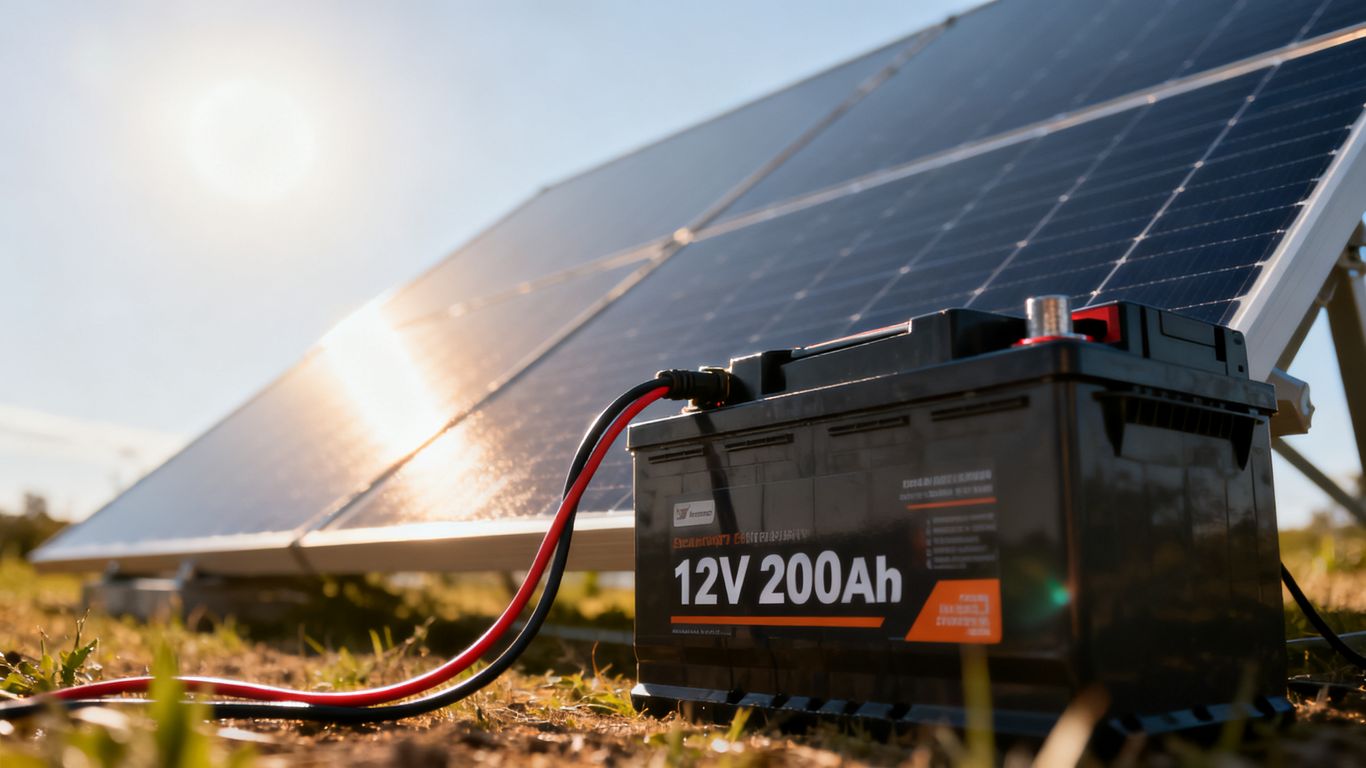
Wondering which solar panel to choose to recharge your 12V 200Ah battery? That’s an excellent question, as the right equipment makes all the difference. With different panel technologies and charge controllers, it’s easy to get lost. In this article, we’ll clarify everything to help you make the best choice, particularly addressing MPPT and PWM charge controllers and how they influence your battery’s charging time.
Key Takeaways
- To recharge a 12V 200Ah battery, you need a solar panel with a nominal voltage slightly higher than the battery’s, ideally between 12V and 14V.
- The recommended maximum charging current for a 12V 200Ah battery is about 15% of its capacity, which is 15A, corresponding to a solar panel power of approximately 210 Watts.
- Using a charge controller (MPPT or PWM) is highly recommended to avoid overcharging and damaging your battery, regardless of its type (gel, lithium, lead-acid).
- MPPT controllers are more efficient than PWM controllers, offering up to 30% more yield, especially in cloudy weather, and better manage higher panel voltages.
- To correctly size an MPPT controller, consider the total panel power, your battery bank voltage (12V, 24V, 48V), and your panels’ open-circuit voltage (Voc) to avoid exceeding the controller’s input limit.
Understanding Solar Panel Choice for a 12V 200Ah Battery
Choosing the right solar panel for your 12V 200Ah battery is a bit like choosing the right fuel for your car. It needs to match, otherwise, it won’t work properly. Let’s look together at how to make the right choice.
Determining the Necessary Solar Power
To start, you need to know how much energy you consume. This is the first step, even before thinking about the panel. You need to perform an energy audit of everything that will be connected to your system. Think about your devices, their consumption, and how long they will run per day. The idea is that your solar panel can ideally cover your consumption on a sunny day. For example, a 100W panel can produce about 40 Ah in the summer in Western France, but much less in winter. For a 200Ah battery, you need to calculate carefully to avoid running out of energy. There’s no point in having an overly powerful panel if you don’t have the capacity to store all that energy, or if you don’t need it. You need to find the right balance. The goal is to be able to recharge your 12V 200Ah battery without overstressing it. To give you an idea, for a 200Ah battery, we often aim for a panel power that allows it to be recharged in a sunny day, which can translate to a panel power of 100W to 200W depending on your location and the season. You must remember to adapt the power to your actual consumption.
Matching Panel Voltage to Battery Voltage
Your solar panel’s voltage must be compatible with your battery’s voltage. For a 12V battery, it’s recommended to use a panel with a nominal voltage slightly higher, say between 12V and 14V. If the voltage is too low, the battery won’t charge properly. If it’s too high without a suitable controller, you risk damaging it. It’s a matter of balance so that current can flow efficiently and safely.
Considering Maximum Charging Current
Every battery has a limit on the current it can accept for recharging. This is known as the « C rating. » For a 200Ah battery, the maximum charging current is generally around 15% of its capacity, which is about 30 Amperes. Therefore, your solar panel, via the controller, must not exceed this limit. Too much current can damage the battery and reduce its lifespan. You need to choose a panel whose power, once converted to current by the controller, remains within acceptable limits for your 200Ah battery. For example, a 200W panel at 14.4V (typical charging voltage) delivers about 13.8A, which is perfectly reasonable for a 200Ah battery.
It is truly important not to overlook these technical aspects. A wrong choice can be costly in the long run, both in terms of performance and the lifespan of your equipment.
Charge Controllers: MPPT and PWM, Which to Prefer?
Specifics of PWM Controllers
PWM controllers, for « Pulse Width Modulation, » represent an older and simpler technology. Their main role is to adapt the voltage of solar panels to that of your 12V battery. They work by « chopping » the current, thus making it compatible with the battery. It’s an economical solution, often sufficient for small installations, say less than 150W. However, their efficiency decreases when sunlight conditions vary. They also cannot charge a 12V battery with panels whose voltage is significantly higher than the battery’s voltage (for example, a 23V panel is often a limit for a 12V system with PWM).
Advantages of MPPT Controllers
MPPT controllers, « Maximum Power Point Tracking, » are more sophisticated. Thanks to a microprocessor and advanced algorithms, they can continuously track the maximum power point of your solar panels. This means they optimize the voltage and current from the panels to extract as much energy as possible, regardless of light conditions. They can thus increase your system’s efficiency by up to 30% compared to a PWM controller, which is particularly noticeable in cloudy weather or during periods of low sunlight. They also accept higher input voltages, giving you more flexibility in choosing your panels and reducing energy losses due to Joule effect in the cables. It’s a more efficient technology for maximizing your solar installation’s energy production [75e6].
Performance and Cost Comparison
| Characteristic | PWM Controller | MPPT Controller |
|---|---|---|
| Cost | More affordable | Higher |
| Efficiency | Less good, especially in variable weather | Up to 30% higher, optimizes production |
| Max Input Voltage | Limited (e.g., 23V for 12V) | High (e.g., 75V, 100V, 150V), more flexibility |
| Complexity | Simple | More complex, but more efficient |
| Ideal for | Small installations, limited budget | Installations requiring maximum optimization, high-voltage panels |
The choice between PWM and MPPT will therefore depend on your budget, the size of your installation, and your performance expectations. For a 12V 200Ah battery, especially if you are looking to optimize charging and maximize recovered energy, an MPPT controller is generally the most judicious choice, despite a higher initial cost. It allows for better energy management and contributes to a longer lifespan for your battery bank [2253].
In summary, while PWM is a simple and economical solution, MPPT offers significantly higher efficiency and better energy management, making it a worthwhile investment for most users looking to get the most out of their solar system.
Sizing the MPPT Controller for Your Installation
For your solar system to work optimally, you need to choose your MPPT charge controller correctly. It’s not that complicated, but there are a few steps to follow to be sure you don’t make a mistake. Let’s look at that together.
Calculating Total Solar Panel Power
The first thing to do is to know how much total power your solar panels will produce. It’s simple: you add up the power of each panel. For example, if you have two 100Wp panels, your installation is 200Wp. If you have four 300Wp panels, that goes up to 1200Wp. It’s this total power that will guide the choice of your controller. The controller must be able to handle this energy without problems. Consider the total power you plan to install, as this directly influences the type of controller to choose. The necessary solar power will depend on your needs.
Identifying Battery Bank Voltage
Next, you need to look at the voltage of your battery bank. A charge controller can handle more power if the battery voltage is higher. For example, a controller that can handle 15A on a 12V battery will be able to handle more on a 24V battery. If you have a 12V battery bank, you might need a more robust, and therefore more expensive, controller. Sometimes, it’s wiser to aim for a 24V or 48V battery bank voltage and use a DC/DC converter if you need 12V for certain devices. This is often more economical in the long run.
Determining Optimal Panel Wiring
This is where it gets a bit more technical. You need to ensure that the voltage of your solar panels, once connected, does not exceed the maximum voltage your MPPT controller can accept. Panels have an open-circuit voltage (Voc) that can increase when it’s cold. Therefore, you need to include a safety margin, often around 10%. To avoid exceeding this limit, you can connect the panels in series or in parallel. Series connection increases voltage, while parallel connection keeps voltage low while increasing current. The choice will depend on your battery bank voltage and your controller’s specifications. For example, if the open-circuit voltage of your panels is 40V and your controller accepts 75V, you could put two in series (40V + 40V = 80V, be careful, that exceeds it!). In this case, it would be better to connect them in parallel or reconsider the configuration. It’s important to understand how to connect your panels to avoid damaging your equipment. A good MPPT controller is the key to an efficient system.
Correctly sizing the MPPT controller is a key step to optimizing solar energy production and ensuring the longevity of your system. You need to consider the total panel power, your battery bank voltage, and the maximum voltage accepted by the controller, adding a safety margin. Incorrect configuration can lead to performance loss or even damage to the equipment.
Optimizing Charging Time with an MPPT Controller
The Role of MPPT in Maximizing Production
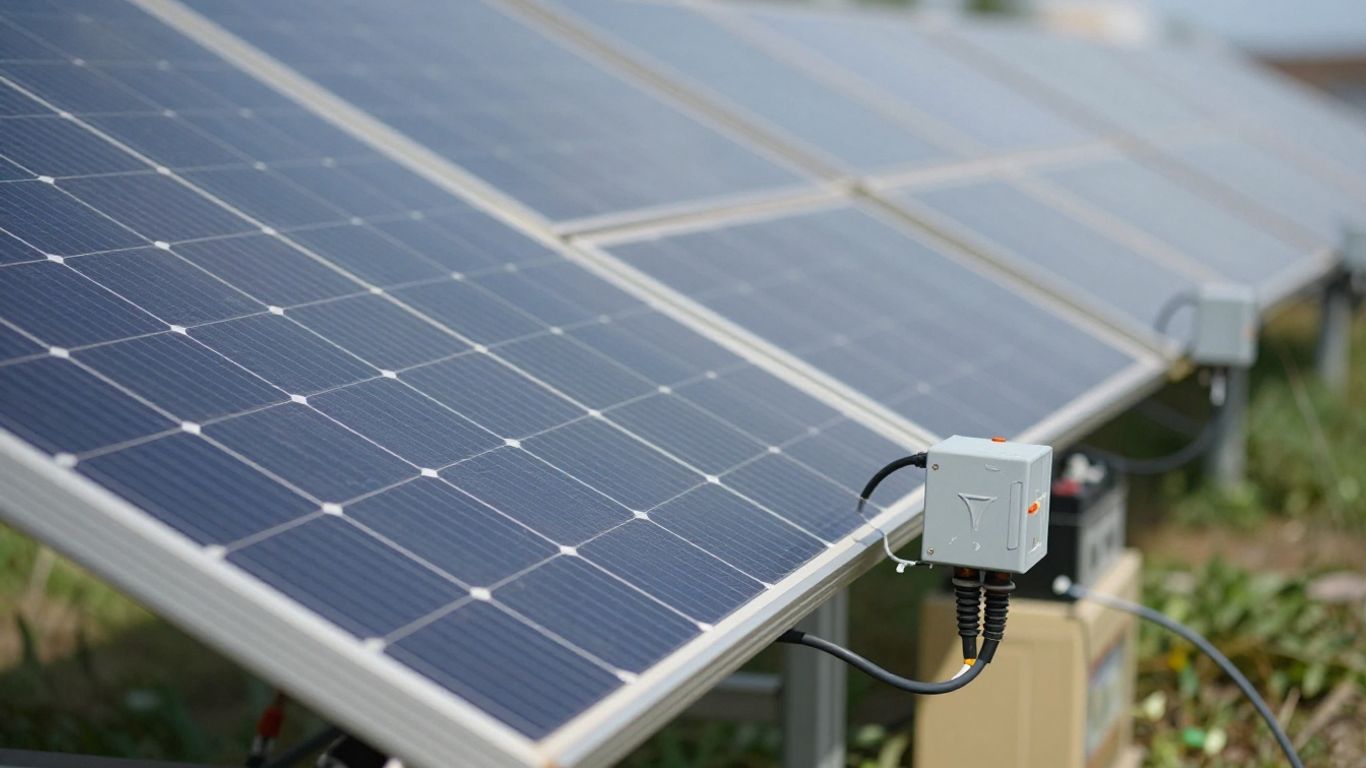
An MPPT (Maximum Power Point Tracking) charge controller is a key component for getting the most out of your solar installation, especially when you’re looking to optimize the charging time of your 12V 200Ah battery. Unlike simpler PWM controllers, MPPT actively adjusts the voltage and current coming from your solar panels to ensure they are always operating at their maximum power point. This means that regardless of sunlight conditions or temperature, the controller constantly seeks to extract the maximum possible energy from your panels. This dynamic adaptation capability is what allows for faster and more efficient charging of your battery.
Impact of Weather Conditions on Charging
Weather conditions play a major role in your solar panels’ energy production. Cloudy skies, morning fog, or late afternoon see your panels’ power output decrease significantly. A PWM controller, which works somewhat like a switch, will struggle to manage these fluctuations and will be less efficient. An MPPT, on the other hand, is designed to handle these variations. It can continue to extract energy even when sunlight is weak, by adjusting its strategy to keep the power output as high as possible. This results in more consistent charging of your battery, even in less favorable weather. For example, on a partly cloudy day, a system with an MPPT controller can produce up to 30% more energy compared to a PWM system [fc95].
Improving Battery Lifespan
Optimizing charging time isn’t just about how quickly your battery gets full, but also about how it’s charged. MPPT controllers, by more finely managing current and voltage, help prevent overcharging and excessive deep discharges, which are the main enemies of battery lifespan. They keep the battery within a healthier charging range, which can extend its longevity. Furthermore, by maximizing the amount of stored energy, you reduce the need for frequent charging cycles, which is also beneficial for the long-term health of your 12V 200Ah battery.
Here are some key points to remember:
- Increased Efficiency: MPPT can increase the overall efficiency of your solar system, giving you more stored energy.
- Faster Charging: Thanks to its maximum power point tracking, the time needed to recharge your battery is reduced.
- Better Variation Management: It adapts better to changes in light and weather conditions.
- Battery Protection: More controlled charging contributes to a longer lifespan for your battery bank.
Controller Input Voltage and Output Current
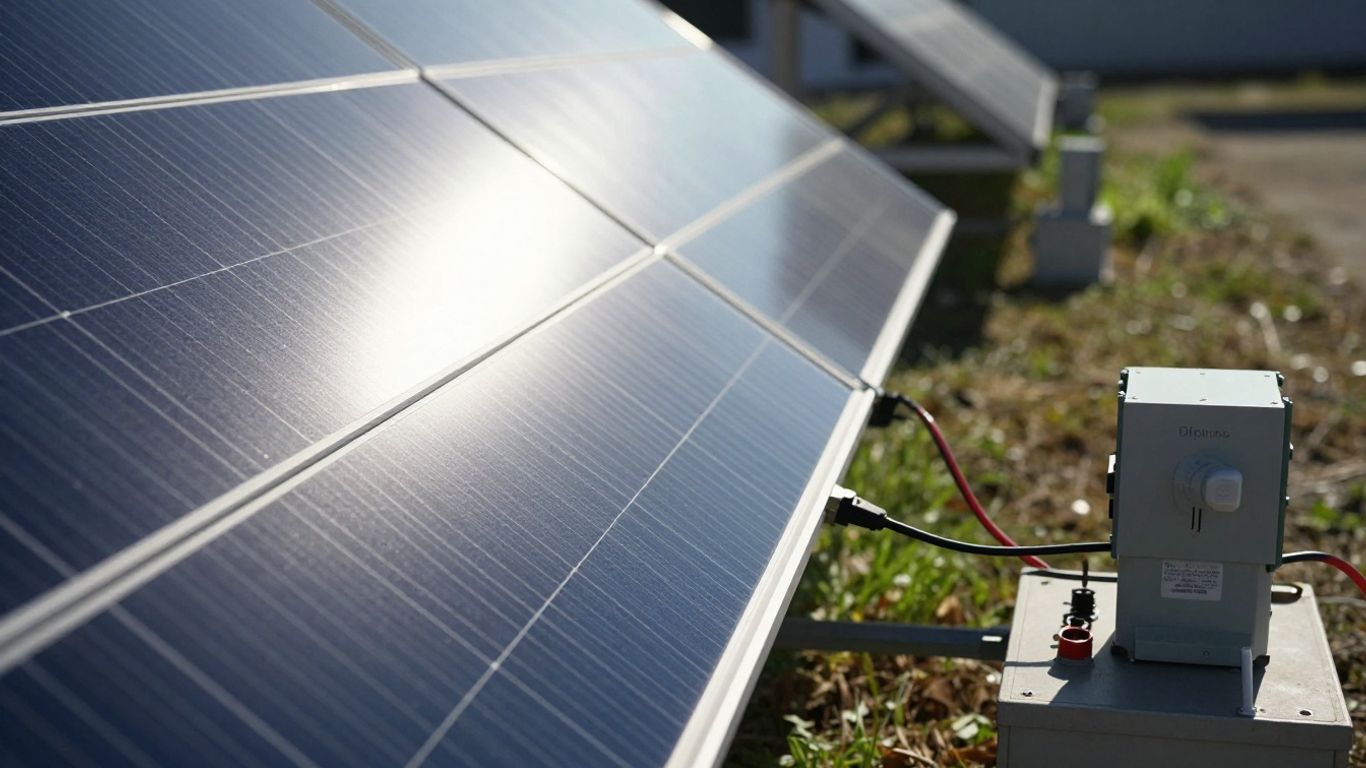
Once you’ve chosen your solar panel and controller, it’s time to look more closely at the controller’s technical specifications, particularly its input voltage and output current. These two parameters are essential for ensuring efficient and safe charging of your 12V 200Ah battery.
Understanding Panel Open-Circuit Voltage (Voc)
Open-circuit voltage, often abbreviated as Voc (Voltage Open Circuit), represents the maximum voltage a solar panel can produce when it’s not connected to anything, i.e., without a load. This value is indicated on your panel’s datasheet. If you connect multiple panels in series, you must add their respective open-circuit voltages to get the total solar array voltage. For example, if you have two panels with a Voc of 23V each and you connect them in series, the total voltage will be 46V. It is imperative that the maximum input voltage accepted by your controller is higher than this total voltage to prevent any damage. Solar panels typically output a voltage around 18V, but the open-circuit voltage can be higher, up to 23V or more for 12V panels [df4d].
Matching Controller Input Voltage
The choice of controller must therefore be made considering the maximum input voltage it can handle. If you’ve calculated a total voltage of 46V for your panels in series, you’ll need to choose a controller whose maximum input voltage is higher than this value, for example, 75V or 100V. This gives you a safety margin and allows for the possibility of adding more panels in the future without having to change the controller.
Checking Output Current for the Battery
The controller’s output current, measured in amperes (A), corresponds to the maximum current the controller can deliver to your battery. To calculate it, you can divide the total power of your solar panels (in Watts) by your battery’s charging voltage (which is generally around 14.4V for a 12V battery under charge). For example, for a 200W panel, the calculation would be: 200W / 14.4V ≈ 13.8A. You will therefore need to choose a controller capable of supplying at least this current. It is often recommended to choose a controller whose output current is slightly higher than your calculated need for better longevity and to account for real production conditions.
Here is a summary table to help you:
| Parameter | Description |
|---|---|
| Open-Circuit Voltage (Voc) | Maximum panel voltage without load. Add them up if panels are in series. |
| Controller Input Voltage | Must be higher than the total voltage of your panels (Voc added if in series). |
| Panel Power (W) | Total power of your solar installation. |
| Battery Voltage (V) | Nominal voltage of your battery bank (here, 12V). |
| Output Current (A) | Calculated by: Power (W) / Battery Voltage (V). The controller must be able to supply this current. |
It is important to note that the controller’s output voltage, once the charge is stabilized, will be close to the battery voltage, which is about 12V [2a80]. The controller acts as an intermediary, adapting the power and voltage from the panels for optimal charging of your battery bank.
In Summary: Which Controller to Choose for Your 12V 200Ah Battery?
To efficiently recharge your 12V 200Ah battery, the choice of charge controller is an important step. If your budget is limited and your solar installation is small, a PWM controller may suffice. However, to optimize energy production, especially in variable weather, and to ensure faster charging and better longevity for your battery, an MPPT controller is highly recommended. It represents a higher initial investment, but its efficiency gains and ability to handle higher voltages make it the preferred choice for most modern solar systems. Be sure to check the compatibility of voltages and currents between your solar panels, your battery, and the controller you choose.
Frequently Asked Questions
What is the main difference between an MPPT and a PWM controller?
Imagine a controller as a guardian for your battery. A PWM controller is a simple model that does the basic job: it ensures the solar panel voltage is suitable for your battery. It’s an economical option for small installations. An MPPT controller, on the other hand, is smarter. Thanks to advanced technology, it manages to recover more energy from your solar panels, especially when the sun isn’t at its best (e.g., when there are clouds). Therefore, it’s more efficient and allows your battery to charge faster and better.
How do I know what solar panel power to choose for my 12V 200Ah battery?
To choose your panel correctly, you need to consider two important things: voltage and current. Your panel’s voltage should be slightly higher than your battery’s (for example, for a 12V battery, a panel around 17-18V is often good). Then, the charging current should not be too high to avoid damaging your battery. A general rule is that the charging current should not exceed 15% of your battery’s capacity. For a 200Ah battery, this means a maximum current of about 30A. By multiplying voltage and current, you get the maximum power of your panel. It’s often advisable to aim slightly lower for added safety.
Why is an MPPT controller better for charging my battery?
The MPPT controller is an efficiency champion! It constantly seeks the best moment to capture maximum energy from your solar panels, even when conditions change (clouds, low sun). It converts this energy in a way that makes it perfect for charging your battery. The result: your battery fills up faster, and you better utilize all the energy your panels produce. It’s a bit like having a superhero who ensures nothing is wasted.
What is the maximum input voltage my MPPT controller can handle?
Each MPPT controller has a limit on the voltage it can accept as input, indicated by a number like ’75V’ or ‘100V’ on the controller. It is very important never to exceed this limit, as it could damage the controller. To determine the total voltage of your panels, you add the open-circuit voltage (Voc) of each panel if you connect them in series. You should always include a small safety margin (about 10%) to ensure you never exceed this limit, even under ideal conditions.
How is my battery’s charging time affected by the choice of controller?
Your controller choice has a big impact on charging time. An MPPT controller, thanks to its ability to capture more energy, will charge your battery much faster than a PWM controller, especially if the weather isn’t perfectly sunny. Basically, with an MPPT, you maximize the amount of energy sent to your battery, which reduces the time needed for it to be full. This is particularly useful if you rely on your battery for your power.
Can I connect multiple solar panels together to charge my 12V battery?
Absolutely! You can definitely connect multiple solar panels together, either in series (to increase voltage) or in parallel (to increase current). However, you must be very careful not to exceed the maximum voltage accepted by your MPPT controller. How you connect your panels (and your batteries, if you have multiple) must be carefully considered for the system to work correctly and safely. This is where the choice of controller and the type of wiring are crucial.