Choosing the right electrical power for your home or construction site is essential. It prevents unpleasant surprises like power outages, while keeping your expenses under control. It’s not just about looking at the power of your appliances, but also how and when you use them. We’ll explore together how to accurately assess your needs to subscribe to the most suitable power, without paying for unnecessary capacity.
Key Takeaways
- Understanding the difference between subscribed power (your contract) and connection power (network capacity) is the first step. Standard tiers for individuals generally range from 3 to 12 kVA, with 6 kVA for a standard home.
- It’s crucial to inventory all your appliances, note their power consumption, and estimate their simultaneous usage. Don’t forget to add a safety margin (around 15-20%) for unforeseen events or future changes.
- Electric heating has a major impact on the required power. You need to anticipate your needs, especially in winter, as it often represents the largest instantaneous consumption.
- Tools like wattmeters or connected apps (via your Linky meter, for example) help you measure your actual consumption and identify the most power-hungry appliances.
- Adapting your subscription to your real needs, adopting sensible consumption habits (off-peak hours, energy-efficient appliances), and anticipating new installations (electric vehicles, solar) are key to optimizing your power and reducing your bills.
Understanding the Basics of Electrical Sizing
Before diving into the precise calculation of the power you need, it’s important to grasp a few fundamental concepts. This will help you avoid costly mistakes and inconveniences, such as unexpected power outages.
Defining Subscribed Power and Connection Power
Subscribed power is the maximum electricity consumption threshold you have chosen with your provider. It is expressed in kilovolt-amperes (kVA) and directly influences the amount of your monthly subscription fee. If you exceed this power, your circuit breaker will trip, cutting off the power supply.
Connection power, on the other hand, represents the maximum capacity that the electrical grid can supply to your home or construction site. It is determined by the local infrastructure and approved by the grid operator (such as Enedis in France). Generally, the subscribed power cannot exceed the connection power.
Therefore, it is essential to choose your subscribed power wisely to avoid paying for capacity you don’t need, while ensuring you are not limited in your daily use.
Identifying Standard Power Tiers for Individuals
To simplify the choice, electricity providers offer standard power tiers. Here are the most common ones for individuals:
- 3 kVA: Often insufficient for a modern home, even a small one, especially if there’s some household appliances. High risk of outages.
- 6 kVA: This is the most common tier for a studio or a medium-sized apartment (1-2 bedrooms) without primary electric heating. It’s suitable if you manage the simultaneous use of your appliances well.
- 9 kVA: Recommended for detached houses, especially those equipped with electric heating, or for larger apartments with increased needs.
- 12 kVA and above: Necessary for very energy-intensive homes, installations with many power-hungry appliances (workshops, electric vehicles charged frequently), or professional sites.
Choosing the right tier is a balance between subscription cost and the flexibility of using your electrical equipment. A wrong choice can lead to extra costs or frustration.
Analyzing the Impact of Electric Heating on Required Power
Electric heating is one of the most significant consumption points in a home. An electric radiator, for example, can consume between 1000 and 2000 watts (or 1 to 2 kW) per unit. If you have several radiators running at the same time, especially during cold spells, the power demand can increase very rapidly.
Therefore, you need to consider the total power of all radiators that could be activated simultaneously. If your heating system is your primary heating method, you will likely need to opt for a higher subscription, such as 9 kVA, or even 12 kVA, to avoid outages. Also, think about other appliances running concurrently (water heater, oven, washing machine…). The total can quickly become substantial.
Methodology for Assessing Your Power Needs
To avoid ending up with an installation that trips constantly or, conversely, paying too much for an unnecessary subscription, you need to proceed step by step. This requires a bit of rigor, but it will save you a lot of trouble.
Inventory All Your Electrical Appliances
The first thing to do is to go around your home or construction site and note down absolutely everything that consumes electricity. Think about large appliances like the refrigerator, oven, washing machine, but also smaller ones: phone chargers, lamps, television, computer. For each appliance, note its rated power, usually indicated on a label. If you can’t find it, a quick internet search with the brand and model is often sufficient. It is essential to list all equipment likely to be used. For example, a refrigerator consumes about 80 W continuously, while a microwave can reach 900 W when in operation.
Estimate Simultaneous Equipment Usage
This is where it gets a bit more complicated, as we never use all our appliances at the same time. You need to think about what runs together. For instance, the refrigerator runs constantly, but the washing machine and dryer only run a few hours a week, and often not at the same time. Appliances with motors, like a vacuum cleaner or a concrete mixer, require more power at startup. You need to estimate the maximum power you might use at any given moment. For example, if you use your oven (2000 W) at the same time as your dishwasher (1500 W) and the lighting (100 W), you’ve already reached 3600 W. You also need to consider startup surges that can double the rated power of some appliances.
Apply a Safety Margin for Unforeseen Events
Once you have an idea of the maximum power used simultaneously, you need to add a safety margin. Why? Because your habits can change, you might buy new appliances, or simply because the electrical grid isn’t always perfect. A margin of 15 to 20% is generally recommended. This helps you avoid overloads and unexpected trips. For example, if your calculation results in 7000 W, adding 20% brings you to 8400 W. You will then need to choose the closest standard power tier, which would be 9 kVA (kilovolt-amperes) in this case, a unit often used for electrical subscriptions.
Accurate sizing of your electrical installation is key to optimal comfort and a controlled bill. Underestimation leads to frequent outages, while overestimation results in unnecessary subscription costs. It’s about finding the right balance by methodically analyzing your real needs and anticipating changes.
Here is a simplified table to help you visualize:
| Type of Use | Estimated Power (W) | Safety Margin (20%) | Total Power (W) | Recommended kVA Tier |
|---|---|---|---|---|
| Studio without electric heating | 2000 | 400 | 2400 | 3 kVA |
| Standard apartment (6 kVA) | 4500 | 900 | 5400 | 6 kVA |
| House with electric heating | 7000 | 1400 | 8400 | 9 kVA |
| Construction site (powerful tools) | 9000 | 1800 | 10800 | 12 kVA |
Practical Cases and Power Calculation Examples
To accurately understand your real needs, there’s nothing better than applying calculation principles concretely. Let’s see how this translates for different scenarios.
Sizing for a Studio or Small Apartment
In a small space like a studio, inventorying appliances is usually simpler. Let’s take the example of a 25 m² studio with the following equipment:
- Refrigerator: 100 W (continuous use)
- LED lighting: 20 W (frequent use)
- Television: 50 W (frequent use)
- Laptop: 60 W (frequent use)
- Microwave: 900 W (occasional use)
- Washing machine: 1500 W (occasional use)
- Auxiliary heater (if needed): 1000 W (occasional use)
Next, you need to estimate simultaneous usage. The refrigerator runs constantly. Lighting, TV, and computer can be used together. The microwave or washing machine are used alone, but rarely at the same time as the auxiliary heater.
For typical use, you could add the power of appliances frequently used together: 100 W (fridge) + 20 W (lighting) + 50 W (TV) + 60 W (computer) = 230 W. If you add the microwave, it goes up to 1130 W. If you use the washing machine, that’s an additional 1500 W. The auxiliary heater, if used, adds 1000 W.
It’s rare for all the most powerful appliances to be used at the same time. However, to ensure safety and avoid tripping the breaker, you need to plan for a margin. A subscribed power of 3 kVA (approximately 1500 W single-phase) is often sufficient for a studio, but if you plan to use the auxiliary heater at the same time as other appliances, it would be safer to aim for 4.5 kVA (approximately 2250 W).
Adaptation for a Detached House with Electric Heating
A detached house, especially if heated by electricity, has much higher needs. Heating often accounts for the largest portion of consumption.
Consider a house with:
- Electric heating: 4 radiators of 1500 W each (i.e., 6000 W if all are running).
- Domestic hot water: 2000 W water heater.
- Oven: 2500 W.
- Cooktop: 7000 W (maximum power, rarely used).
- Refrigerator: 150 W.
- Washing machine: 2000 W.
- Tumble dryer: 2500 W.
- Lighting, TV, computers, small appliances: let’s estimate an average of 1000 W.
Simultaneous usage is more critical here. If all four radiators are running at full power (6000 W), the water heater kicks in (2000 W), and you use the oven (2500 W), you’ve already reached 10,500 W. Therefore, it’s essential not to run all energy-intensive appliances at the same time.
For a house with electric heating, a subscribed power of 9 kVA (approximately 4500 W) is a minimum, but 12 kVA (approximately 6000 W) or even 15 kVA (approximately 7500 W) is often necessary for optimal comfort, especially in winter. You need to think about the formula P = V × I to understand how voltage and current influence the total available power [4d54].
Specific Needs for Construction Site Tools
Construction sites, whether professional or for major personal projects, often require higher power than a standard home. Tools like grinders, circular saws, concrete mixers, or compressors have startup power surges that can be double their rated power.
Let’s take an example for a construction site with:
- Concrete mixer: 1200 W (startup surge: 2400 W).
- Circular saw: 1500 W (startup surge: 3000 W).
- Hammer drill: 800 W (startup surge: 1600 W).
- Site lighting: 500 W.
- Various small tools: 1000 W.
If you use the concrete mixer and the circular saw simultaneously, you must consider their startup surges. 2400 W + 3000 W = 5400 W, to which other appliances are added. Therefore, you need to plan for a power much higher than the sum of the rated powers. For this type of use, it is common to use generators whose power is specifically adapted to the site’s needs. A power of 10 kVA (approximately 5000 W) can be a starting point, but it often needs to be increased to 15 kVA (7500 W) or more, depending on the number and power of tools used simultaneously. It is always recommended to consult a professional for the precise sizing of a construction site installation to avoid any risk of overload or failure [4d54].
Estimating the required power should not be a simple addition. It involves a detailed analysis of usage, consumption peaks, and a safety margin to ensure the reliability of your electrical installation, whether at home or on a construction site.
Tools and Technologies for Precise Monitoring
To effectively manage your electricity consumption and ensure that your subscribed power matches your actual needs, it’s essential to equip yourself with the right tools. Fortunately, technology offers increasingly accessible solutions for monitoring your energy usage.
Using a Wattmeter to Measure Instantaneous Consumption
A wattmeter is a simple and effective device for determining the consumption of a specific appliance. It plugs in between the wall socket and the appliance you want to measure. It shows you in real-time the instantaneous power consumed (in Watts) as well as the cumulative consumption over a given period. It’s an excellent way to identify the most energy-hungry appliances in your home, those that consume even in standby mode, or to verify if an installation is respecting your meter’s limits.
Leveraging Connected Apps and Smart Meters
Communicating meters, like Linky in France, pave the way for more advanced energy monitoring. Paired with mobile apps or your electricity provider’s online customer portals, they allow you to view your consumption and power data, often hour by hour, or even minute by minute. These platforms provide a comprehensive view of your usage and can even alert you to power overages. Some solutions, like smart home assistants, go further by analyzing your habits to suggest adjustments.
Understanding the Difference Between Active and Apparent Power
In the field of electricity, it’s useful to distinguish between two concepts: active (or real) power and apparent power. Active power, measured in Watts (W), is what produces useful work (light, heat, motion). Apparent power, measured in Volt-amperes (VA), represents the total power that the electrical circuit must supply, including active power and reactive power (necessary for the operation of certain devices like motors or transformers). Your electricity subscription is expressed in kVA (kilovolt-amperes), which corresponds to the maximum apparent power your installation can deliver. Understanding this distinction helps you better interpret your meter readings and correctly size your installation, especially if you use industrial equipment or motors.
Regular monitoring of your electricity consumption, using tools like a wattmeter or connected apps, is key to identifying significant energy expenditure areas and adjusting your subscription. This allows you to avoid overspending due to excessive power or the inconvenience of outages due to insufficient power.
Optimizing Your Electrical Power to Reduce Costs
Once you have a good idea of the power you actually need, it’s time to look at how you can adjust your contract to save money. It’s a bit like owning a car: there’s no point paying for a V8 engine if you only drive in the city. Your electricity contract is the same.
Adjust Your Subscription Based on Your Real Needs
The first thing to do is look at your bill. You’ll find your subscribed power there, usually expressed in kVA. This number determines the amount of electricity your installation can supply simultaneously. If this number is too high for your usage, you’re paying a higher fixed monthly amount for nothing. Conversely, if you trip the breaker often, your power is too low, and you need to increase it, but that’s not the topic here.
How to know if your power is too high?
- Monitor your consumption peaks. If you use tools like a wattmeter or your smart meter’s apps (like Linky), check the times when you consume the most. If these peaks are well below the power you’ve subscribed to, that’s a sign.
- Assess your equipment. Do you have many very energy-intensive appliances? If not, and you don’t plan to add new ones that consume a lot, your current power might be oversized.
- Consider the history. If you’ve never had a breaker trip and your equipment hasn’t changed in years, chances are your subscription is higher than necessary.
Here’s a quick guide to help you see more clearly:
| Subscribed Power (kVA) | Typical Use | Risks if too high | Risks if too low |
|---|---|---|---|
| 3 | Small dwelling without electric heating | Unnecessary cost | Frequent outages |
| 6 | Studio / Standard apartment (managed use) | Unnecessary cost | Outages with intensive use |
| 9 | House with electric heating or light construction site | Unnecessary cost | Outages with intensive use |
| 12+ | Energy-intensive house, professional site | Unnecessary cost | Frequent outages |
If you find that your power is too high, simply contact your electricity provider. The change is usually simple and can be done remotely. Reducing your subscribed power can save you several tens of euros per year on the fixed part of your bill.
Adopt Sensible Consumption Habits
Beyond the technical aspect of subscribed power, your way of using electricity has a direct impact on your bill. This is where simple actions make a big difference.
- Take advantage of off-peak hours. If your contract allows, schedule your most power-hungry appliances (washing machine, dishwasher, water heater) to run during off-peak hours. The price difference can be significant.
- Eliminate standby power. Many appliances continue to consume electricity even when turned off, simply in standby mode. Remember to turn them off completely or use power strips with switches to cut the power.
- Prioritize energy-efficient appliances. When buying new appliances, pay close attention to their energy label. An A+++ rated appliance will consume much less than an equivalent A or B rated appliance, and this will be reflected in your bill in the long run.
The hidden consumption of appliances on standby can represent up to 10% of your annual bill. Completely turning off unused appliances, especially at night, is a simple but effective way to reduce your expenses.
Anticipate the Impact of New Installations (Electric Vehicles, Solar)
The world is evolving, and so are your electrical needs. The arrival of an electric vehicle at home or the installation of solar panels changes the game.
- Electric vehicle: Charging an electric car requires significant power. If you charge your vehicle every day, you may need to increase your subscribed power to avoid outages, especially if you use other appliances at the same time.
- Solar panels: If you produce your own electricity, you can potentially reduce your overall consumption drawn from the grid. This may allow you to lower your subscription. However, you need to properly size your installation to match your actual needs and storage capacity.
It is therefore important to simulate your new needs before making these investments. Good planning will allow you to optimize both your comfort and your budget.
What Can Be Powered by a 300W Solar Panel?
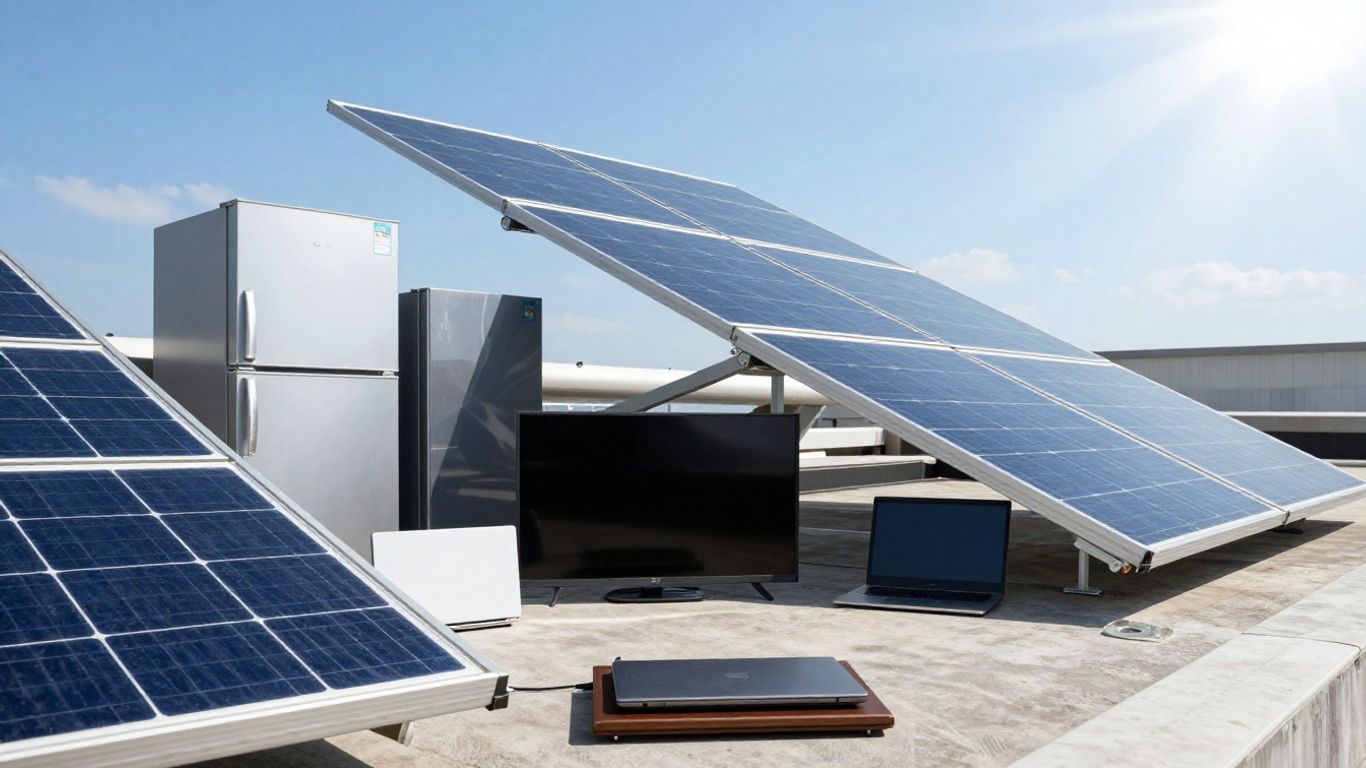
Are you wondering what you can power with a 300-watt solar panel? That’s an excellent question, especially if you’re considering a small installation for your second home, RV, or simply to test self-consumption. A 300W panel, while modest, can already power some everyday appliances, provided you understand its limitations and optimize its use.
Estimating the Consumption of Common Appliances
To know what a 300W panel can power, you first need an idea of the consumption of the appliances you use. The power of an appliance, expressed in watts (W), gives you an indication of the energy it requires when in operation. Here are some typical examples:
- LED lighting: Around 5 to 15 W per bulb.
- Phone charger: Generally between 5 and 20 W.
- Laptop: Between 30 and 70 W, depending on usage.
- Television (LED): From 30 W for small models to 100 W for larger ones.
- Refrigerator (A++ class): Around 80 to 150 W when running (but it doesn’t run continuously).
- Fan: From 30 to 70 W.
- Coffee maker / Kettle: Very energy-intensive, they can exceed 1000 W, but operate for short durations.
It’s important to note that the power indicated on an appliance is often its *maximum* consumption. Furthermore, some appliances, like refrigerators, have intermittent consumption.
Calculating Autonomy with a 300W Solar Panel
A 300W solar panel does not produce 300W continuously. Its production depends on sunlight, orientation, tilt, and temperature. Under ideal conditions, it can produce about 300W. However, you also need to consider battery storage capacity if you want to use the energy when the sun isn’t shining.
To estimate autonomy, you can do a simple calculation: Panel Power (in W) x Sunlight Duration (in hours) = Total Energy Production (in Wh or kWh). This energy must then cover the consumption of your appliances.
For example, if your panel produces an average of 200W for 5 hours during the day, you have 1000 Wh (or 1 kWh) of usable energy. If you have a laptop that consumes 50W, you could use it for 20 hours (1000 Wh / 50 W = 20h), provided this energy is stored or consumed during production hours.
It is essential to distinguish between instantaneous power (in Watts) and energy produced over a period (in Watt-hours). An appliance may require a lot of power, but for a short duration, while another requires less, but over a longer period.
Examples of Appliances Powered by a 300W Panel
With a 300W solar panel, coupled with a battery of sufficient capacity (e.g., 100 Ah, or about 1200 Wh for a 12V system), here’s what you could reasonably power:
- Moderate daily use: You could power the LED lighting in your space, charge your phones and tablets, use a laptop for several hours, and run a small television. This is ideal for camping or a small studio.
- Low-consumption appliances: Powering small devices like radios, water pumps, or fans is entirely feasible.
- Occasional tools: Cordless garden tools or small portable power tools could be recharged, but intensive use could quickly deplete the battery.
You need to be realistic: a 300W panel will not be enough to power very energy-intensive appliances like an electric heater, an oven, or a cooktop for an extended period. For that, a much larger installation would be required.
Managing Your Electricity Consumption: A Wise Investment
In summary, accurately assessing the electrical power needed for your home or construction site is an essential step. It not only helps you avoid inconveniences like power outages but also allows you to save money on your electricity bill. By taking the time to inventory your appliances, estimate their simultaneous usage, and apply a safety margin, you ensure a suitable and efficient electrical installation. Don’t hesitate to use available tools and, if in doubt, consult a professional for precise sizing. Good management of your electrical power contributes to lasting comfort and more responsible energy use.
Frequently Asked Questions
How do I know if I need to change my electrical meter’s power rating?
If your installation trips frequently when you use multiple appliances at the same time, or if you’ve bought new appliances like electric heaters or tools for a construction site, it’s time to check. Try to note when the outages occur and talk to your electricity provider to see if you need to change your subscription power. Using a power consumption meter can help you see if you’re frequently exceeding the limit.
Can I calculate the ideal power for my home myself?
Yes, you can definitely estimate the power you need. To do this, make a list of all the appliances you use at the same time (like heating, washing machine, TV, computer). Add up the power of each of these appliances. Don’t forget to add a small safety margin, about 10% to 20%, to be sure you won’t be caught off guard. If your situation is complex, such as for a business or a construction site, it’s wiser to seek professional advice.
What is the difference between active power and apparent power?
Active power, measured in watts (W), is the energy your appliances actually use to function. Apparent power, in volt-amperes (VA), accounts for all the energy that arrives from the grid, including energy that is not directly used. For your bill and choosing the right power, active power is what matters most. However, you still need to pay attention to apparent power to avoid overloading cables or your generator.
When using a generator, do I need to pay special attention to anything for power calculation?
Absolutely. It’s very important to accurately calculate the power of your generator. You need to consider the total power of all the appliances you will plug in, and remember that some appliances require much more energy when they start up. There are specific guides to help you avoid mistakes and choose the right power so that everything works properly and safely.
Are there digital tools to help choose my power and pay less?
Yes, there are applications and software that can help you. They analyze how you typically consume electricity, predict if you will consume more at certain times of the year, and suggest the most suitable power for your subscription. These tools often use information from your smart meter (like Linky) and are offered by energy providers or specialized companies.
How do I choose the right power for a construction site?
For a construction site, you need to be particularly careful. You will be using tools that consume a lot of energy, such as concrete mixers or electric saws. Therefore, you need to add up the power of all the tools you plan to use simultaneously, and add a significant safety margin. If you have any doubts, it’s best to ask an electrician for advice to ensure you don’t encounter any problems.