To help you see more clearly when choosing your solar panel for a 12V 200Ah battery, here are the essential points to remember.
Key Points to Remember
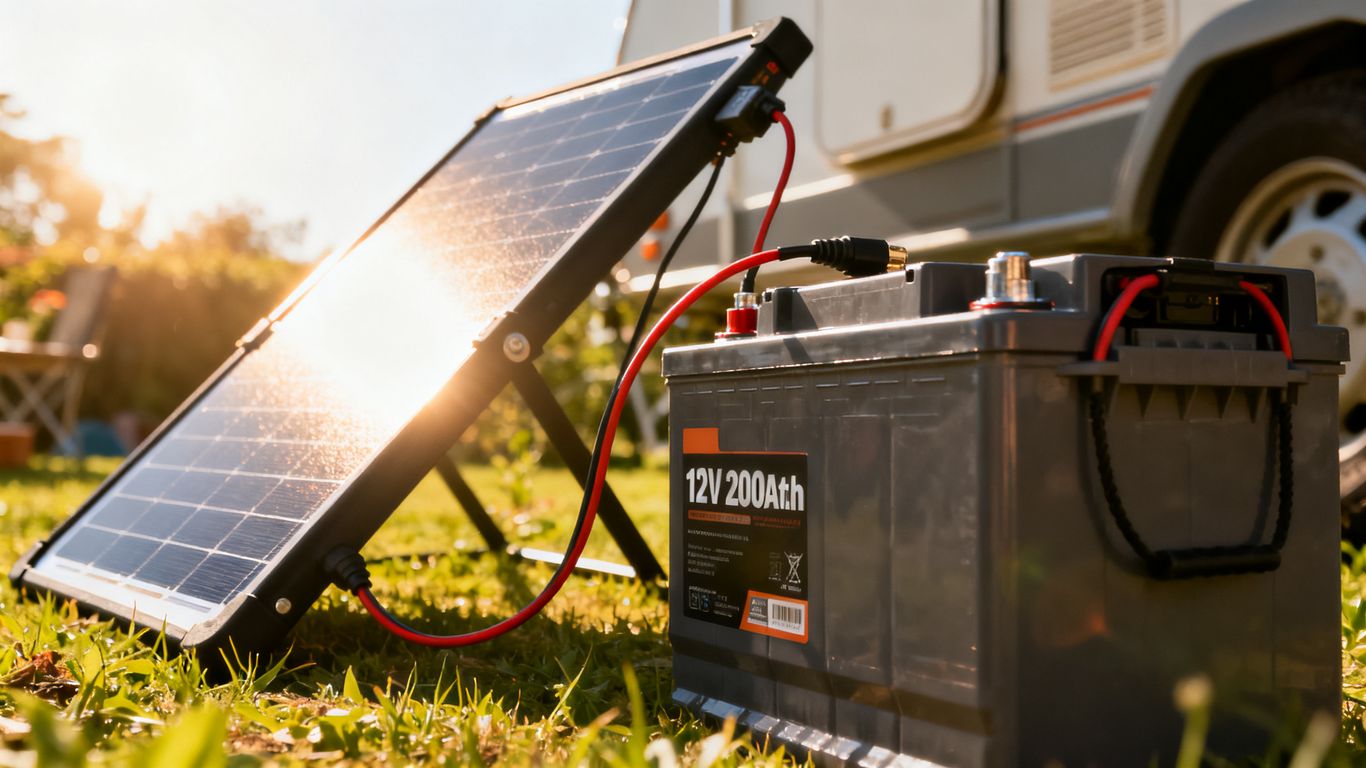
- A 12V 200Ah battery has a total capacity of 2400 Wh.
- Calculate the necessary power by considering sunlight hours and losses (around 20-30%).
- A 600W panel is often recommended for a full recharge in one day, but this can be adjusted based on your consumption.
- Orientation, tilt, and the type of charge controller (MPPT is more efficient) greatly influence performance.
- Consider the depth of discharge to preserve your battery’s lifespan, especially for lead-acid batteries.
Understanding Energy Needs for a 12V 200Ah Battery
Before you start buying a solar panel, it’s essential to clearly understand your energy needs. A 12V 200Ah battery has a storage capacity of 2400Wh (12V x 200Ah). However, this raw figure doesn’t tell the whole story about how you’ll use and recharge it.
Calculating the Battery’s Total Capacity in Watt-hours
For a 12V 200Ah battery, the total capacity is 2400Wh. This is the maximum amount of energy it can store. It’s helpful to visualize this: a 50Ah battery stores 600Wh, a 100Ah battery stores 1200Wh, and yours, at 200Ah, reaches 2400Wh. This figure is your starting point for estimating how long your devices can run and what solar panel power will be needed to recharge it.
Identifying Factors Influencing Actual Consumption
Your actual consumption won’t always equal the battery’s theoretical capacity. Several elements come into play. Think about all the devices you plan to connect: a 12V refrigerator, LED lights, a laptop, a phone, a water pump… Each has its own consumption, expressed in Watts. You also need to consider the usage time for each device. A fridge consumes little continuously, but an electric coffee maker can demand a lot of power for a few minutes. Therefore, you need to make a list of your equipment and estimate their daily usage to get a more precise idea of your real energy needs. It’s a bit like grocery shopping: you need to know what you’re going to cook before buying the ingredients.
Determining the Impact of Depth of Discharge on Lifespan
Depth of Discharge (DoD) is a key factor for your battery’s longevity. Discharging a battery to 100% of its capacity each time will significantly reduce its lifespan. For lead-acid batteries (AGM or gel), it’s advisable not to go below 50% of their capacity. This means that out of your 200Ah, you’ll practically only use 100Ah to preserve the battery. Lithium batteries are more tolerant, often allowing up to 80% discharge (i.e., 160Ah for a 200Ah battery). Ignoring this point is like constantly running on reserve: it eventually wears out the engine faster. Choosing the right type of battery and respecting these limits is therefore an important step for a sustainable investment. If you’re looking for solutions for your setup, global mobility solutions can sometimes inspire similar approaches for resource management.
Sizing the Necessary Solar Panel Power
Now that you have an idea of your energy needs, it’s time to move on to the next step: determining your solar panel’s power. This is a step where you shouldn’t make a mistake, because an undersized panel will never charge your 12V 200Ah battery correctly, and an oversized panel represents an unnecessary investment.
Estimating Effective Sunlight Hours
The amount of energy your solar panel can produce depends directly on the amount of sunlight it receives. It’s not simply about the number of daylight hours, but rather the *effective sunlight hours*. These hours correspond to the time when the sun is high enough and intense enough to generate significant energy production. This varies greatly depending on your geographical location, the season, and even the local weather. For example, a sunny summer day in the south of France will not have the same potential as a winter day in the north.
To get a realistic estimate, you can consult sunlight maps specific to your region or use online tools that provide this data. Don’t forget that even on cloudy days, a solar panel continues to produce electricity, but at a reduced level. It is therefore wise to consider an average, taking into account less favorable days.
Applying the Required Power Calculation Formula
To calculate the required power of your solar panel, you need to consider several elements. The basic formula is: Panel Power (W) = (Battery Capacity (Ah) × Battery Voltage (V)) / Effective Sunlight Hours × Loss Factor.
For a 12V 200Ah battery, this represents a total capacity of 2400 Wh (12V * 200Ah). If we estimate, for example, 4 hours of effective sunlight per day and apply a loss factor of 0.7 (to account for system inefficiencies, temperature, etc.), the calculation would be: (2400 Wh) / (4 hours) / 0.7 ≈ 857W. This figure is a rough indication. It is often recommended to slightly oversize to ensure a full charge, especially if you have significant energy needs or if you are in a region with less generous sunlight. A common rule of thumb suggests a solar panel of about 1.5 to 2 times the battery’s Ah capacity in watts for lead-acid batteries, which would give between 300W and 400W for a 200Ah battery. For LiFePO4 batteries, a ratio of 1 to 1.5 times is often sufficient, i.e., 200W to 300W. It is therefore important to choose wisely based on your battery’s chemistry, as we will see later.
Adjusting Power Based on Usage and Desired Charging Time
The previous calculation gives you a baseline, but it needs to be adjusted. If you use your system intensively and need your battery to be recharged quickly every day, you’ll need to opt for higher panel power. Conversely, if your consumption is moderate and you can afford a longer charging time, a lower-power panel may suffice. For example, for a 12V 200Ah battery:
- Fast Recharge (Full Daily Need): A 400W to 600W panel may be necessary, especially if sunlight is not optimal.
- Slow Recharge (Maintenance or Low Consumption): A 200W to 300W panel may be sufficient to maintain the charge or compensate for a small daily discharge.
It is also relevant to consider adding portable panels for increased flexibility, allowing you to orient them optimally when you are parked. Think about how you will use your system daily to make the right choice. A good starting point for a 200Ah battery is often a 300W panel, but this can vary. For faster charging, a 600W panel is an option to consider, as suggested by some recommendations for large capacity batteries.
It is essential not to underestimate efficiency losses. Between ambient temperature affecting panel performance, losses in cables, and charge controller efficiency, the actual power produced is always less than the panel’s rated power. Planning for a safety margin is therefore a prudent approach.
Taking into Account System Losses and Efficiency
Even with the best solar panel and the most efficient battery, your system will never operate at 100% of its theoretical potential. It’s important to understand and quantify these losses to correctly size your installation. Ignoring these factors can lead to an underestimation of the required power, and therefore insufficient charging of your 12V 200Ah battery.
Assessing Losses Related to the Charge Controller
The charge controller plays an essential role in protecting your battery from overcharging and deep discharge. However, this component is not perfect and causes some energy loss during conversion. PWM (Pulse Width Modulation) controllers are generally less efficient than MPPT (Maximum Power Point Tracking) controllers. A PWM controller can cause a loss of about 10 to 20%, while an MPPT controller, although more expensive, optimizes energy production and minimizes these losses, often below 5%.
Quantifying Losses Due to Cables and Shading
The length and gauge of the cables used to connect your solar panels to your charge controller and battery have a direct impact on efficiency. Cables that are too thin or too long create electrical resistance, dissipating some of the energy as heat. Similarly, even partial shading on a panel can drastically reduce its production. It is therefore crucial to choose cables of adequate gauge and to avoid any source of shading, even temporary, as much as possible. Good installation planning is key to minimizing these drawbacks.
Considering the Intrinsic Efficiency of Solar Panels
Beyond system-related losses, the solar panel itself has an efficiency that is never 100%. Datasheets often indicate a nominal power measured under ideal conditions (STC – Standard Test Conditions). In reality, factors such as ambient temperature, the angle of sunlight incidence, and panel soiling can reduce this power. It is common to estimate an overall system loss, including all these inefficiencies, between 20% and 30%. To compensate for these losses, it is recommended to increase the calculated power of your solar panel by about 25%. For example, if your initial calculations indicate that a 200W panel is needed, it would be more prudent to opt for a panel of around 250W to ensure adequate charging.
It is essential not to overlook these losses. They may seem minor individually, but their cumulative effect can significantly impact the overall performance of your solar charging system. A realistic sizing approach, taking these factors into account, will ensure better autonomy and greater reliability for your installation.
Concrete Examples of Solar Panel Configurations
Now that you have a better idea of your battery’s needs and the theoretical power required, let’s look at some practical examples. These scenarios will help you visualize what you could achieve with different solar panel sizes.
Daily Recharge Scenario with a 600W Panel
For a 12V 200Ah battery, which represents a total capacity of 2400 Wh (12V * 200Ah), a 600W solar panel can offer a fairly rapid recharge, especially if you benefit from good sunlight conditions. In an ideal scenario with about 5 hours of effective sunlight per day, a 600W panel could potentially produce up to 3000 Wh (600W * 5h). This would not only fully recharge your battery but also compensate for part of your daily consumption. It is important to note that this power is an estimate and that real-world conditions, such as shading or temperature, can affect production. For larger systems, combining several 300W or 400W panels can be a flexible approach.
Adaptation for Slower Charging with a 300W Panel
If you don’t need such a fast recharge or if your consumption is more moderate, a 300W panel may suffice. With 5 hours of sunlight, this panel would produce about 1500 Wh. This means it wouldn’t fully recharge your 200Ah battery in a single day, but it would contribute significantly to keeping it charged, especially if you use your system intermittently or have lower energy needs. This is a more economical and easier-to-install option for many uses, such as camping setups or small solar systems.
Power Examples for Different Battery Capacities (50Ah, 100Ah, 200Ah)
The choice of solar panel power depends directly on your battery’s capacity. Here are some examples to guide you:
- 12V 50Ah Battery (600 Wh): For a full recharge in 5 hours of sunlight with an MPPT controller, a 150W panel is often recommended. If you use a PWM controller, you should aim for a 190W panel instead.
- 12V 100Ah Battery (1200 Wh): With an MPPT controller and 5 hours of sunlight, a 320W panel would be appropriate. For a PWM controller, you should count on about 400W.
- 12V 200Ah Battery (2400 Wh): As mentioned, for a fast recharge with an MPPT controller and 5 hours of sunlight, a 640W panel is a good reference. With a PWM controller, aim for around 800W.
It is always wise to plan for a safety margin, as real-world conditions are rarely ideal. Consider adding 20 to 30% extra capacity to account for losses and seasonal variations. Using an MPPT charge controller is generally more efficient, especially in variable weather.
Optimizing Your Solar Installation Performance
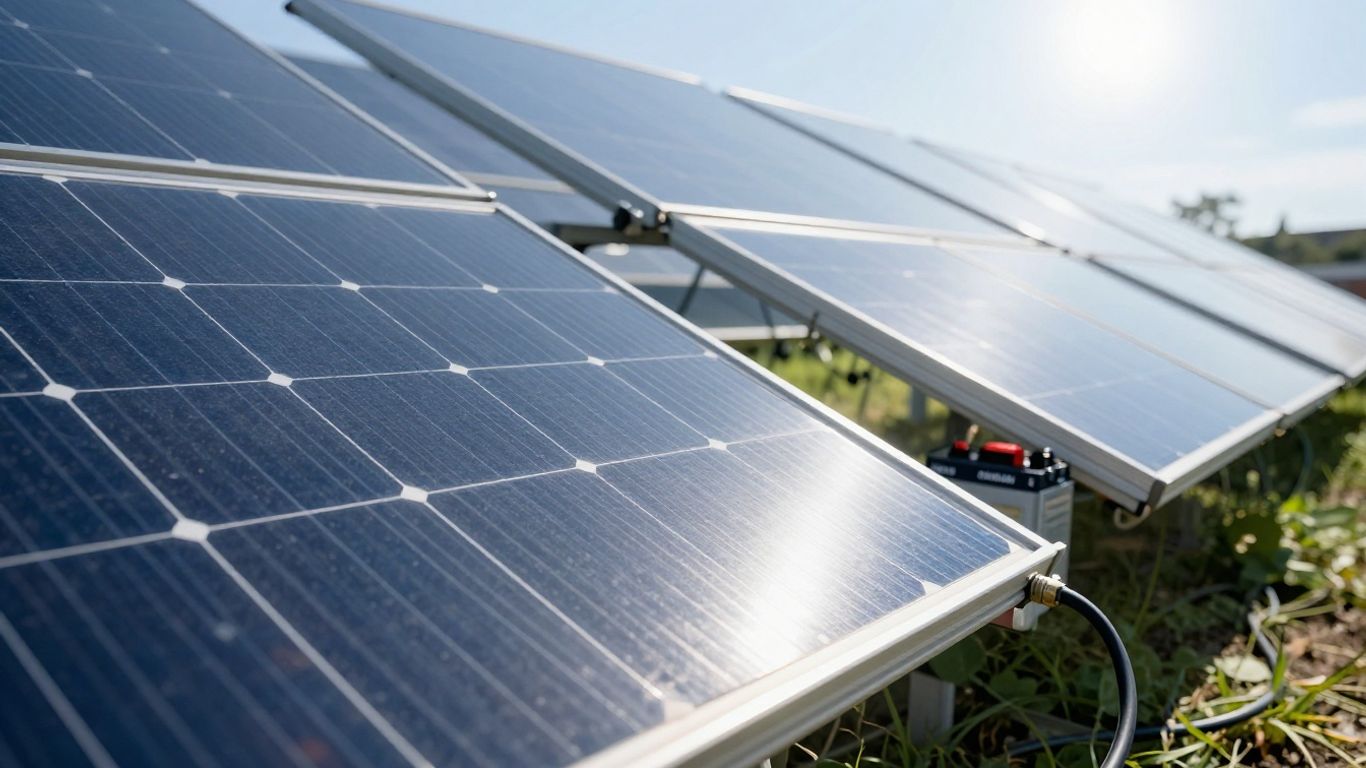
Once you’ve chosen your panels and battery, it’s time to think about how to get the most out of them. It’s not just a matter of plugging things in; there are tricks to make your system work best, especially when it comes to recharging a 12V 200Ah battery.
This might be the easiest point to adjust, but it has a huge impact. Think of it like aiming a flashlight: if you don’t point it directly at what you want to illuminate, it’s not very useful. For your solar panels, it’s the same. In the Northern Hemisphere, they should face south. If you’re in the Southern Hemisphere, they should face north. The tilt angle is also important. A good rule of thumb for year-round use is to set the tilt to about 80% of your latitude. For example, if you are at a latitude of 40°, a tilt of 32° is a good starting point. Of course, if you want to maximize charging in winter, you could increase this angle (latitude + 15°), and decrease it in summer (latitude – 15°) to avoid overheating. Shade is enemy number one. Even a small partial shadow on one panel can significantly reduce the production of the entire series of panels, sometimes by 30-50%. Therefore, you really need to pay attention to anything that might cast a shadow on your panels, whether it’s trees, buildings, or even antennas.
The charge controller is a bit like the conductor of your system. It protects your battery from overcharging and deep discharge, and it ensures that the energy from the panel is used optimally. There are two main types: PWM and MPPT.
- PWM (Pulse Width Modulation): This is the simplest and cheapest technology. It works well when the panel’s voltage is very close to the battery’s voltage. It’s a bit like the controller rapidly connecting and disconnecting the panel to maintain the battery voltage. It’s effective in ideal conditions, but can be less performant when the weather changes or when the panel’s voltage is much higher than the battery’s.
- MPPT (Maximum Power Point Tracking): This is the more advanced and expensive technology. An MPPT controller can find the maximum power point of your panel, even when conditions change. It can also convert a higher panel voltage to a lower voltage for the battery, while recovering lost energy. This is particularly useful if you have panels with a higher voltage than your battery, or if you are in a region with variable sunlight. For a 12V 200Ah battery, an MPPT controller is often recommended to maximize charging, especially if you are using panels over 200W. It can provide up to 30% more energy compared to a PWM in certain conditions. It is important to correctly size your charge controller so that it matches the total power of your panels and the voltage of your battery bank.
Sometimes, your fixed installation isn’t enough, or you need more energy occasionally. This is where portable solar panels come in. They are perfect for supplementing your system, especially if you travel or have varying energy needs. You can deploy them when you’re parked and easily store them when you move. They are often lighter and easier to handle than rigid panels. Even a small portable panel of 50W or 100W can make a difference in maintaining the charge of your 12V 200Ah battery during less sunny days or when you’re using power-hungry devices. It’s a practical solution for an auxiliary power source without having to modify your main installation. Think of it as a mobile extension of your solar system, ideal for RV adventures.
Weather conditions have a direct impact on your panels’ performance. Excessive heat, for example, can reduce their efficiency. It is therefore wise to ensure adequate ventilation around the panels and to consider maximum operating temperatures when sizing your system. In very hot climates, an MPPT controller can offer an additional advantage by better managing these temperature and voltage variations.
Choosing the Right Solar Panel for Your Battery Type
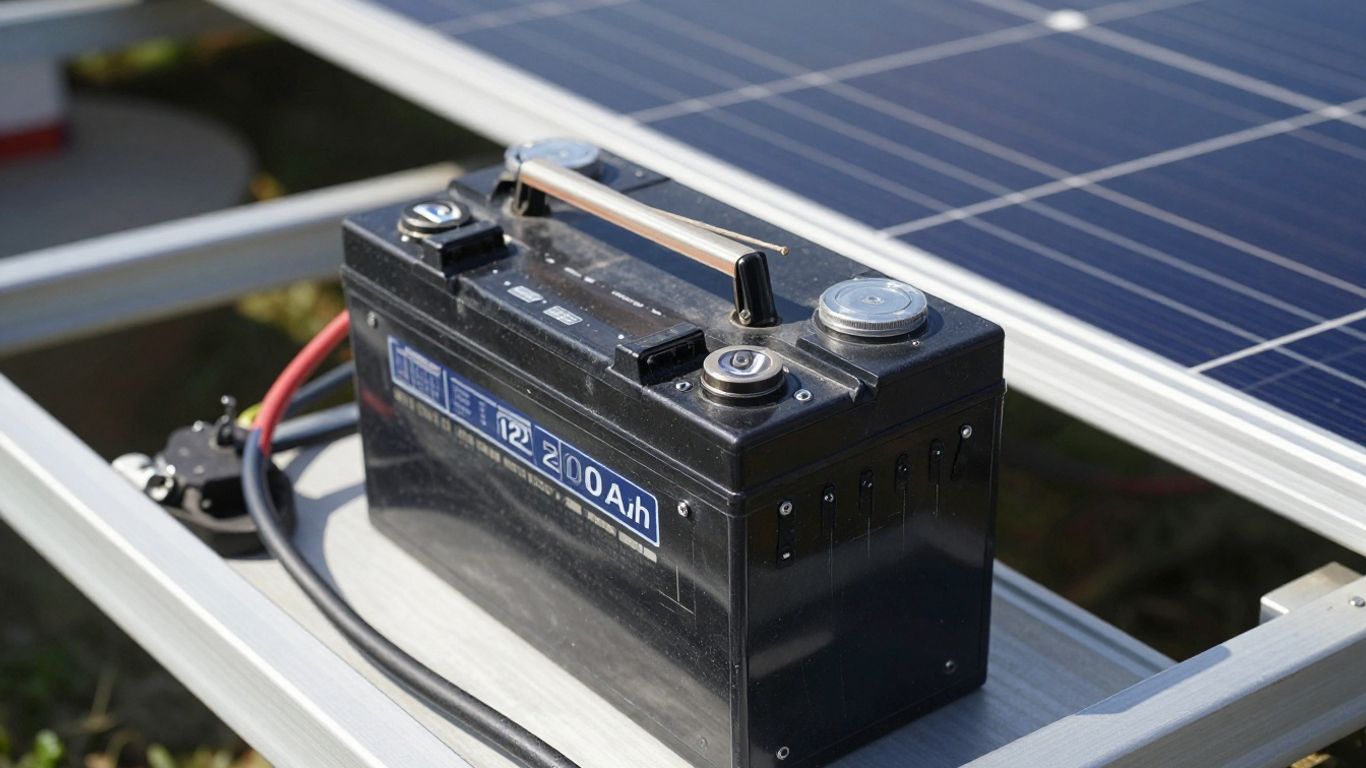
Charging Differences Between Lead-Acid, AGM, and Lithium Batteries
It’s important to understand that not all batteries charge the same way. Lead-acid batteries, whether conventional or AGM (Absorbent Glass Mat), have specific charging requirements. Lithium batteries, especially LiFePO4, are more tolerant but may require minimum charging currents to function properly. Ignoring these differences can lead to inefficient charging, or even damage your battery in the long run. For example, a lead-acid battery can accept a wider voltage range, while a lithium battery will prefer a more stable and constant charging current. Adapting the power and voltage of your solar panel to your battery’s needs is therefore a key step.
Compatibility Between Solar Panel and Charge Controller
The solar panel and the charge controller form an inseparable duo. A solar panel that is too powerful for a basic (PWM) controller may not be exploited to its full potential, or worse, could damage the controller. Conversely, an undersized panel will not efficiently recharge a battery, even with an excellent MPPT controller. It is therefore essential to ensure that the output power and voltage of your solar panels are compatible with your controller’s specifications. For a 200Ah battery, an MPPT controller is generally recommended to optimize charging, especially if you opt for lithium batteries.
Rules of Thumb for Sizing Based on Battery Chemistry
To help you see more clearly, here are some general rules for sizing your solar panel based on battery type:
- Lead-Acid Batteries (Flooded or AGM): Aim for a solar panel power between 1.5 and 2 times the battery’s nominal capacity in amp-hours (Ah). For example, for a 12V 200Ah battery, a 300W to 400W panel would be a good starting point.
- Lithium Batteries (LiFePO4): These batteries are more efficient. A solar panel power equivalent to the battery’s nominal capacity in amp-hours (Ah), or even 1.5 times, is often sufficient. For a 12V 200Ah battery, a 200W to 300W panel could be suitable, provided the charge controller is adapted.
It is always wise to consult your battery manufacturer’s specifications for their precise charging recommendations. Remember that these figures are guidelines; actual sunlight conditions and your energy consumption will influence the final size of your solar installation.
Conclusion
Choosing the right solar panel for your 12V 200Ah battery is not an exact science, but a matter of calculations and adjustments. By understanding your energy needs, estimating sunlight, and accounting for losses, you can determine the ideal power. Don’t forget that orientation, charge controller type, and even your battery’s chemistry play a role. For an optimal installation, don’t hesitate to consult professionals who can guide you to the most suitable solution for your specific situation. Good planning will ensure reliable and sustainable solar autonomy.
Frequently Asked Questions
What is the total capacity of a 12V 200Ah battery in watt-hours?
A 12-volt, 200-ampere-hour battery can store 2400 watt-hours. It’s like an energy tank that is 2400 Wh in size.
How many hours of sunlight per day should I count on to recharge my battery?
On average, we count about 4 to 6 hours of good sunlight per day in France. But this changes a lot depending on the season and the weather. It’s less in winter, more in summer.
Why do I need to add a margin for losses?
Because energy doesn’t travel perfectly! There are losses when electricity passes through cables, when the charge controller converts the current, and even when the panel isn’t perfectly exposed to the sun. We estimate these losses at about 20 to 30%.
Is a 300W panel enough for a 12V 200Ah battery?
A 300W panel will recharge your battery, but it will be slower. If you consume a lot each day, it might take several days to fill it completely. If your consumption is low, it might be okay.
What is the best type of charge controller?
The MPPT controller is generally better than the PWM. It’s smarter at finding the maximum energy the panel can provide, especially when the sun isn’t perfect. It’s a bit more expensive, but more efficient.
Should I completely discharge my battery before recharging it?
No, definitely not! For lead-acid batteries, it’s recommended not to go below 50% charge for them to last longer. Lithium batteries can go a bit lower, but you should still avoid draining them completely.