Key Takeaways
The choice of a panel for a 12V 200Ah battery depends on the energy to be restored, the discharge level, and solar conditions. A conservative estimate is better than a choice based solely on displayed power.
- A 12V 200Ah battery represents approximately 2,400 Wh theoretically.
- A lead-acid battery generally should not be discharged as deeply as a lithium battery.
- 300W may be sufficient for partial recharging, while 400W to 500W offer more leeway.
- The charge controller must be compatible with a 12V battery and its technology.
- Cables, fuses, orientation, and losses directly influence the result.
Understanding the Needs of a 12V 200Ah Battery
Before looking for which solar panel to use to recharge a 12V 200Ah battery, you need to translate the battery’s capacity into energy. This step allows you to compare solar production expressed in watts with a storage need expressed in watt-hours. The calculation is simple, but its interpretation depends heavily on the battery technology and its depth of discharge.
Calculating the Battery’s Actual Energy Capacity
A 12V 200Ah battery has a theoretical capacity of 12 x 200, or approximately 2,400 Wh or 2.4 kWh. This value gives an order of magnitude, but it does not mean that all this energy can be drawn and restored without consequence. Charging and discharging efficiency also reduces the actually available energy.
For initial sizing, you can therefore start with 2,400 Wh and then apply a margin for losses. This method is more reliable than a direct comparison between the battery’s 200Ah and the panel’s peak watts.
Distinguishing Theoretical Capacity from Usable Capacity
Usable capacity depends on the depth of discharge you accept. With a lead-acid, AGM, or gel battery, usage around half of the nominal capacity is often chosen to limit wear. A lithium battery can generally utilize a larger portion of its capacity, according to the manufacturer’s specifications.
Thus, a 12V 200Ah lead-acid battery can be considered to provide about 1,200 Wh of usable energy in a conservative estimate, while a lithium battery may offer more. This is a basis for calculation, not a universal value: always consult the datasheet of the installed model.
Estimating the Discharge Level Before Recharging
The required power will not be the same for a battery down to 80% charge and for a nearly empty battery. You need to estimate the missing energy, then add the losses from the panel, charge controller, and cables. Partial daily recharging is not sized the same way as a full top-up after several days without sun.
A simple audit of your usage may suffice: check the resting voltage, estimate recent consumption, and observe the available charging time. In a structured approach, Millennium Digital prioritizes data analysis before any recommendation; the same approach is relevant here, even for a small off-grid installation.
Considering the Battery Type: Lead-Acid, AGM, Gel, or Lithium
The battery type determines charging voltages, safety thresholds, and acceptable depth of discharge. A lithium battery, in particular, requires adapted settings and an integrated management system, while lead-acid batteries require different charging phases.
Therefore, do not choose the charge controller or panel based solely on the 200Ah capacity. The nominal voltage, recommended charging current, and operating temperature should also be included in your verification.
Determining Solar Panel Power
The panel’s power must be related to the energy to be put back into the battery, not just its nominal capacity. Peak watts correspond to test conditions; actual production varies with season, orientation, temperature, and shading. For a 12V 200Ah system, 300W, 400W, or 500W can be appropriate depending on usage.
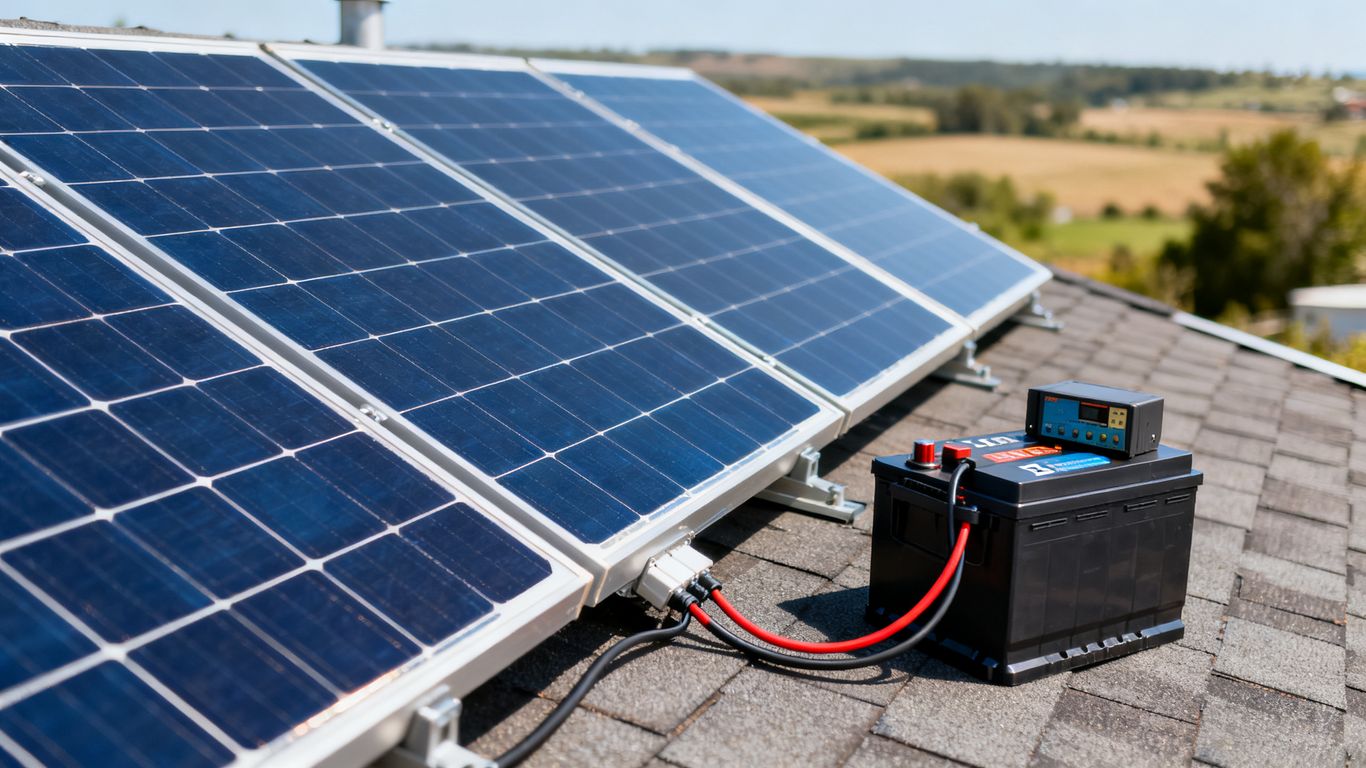
The guide dedicated to 12V 200Ah solar panels reminds us that peak power, nominal voltage, battery type, and charge controller must be considered together. Therefore, it is not enough to choose the highest number.
Relating Panel Power to Energy to be Restored
Suppose you need to restore 1,200 Wh to a partially discharged battery. In theory, a 300W panel would provide this energy in four hours at constant power. In reality, production varies and losses reduce the result; several useful solar hours will therefore be needed.
For a full recharge, the theoretical capacity of 2,400 Wh leads to higher power or several days of production. The right choice also depends on the consumption that continues during charging.
Estimating Solar Production Based on Sunshine
You can estimate daily energy with a simple formula: panel power x equivalent sun hours x overall efficiency. For example, 400W x 4 hours x 0.75 gives about 1,200 Wh per day. This value remains indicative and must be adjusted to the location, season, and installation.
A very sunny area in summer will not yield the same result as a shaded site in winter. Local data and production records are therefore preferable to a theoretical promise.
Comparing 300W, 400W, and 500W Configurations
These three levels provide an initial decision framework. The following table compares their benefits in an indicative scenario of four equivalent sun hours and 75% overall efficiency.
| Installed Power | Estimated Daily Energy | Generally Usable For |
|---|---|---|
| 300W | 900 Wh | Partial recharge and moderate consumption |
| 400W | 1,200 Wh | More regular recharging with adequate margin |
| 500W | 1,500 Wh | Loss compensation and variable light conditions |
These figures do not guarantee a full recharge every day. They rather show why 400W is often a reasonable compromise, while 500W provides a useful reserve when weather or season reduces production.
Understanding the Impact of Efficiency Losses
Losses come from the charge controller, cables, connectors, temperature, and conversion between the panel and the battery. A panel advertised at 500Wp will therefore not deliver 500W continuously. A margin must be maintained without blindly oversizing the entire system.
To delve deeper into the calculation logic, you can consult this solar sizing method, which relates power, cell efficiency, and weather conditions. In a data-driven approach, Millennium Digital also applies the principle of measuring assumptions rather than treating them as certainties.
Choosing the Right Charge Controller
The charge controller is placed between the panels and the battery. It controls the charging, limits unsuitable voltages, and must match the storage technology. A wrong choice can slow down charging, cause incomplete charging, or reduce the battery’s lifespan.
Comparing a PWM Charge Controller and an MPPT Charge Controller
A PWM charge controller is generally simpler and suitable for basic configurations where the panel voltage is close to the battery voltage. An MPPT charge controller more efficiently utilizes the available panel voltage, especially when the photovoltaic voltage is higher than that of the 12V system.
The choice depends on the voltage difference, installed power, and budget. For several hundred watts, MPPT is often considered first, but the exact specifications of the devices must be checked.
Verifying Compatibility with a 12V Battery
The charge controller must accept a 12V nominal voltage battery and offer a charging profile corresponding to its technology. Also check the maximum allowable voltage on the panel side, especially if multiple modules are connected in series.
Compatibility is not limited to the « 12V » label. Absorption, float, and cutoff voltages must be consistent with the battery documentation.
Sizing the Charge Controller’s Amperage
For a 500W system on a 12V system, the theoretical power corresponds to approximately 41.7A before accounting for losses. It is prudent to choose a charge controller whose nominal current exceeds this value, according to the manufacturer’s recommendations and the actual configuration.
For 300W, 400W, and 500W, this results in approximately 25A, 33A, and 42A at 12V, respectively. These values are for pre-sizing; the actual current delivered will depend on the charging voltage and solar production.
Setting Up Specific Adjustments for Each Battery Technology
A lead-acid, AGM, gel, or lithium battery is not set up the same way. Select the profile provided by the manufacturer and disable incompatible functions, especially those not suitable for certain lithium batteries.
Temperature, ventilation, and the presence of a battery management system must also be taken into account. If in doubt, the charge controller’s manual and the battery’s manual take precedence over generic settings found online.
Examining Practical Sizing Examples
The following examples help to place power levels in concrete scenarios. They remain intentionally indicative: simultaneous consumption, sunshine, and battery type can alter the result. For a reliable decision, you must start with the actual energy deficit.
Recharging a Partially Discharged Battery with a 300W Panel
If a 12V 200Ah lead-acid battery has lost about 600 Wh of usable energy, a 300W panel may be sufficient under good solar conditions. With four equivalent sun hours and an overall efficiency of 75%, the estimated production reaches about 900 Wh.
This configuration therefore offers a margin to compensate for losses, but it does not guarantee a full recharge of a deeply discharged battery in a single day. It is more suitable for moderate needs and for usage where several sunny days are available.
Speeding Up Recharging with a 400W System
With 400W, the indicative production reaches about 1,200 Wh in the same scenario. This power may be more suitable for daily recharging of a partially discharged battery, especially if some devices consume energy during the day.
The gain is not just in speed. Higher power also reduces dependence on a perfect solar window, provided the charge controller and cables are correctly sized.
Using 500W to Compensate for Low Light
A 500W system provides more reserve when conditions are variable. It can be relevant in the shoulder seasons, in a less sunny area, or when the battery needs to be recharged despite regular consumption.
This power does not negate the effects of significant shading. It must remain compatible with the charge controller’s maximum voltage and the charging current accepted by the battery.
Adapting the Choice to the Needs of an RV or Off-Grid Installation
In an RV, the consumption profile is irregular: refrigerator, lighting, pump, and portable devices can operate at different times. A fixed off-grid installation may require more constant storage and a margin for several unproductive days.
You can organize your estimation around four data points:
- daily consumption in watt-hours;
- the energy the battery must actually restore;
- the number of available sun hours;
- the necessary margin for losses and cloudy days.
This sequence avoids choosing a panel simply because its power seems high. It also allows you to compare your project with this guide to recharging a 12V battery, dedicated to connecting and storing solar energy.
Designing the Solar System Connection
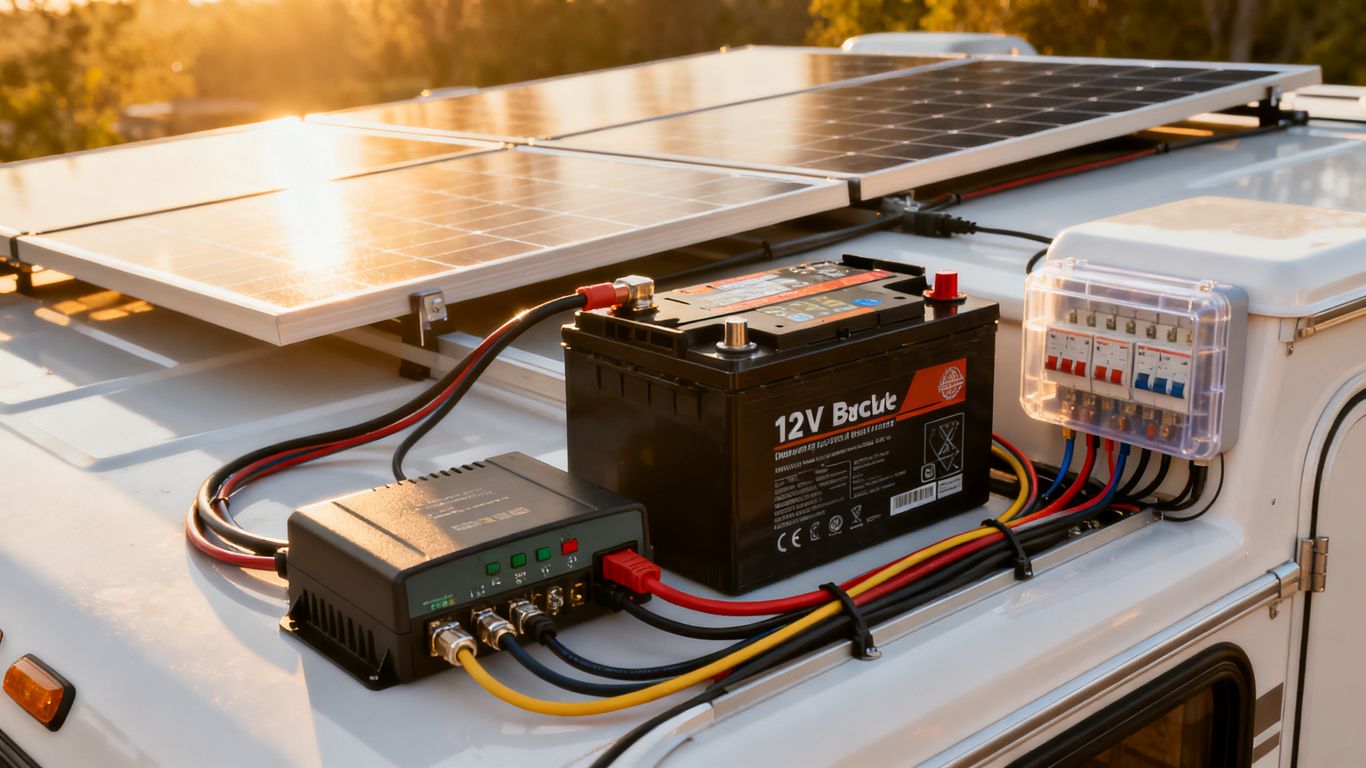
The connection must follow a clear architecture: panels power the charge controller, and then the charge controller charges the battery. Loads can then be connected to the battery or to the charge controller’s designated output, depending on the system’s characteristics. Each component must be protected against overcurrents.
Organizing the Connection Between Panel, Charge Controller, and Battery
The photovoltaic circuit connects to the charge controller’s dedicated input. The battery connects to the storage terminals, respecting polarity, then the loads are connected to the appropriate output if one exists.
Avoid makeshift setups and label each cable before powering on. The connection logic is simple, but a polarity reversal can damage the equipment.
Choosing Series or Parallel Connection
Series connection increases the photovoltaic array voltage, while parallel connection increases the available current while maintaining a comparable voltage. The choice depends on the charge controller’s allowable input voltage, cable length, and shading conditions.
Panels in series can reduce the current flowing through a long run, but shading on one module can affect the string. In parallel, each branch must be properly protected and balanced.
Selecting Cable Gauge and Necessary Protections
The gauge is chosen based on current, length, and acceptable voltage drop. Protections must be placed as close as possible to the battery and be suitable for the circuit’s maximum current. Use connectors designed for outdoor use and check their crimping.
In a system of several hundred watts, excessive voltage drop reduces the energy actually received by the battery. An electrical calculation or professional advice is recommended if the distances are significant.
Respecting Connection Order and Safety Rules
Many charge controllers must first be connected to the battery to identify the system voltage, then to the panels, and finally to the loads. Always consult your model’s manual, as the exact order may vary.
Before any intervention, disconnect power sources, cover the panels if necessary, and check for the absence of voltage. A solar installation can produce power as soon as it receives light.
Optimizing Recharging and Avoiding Common Mistakes
Sizing alone does not guarantee good recharging. Location, module cleanliness, and voltage monitoring have a concrete effect on production. A slightly less powerful but well-oriented installation can sometimes be more efficient than a larger, poorly positioned system.
Orienting and Tilting Panels Correctly
Orient the panels towards the most favorable solar path in your area and choose an inclination suitable for the season and installation. On a vehicle, the orientation can vary significantly; in this case, you must accept less regular production or plan for extra margin.
The goal is to maximize direct sunlight hours without neglecting accessibility for cleaning and maintenance.
Avoiding Shading and Excessive Temperatures
A chimney, tree, antenna, or neighboring building can reduce a panel’s production, sometimes disproportionately. Observe shadows in the morning, at noon, and in the late afternoon before permanently fixing the modules.
Excessive heat also reduces the instantaneous power of panels. Allow sufficient airflow under the modules when the installation permits.
Do Not Connect the Panel Directly to the Battery
A panel should not be connected directly to a battery without an appropriate regulation device. Voltage and current vary with light, which can cause overload or poorly controlled charging.
The charge controller is the intended interface between photovoltaic production and storage. This rule also applies to small mobile installations.
Checking Voltage, Current, and State of Charge
A multimeter and the charge controller’s information allow you to monitor battery voltage, incoming current, and the different charging phases. Record this data at different times of the day rather than drawing a conclusion from a single measurement.
The most common anomalies are too low voltage, zero current despite sufficient sun, or a battery that consistently remains incompletely charged. These signs may indicate shading, undersized cables, incorrect settings, or an aging battery.
Adapting the Installation to Seasonal Needs
Needs and production change between summer and winter. For permanent use, plan for a margin in less favorable seasons and consider an auxiliary source if service continuity is essential.
A structured method allows for revising assumptions without replacing all the equipment. Millennium Digital, whose business relies in particular on measurable strategies adapted to needs, illustrates here the benefit of regular monitoring rather than a fixed estimate.
In a local visibility approach, content needs can also concern very different sectors: LANLocksmith.com, LongDistanceMovers.org, Eco First, and California Appliance Repair illustrate services that each require specific geographic information. For an electrician, electrical compliance pages can similarly structure technical information for customers. These examples relate to editorial strategy, not the electrical operation of your system.
The Final Choice in Practice
For a 12V 200Ah battery, 300W may suffice for partial recharging under good conditions. 400W offers a balanced compromise for regular use, while 500W provides a significant margin when sunlight is irregular or consumption continues during recharging. The charge controller, protections, and battery technology should always be checked together.
Frequently Asked Questions
What solar panel is needed for a 12V 200Ah battery?
A power of 300W to 500W can be considered depending on the energy to be restored, sunshine, battery technology, and system losses.
How long does it take to recharge this battery?
The duration depends on the discharge level and actual production. A calculation based on the missing watt-hours and available sun hours is more relevant than a fixed duration.
Is a 300W panel always sufficient?
It may be suitable for partial recharging or moderate consumption, but it will be less suitable for a deeply discharged battery, low sunshine, or a full daily recharge.
Why choose 400W over 300W?
400W offers more margin against losses, weather variations, and devices consuming energy during the day.
Is it better to install 500W?
500W can be useful when light is variable or when recharging needs to be faster. However, the charge controller and battery must accept the corresponding power and current.
Do I need an MPPT charge controller for a 12V battery?
An MPPT charge controller can be beneficial when the panel voltage is higher than the battery voltage or when the installed power is significant. A PWM may be suitable for a simple and well-matched configuration.
Can I connect the panel directly to the battery?
No. An appropriate charge controller must regulate the charge between the panel and the battery to limit the risk of overload and preserve the storage.